49 works in this view — arrow keys or swipe to move between them.
Dance in Art
Nocturne
Fedorovitch, Sophie
- Collection:
- Costume design
- Source:
- Victoria and Albert Museum
- Rights:
- Rights vary by item — check the source record before reusing this image. Source record ↗
- Recorded as:
- V&A — check rights per item
Fedorovitch's designs shaped the visual language of mid-century ballet, and this drawing shows her economy of means and her understanding of the dancer's body as both functional and sculptural. For researchers of ballet history, costume design practice, and the modernist avant-garde, this small sketch documents how dance was planned and communicated before technical photography and video.
What you are looking at
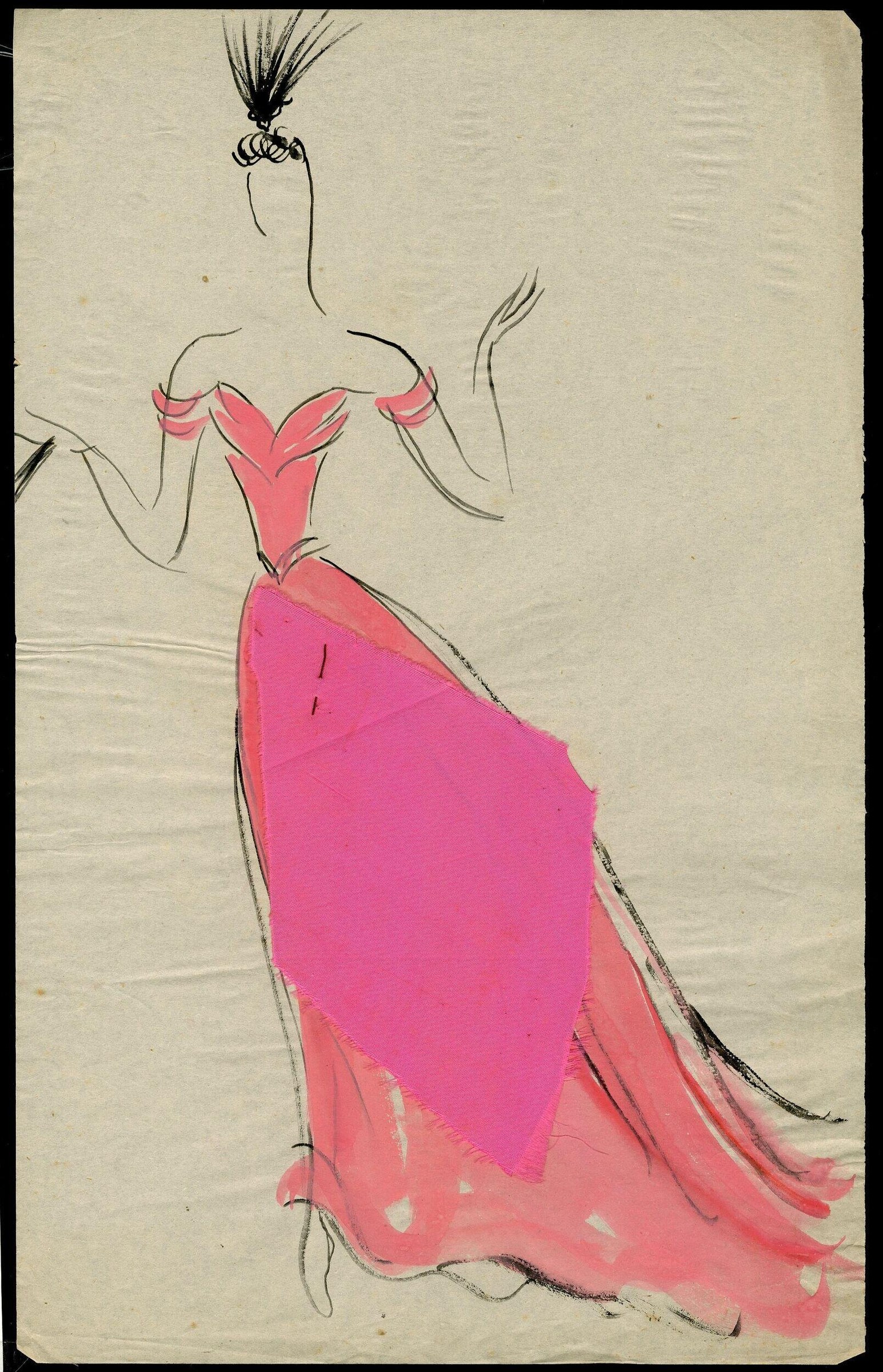
A single female dancer dominates the composition, shown in elegant profile against cream paper. Her figure is rendered in minimal ink line—a slender neck, graceful arm extensions, and elongated limbs that suggest balletic training. The lower two-thirds of the figure is filled with vibrant pink and magenta watercolor or gouache, forming a voluminous skirt or train that sweeps asymmetrically across the page, its hem ragged and expressive. A smaller curved form, rendered in the same pink palette with darker accents, suggests a fitted bodice or corseted upper garment with draped sleeves. Her hair, drawn in bold black ink, is gathered at the crown with lines suggesting pins or ornament. The composition is nearly empty—just the dancer and her costume against white space—which intensifies focus on the geometry of the pose and the dramatic contrast between linear precision and fluid color.
The dancing
The dancer's body is shown in a posed, elongated arabesque or attitude-like extension, with one leg extended and arms held in a classical balletic frame. The line work is economical and assured, suggesting training in drawing from live dancers or choreographic notation. The emphasis is entirely on the silhouette and the relationship between body and costume; no facial features or narrative context are provided. This is a costume design study, not a scene—the figure exists to display the garment.
The dance depicted
This is a design for theatrical ballet, most likely from the Romantic or Neoclassical tradition. The pose and costume suggest a classical female soloist role, possibly a variation or a solo from a larger narrative work. The voluminous tutu-like skirt, the fitted bodice, and the extended line of the body are all consistent with early-to-mid twentieth-century balletic costume. The elongated proportions and the graphic abstraction of the design suggest this may relate to a modernist reimagining of classical ballet, possibly for a company or choreographer experimenting with geometric or constructivist aesthetics.
How it was made
The work combines ink line drawing with watercolor or gouache wash. The ink provides structure and precision—the dancer's body, facial contour, and hair are rendered with confident pen or brush line in a single black. The color is then applied in discrete areas, particularly the skirt and bodice, with visible brushwork and some bleeding or wet-into-wet effects at the hem. This is a working design, not a finished painting—the sketch-like quality and the economy of means are deliberate. The technique is typical of early twentieth-century costume design practice, when such drawings served as specifications for dressmakers and set designers.
About this work
This is a costume design by Sophie Fedorovitch for a ballet work titled or otherwise known as *Nocturne*, dated 1936. Fedorovitch was a significant Russian-born designer for British and European ballet in the mid-twentieth century, known for her spare, architecturally alert approach to costume and set. The drawing shows a soloist in a classical tutu rendered as a study of geometry and movement—the figure's extended pose and the tutu's asymmetrical volume creating a composition that is as much about design principle as about the actual costume. The work belongs to the collection as an example of how theatrical dance was notated and communicated through design in the interwar period, and as evidence of the collaboration between visual artists and choreographers in the modernist ballet movement.
How to look at it
Attend to the tension between the ink outline, which holds the dancer's body in a classical pose, and the watercolor, which releases the costume into movement and volume. The designer has chosen to freeze the moment just as the skirt begins to lift and spread, suggesting velocity and lightness. The asymmetry of the hem—rougher and less controlled on one edge—implies the actual behavior of fabric under motion, a touch of realism amid the stylized form. The economy of the drawing—what is not shown—is as important as what is: no face, no hands, no setting, no other dancers. Everything directs the eye to the costume and to the line of the body.
The artist
Sophie Fedorovitch (1893–1977) was a Russian-born painter and costume and set designer who became central to British ballet in the 1930s and 1940s. She worked closely with choreographers including Frederick Ashton and Andree Howard, creating designs for the Vic-Wells Ballet (later the Royal Ballet) and other companies. Her visual language was marked by restraint, geometric clarity, and a deep understanding of the dancer's body in motion. She moved fluidly between fine art and applied design, and her work reflects the influence of constructivism and modern art movements while remaining grounded in the classical ballet tradition.
The period
In 1936, ballet in Britain and Europe was in the midst of a creative ferment. The Russian Imperial Ballet tradition was being adapted and reinterpreted by new choreographers and visual artists; modernist movements in visual art were influencing costume and set design; and there was intense debate about what ballet could and should represent. Fedorovitch's work emerged in this context, offering an alternative to both the ornate romanticism of nineteenth-century ballet and the avant-garde extremism of some experimental companies. Her designs for works like *Nocturne* helped establish a new visual language for ballet—one that honored classical technique while embracing modern aesthetic economy.
Where it lives
The work is held as part of a costume design collection, indicating it was preserved as a working document and reference material. The attribution to Fedorovitch and the date are recorded in the catalogue; the specific commission or production *Nocturne* refers to has not been recorded in the catalogue provided.
Dance in this work
Questions about this work
Is this a finished artwork or a working sketch?
It is a working design sketch, made to communicate a costume idea to dressmakers and other collaborators. Fedorovitch used this spare, economical style for many of her designs; the line and wash technique allowed quick iteration and clear communication of silhouette and color. Such sketches were the standard working medium for theatrical designers of the period, and they were often preserved in company archives.
What is the 'Nocturne' this design is for?
The catalogue record does not specify which ballet, film, or theatrical production is titled *Nocturne*. Given the date (1936) and Fedorovitch's active commissions, it could be any of several works. If you know of a specific *Nocturne* from that period, or have archival information about Fedorovitch's commissions, please contact the collection.
Why is so much of the page left blank?
The composition is deliberate. By isolating the figure and costume against white paper, the designer draws maximum focus to the silhouette and the relationship between body and garment. This was a common practice in costume design of the period—the blank space lets the eye concentrate on the essential visual information.
What does the rough edge of the skirt mean?
The irregular hem at the lower edge of the skirt suggests movement and the actual behavior of layered tulle or similar fabric under motion. It is both a notation of design intent—this skirt is meant to move and flutter—and a sign of Fedorovitch's confidence in her draftsmanship. A perfectly controlled edge would suggest a static, portrait-like object; the roughness animates the design.
More dance artwork





