49 works in this view — arrow keys or swipe to move between them.
Dance in Art
Nocturne
Fedorovitch, Sophie
- Collection:
- Costume design
- Source:
- Victoria and Albert Museum
- Rights:
- Rights vary by item — check the source record before reusing this image. Source record ↗
- Recorded as:
- V&A — check rights per item
Sophie Fedorovitch was a crucial designer in the modernist reorganization of ballet in 1930s London and Europe, and her costume designs are primary documents of how radical abstraction entered theatrical dance. This work demonstrates that modernism in ballet was not solely a matter of choreography or music but also of costume's capacity to redefine the body's visual and kinetic possibilities. The drawing's survival invites viewers to see costume design as a distinct artistic practice with its own formal ambitions.
What you are looking at
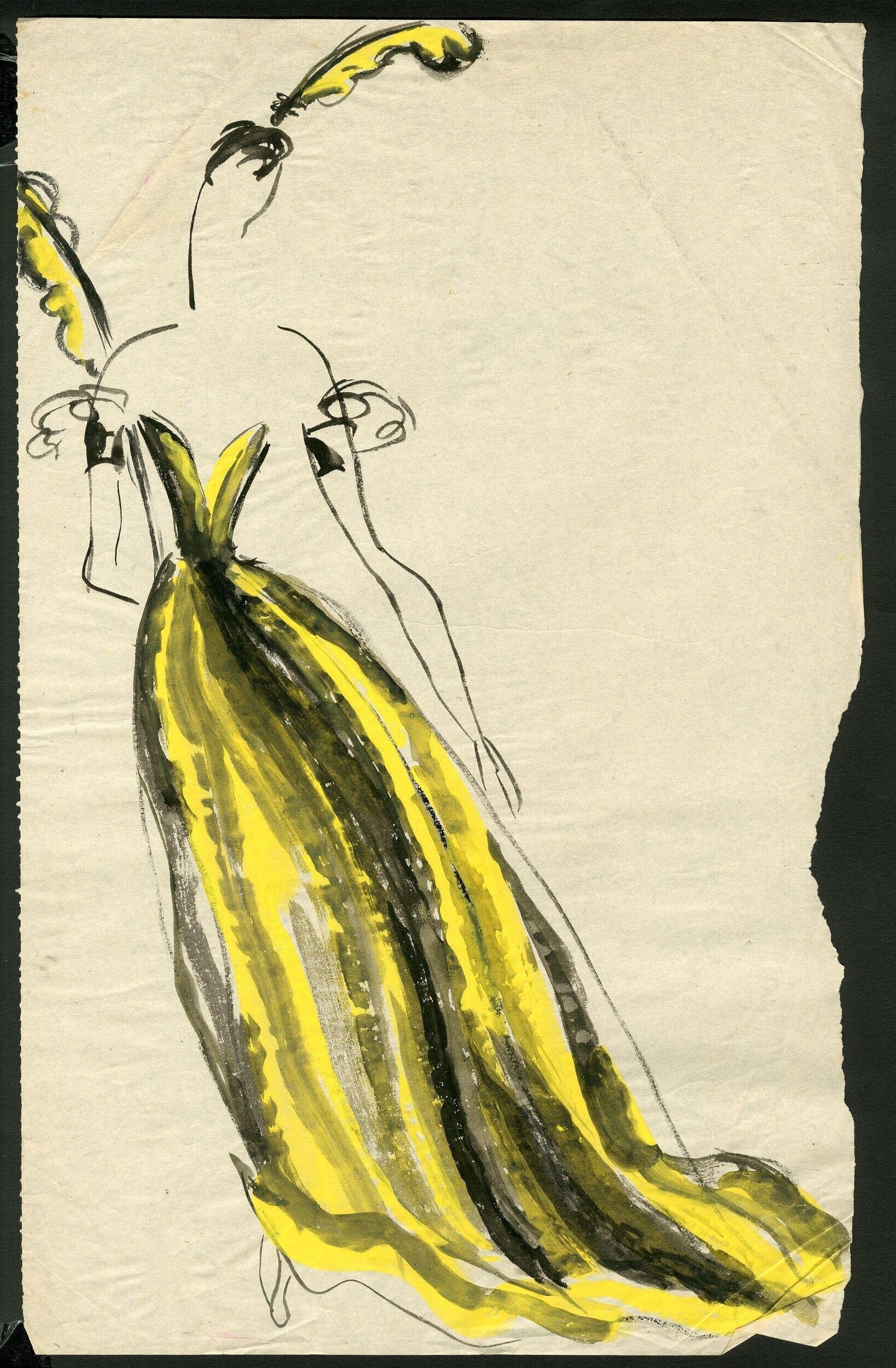
A single figure in an elongated yellow gown dominates the composition, posed in a graceful, attenuated stance against a cream ground. The dress is rendered in vivid yellow with bold black striations suggesting fabric folds and movement, pooling dramatically at the hem. The figure's body is constructed from thin, continuous pen lines that extend upward to a small dark head, with delicate antennae-like appendages rising from it. Two additional similar figures appear in the upper margins of the sheet, smaller and more lightly indicated. The drawing's economy of line and the elongation of the form create an ethereal, almost insectile quality—the antennae and the way the body tapers upward suggest a metamorphosis between human dancer and creature. The yellow dress, the only substantial mass in the composition, reads as the true subject: a sculptural garment suspended in stillness.
The dancing
The central figure stands in an extended vertical alignment with minimal articulation of joints; the body appears as a single tapering line from hem to head, with no visible shift of weight or contrapposto. The arms, if present, are not clearly defined. The pose suggests either a moment of complete stillness—a held balance or arabesque captured in its most abstract form—or a figure in repose rather than active motion. The two smaller figures in the margins echo the same attenuated silhouette and vertical axis, suggesting a study or variation rather than a group composition.
The dance depicted
This is a costume design, not a documentation of dance in progress. The work imagines a dancer's silhouette transformed by an avant-garde gown. The title 'Nocturne' suggests the romantic, ethereal idiom of Romantic-era ballet—nocturnes as night-dream pieces associated with sylphs, spirits, and supernatural scenes. However, the radical abstraction of the body and the insectile morphology point away from narrative ballet toward modernist experiment. The figure could represent a dancer in a moment of weightless suspension or transformation, or the costume itself as the primary performer. Without historical record of this design's stage use, the work remains an imaginative proposal rather than a documented choreographic fact.
How it was made
The work is executed in pen and watercolor or gouache on paper. The drawing employs a continuous line technique for the body and a more painterly approach for the volumetric dress—broad washes of yellow with strong black pen accents to define fabric structure and shadow. The paper appears aged and creased. The combination of linear drawing and color wash was economical and immediate, typical of costume-design practice in the 1930s, allowing rapid iteration and clear communication of both silhouette and fabric behavior to makers and performers. The technique implies this was a working design intended for practical realization.
About this work
Fedorovitch's *Nocturne* is a costume design from 1936 proposing an extraordinary transformation of the dancing body through garment. The work sits at the intersection of Romantic ballet tradition—evoking the supernatural femininity and weightlessness of the sylph—and modernist abstraction, in which the human figure dissolves into pure line and the dress becomes the dominant formal and emotional statement. The elongation and near-abstraction of the figure, the insectile antennae, and the expressive yellowing and deterioration of the paper itself grant the design an uncanny, dream-like presence. As costume design, it is a proposal for how a body might move through space and be perceived; as a drawing, it is a meditation on the relationship between clothing and choreography, mass and weightlessness, figuration and abstraction.
How to look at it
Attend first to the dress itself: note how the yellow and black striation creates the illusion of a three-dimensional, moving garment even though the figure inside it remains still and abstract. The pool of fabric at the base suggests an active body has moved through space and come to rest, or is perpetually suspended at the moment of movement. Then look at the antennae: they are the single non-human element, and they transform the reading from dancer to creature or phantom, suggesting that Fedorovitch was imagining not just a costume but a metamorphosis. The lighter studies in the margins show the designer's working process—considering the silhouette from different angles or at different stages of movement.
The artist
Sophie Fedorovitch (1893–1977) was a Russian-born painter, designer, and collaborator with some of the most innovative choreographers of the twentieth century, including Frederick Ashton and Kurt Jooss. She worked extensively for the Ballets Russes and its successors and was known for costume and set designs that moved away from ornament toward structural simplicity and expressive line. Her practice bridged easel painting and theatrical design, and she brought modernist drawing techniques into ballet's visual vocabulary. She was also a teacher and mentor to younger artists.
The period
In 1936, ballet in Western Europe was at a crossroads between the residual glamour of Diaghilev's Ballets Russes (which had closed in 1929) and the emergence of new, leaner modernist companies. Ashton's early ballets were developing a distinctly English classicism, while German and Central European choreographers including Jooss were using dance to respond to political crisis. Design practice had moved decisively away from the jeweled exoticism of the Ballets Russes toward abstraction and structural clarity. Fedorovitch's work in this period exemplifies the shift: she designed for *Checkmate* (1937) and other Ashton works that paired neoclassical severity with modernist formalism. The 1930s also saw renewed interest in the Romantic era as a historical resource—a past to be retrieved and reinterpreted for contemporary art.
Where it lives
The work is held as a costume design within the Victoria and Albert Museum's collection. It is a drawing on paper, likely created as a proposal or study for a stage costume, though no record of its execution or use in performance has been established.
Dance in this work
Questions about this work
Did this costume ever appear on stage?
The catalogue record does not identify a produced work. It is possible that the design was commissioned or conceived for a specific ballet or pageant, but no documented performance history is available. It may have remained a proposal or study—which was common in Fedorovitch's practice, as she often created designs that advanced her artistic vision even if not realized theatrically.
What is the significance of the antennae?
The antennae mark a threshold between human and insect, or between the naturalistic and the fantastical. In the 1930s, when Surrealism and modernist abstraction were reshaping visual art, such metamorphic imagery suggested the dancer could be something other than human—a spirit, a creature of dream, or a being transformed by the costume itself. This was consistent with the Romantic ballet tradition of the supernatural (*La Sylphide*, *Giselle*) but expressed through modernist abstraction rather than realistic pantomime.
Why is the paper yellowed and creased?
The aging and handling marks are the natural result of the paper's age—the work dates to 1936—and storage or use. The discoloration and creasing are not intentional; they are signs of the object's survival and material history. They add to the work's dreamlike, slightly spectral quality, as if the dancer is fading or returning from the past.
More dance artwork





