49 works in this view — arrow keys or swipe to move between them.
Dance in Art
Nocturne
Fedorovitch, Sophie
- Collection:
- Costume design
- Source:
- Victoria and Albert Museum
- Rights:
- Rights vary by item — check the source record before reusing this image. Source record ↗
- Recorded as:
- V&A — check rights per item
Fedorovitch's designs shaped how mid-century ballet looked and moved; her skill at rendering the dancer's body in motion and in costume offers insight into both the aesthetic values of 1930s modernist dance and the working practice of theatre design. For costume and dance historians, this sheet is evidence of a specific production and a specific moment in the development of British and European ballet.
What you are looking at
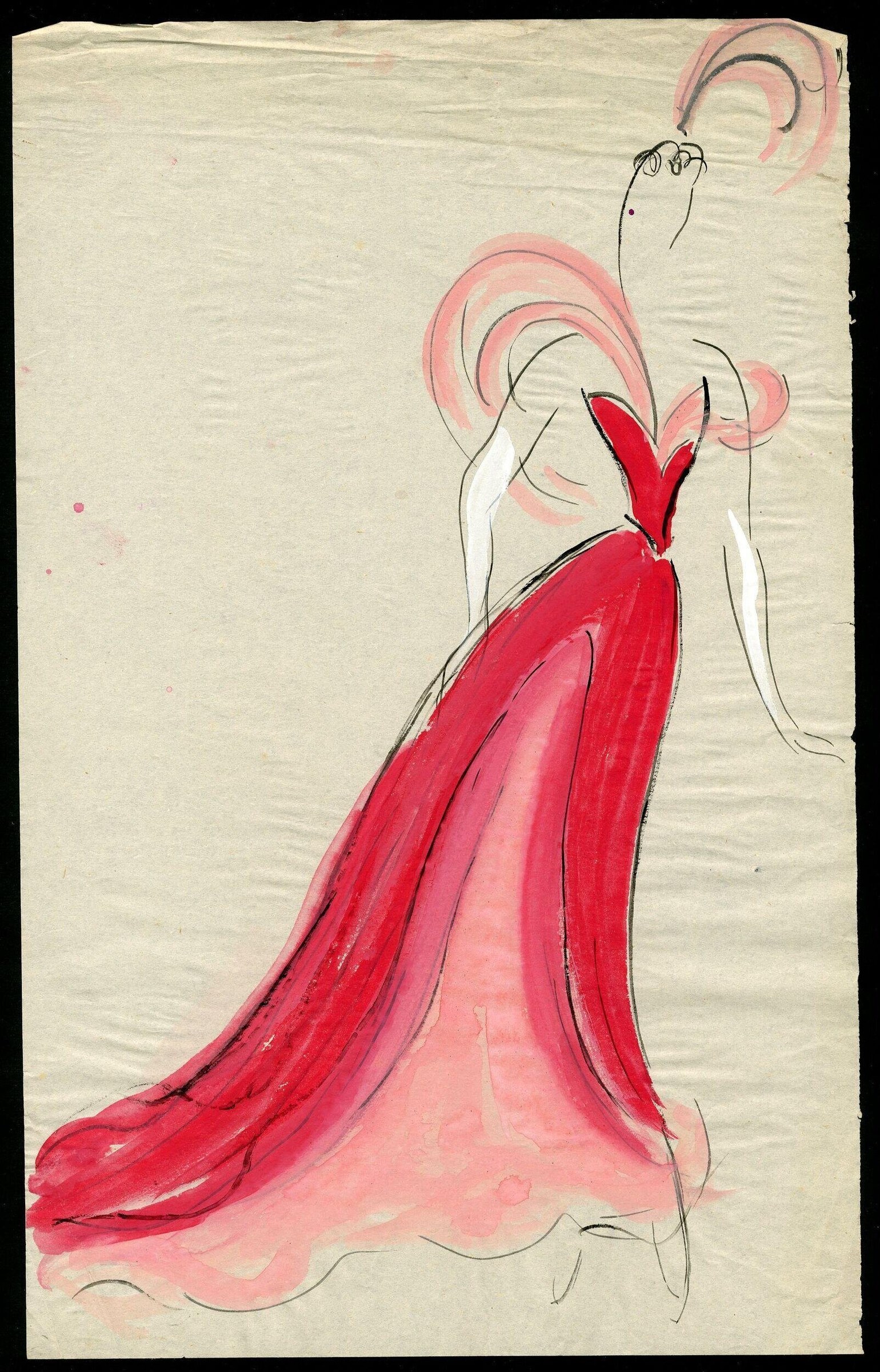
A single figure in elegant profile, rendered in ink and watercolor on cream paper. The dancer wears a striking red gown with a dramatically extended train that sweeps downward and trails behind the body, depicted in graduated tones from vivid crimson to pale pink. The bodice is minimal, rendered in spare black line work, with the upper body depicted in white or left as paper. The head is tilted back in an attitude of abandon or reverie, with dark hair suggested by flowing curved lines and what appear to be decorative elements—possibly a headdress or hair ornament—at the crown. The pose suggests movement frozen mid-turn or mid-leap: the body is elongated and curved, the line of the back arched, the carriage noble. The composition is asymmetrical, with the figure positioned off-center and oriented diagonally across the sheet. The treatment is economical—vast areas of white paper ground the image—but the red drapery receives sustained, skilled attention to volume and shadow.
The dancing
One dancer, female, shown in a balletic or theatrical attitude—back arched, head tilted upward and away, the body moving in an implied spiral or turn. The upper body is rendered in spare outline; all visual weight concentrates on the voluminous skirt. The pose suggests the dancer is either mid-elevation (in the air) or at the apex of a movement that demands back extension and an upward gaze. The arm work is minimal and sketched, the legs are almost invisible beneath the train, and the deportment—long neck, lifted head, noble carriage—is consistent with formal theatrical dance of the early 20th century.
The dance depicted
This is almost certainly a costume design for a solo female dancer, most likely in classical or romantic ballet or in theatrical-contemporary ballet of the 1930s. The silhouette—the near-naked upper body, the voluminous skirt, the emphasis on the line of the back and the carriage of the head—belongs to early modernist ballet, where Sophie Fedorovitch was known as a designer. The red gown and the arabesque-like pose suggest a solo of moment and drama, possibly a character piece or a showpiece for a ballerina. The title *Nocturne* (a nighttime scene, or in music, a lyrical form) may indicate the emotional content: introspection, drama, or the private life of a dancer. Without a record of the choreography, we cannot name the work, but the design signals Fedorovitch's characteristic economy and expressiveness.
How it was made
Ink line with watercolor wash on paper, a standard technique for theatrical costume design in the early 20th century. The artist draws the figure in fine black line and builds the volumetric red drapery with wet watercolor applied in layers, allowing pigment to pool and dry with visible gradation. This technique is economical and rapid—suited to the needs of theatre production—but also expressive: the quality of line conveys the dancer's carriage and movement, while the watercolor handles the mass and weight of the costume itself. The predominance of white paper is a feature of modernist design practice: it emphasizes the figure against undifferentiated space and focuses the eye on the costume silhouette.
About this work
This is a costume design by Sophie Fedorovitch for a theatrical dance, probably a ballet, dating to 1936. It depicts a single female dancer in a red gown with an extended train, shown in a pose of grace and drama—back arched, head tilted upward—that emphasizes the line of the body beneath the costume. Fedorovitch was one of the most influential theatre designers of her generation, known for work with the Ballets Russes and British ballet companies; her designs were celebrated for their economy, expressiveness, and understanding of the dancer's body in motion. This sheet, preserved as a costume design, documents a moment of performance: the shape of the skirt, the carriage of the torso, the angle of the head all work together to convey a narrative moment—suggested by the title *Nocturne*—that the dancer would create in performance. The drawing is both a practical blueprint for the costume maker and an artwork in its own right, capturing the visual poetry of the dance.
How to look at it
Attend to the pose: the arched back and upturned head are the emotional core of the image, and every other element of the costume—the volume of the skirt, its extension, the way it trails—is designed to amplify that gesture. Notice how the artist uses white paper as a compositional tool: the dancer's upper body is almost bare (rendering the torso and arms in spare line), which isolates the line of the back and neck and makes the red skirt read as a second statement. The watercolor technique allows the red to read as volume and weight; the gradation from dark to light suggests the three-dimensionality of the fabric and its movement through space. This is a working design, not a finished artwork, but it is drawn with full control: every line serves the dancer's movement.
The artist
Sophie Fedorovitch (1893–1977) was a Russian-born theatre designer who became one of the defining visual artists of mid-century British and European ballet. She trained as a painter and moved to London via Paris, where she encountered the Ballets Russes. From the 1920s onward she designed costumes and sets for ballet companies across Europe, including the Ballets Russes de Monte-Carlo and the Ballet Rambert, as well as for musical theatre and opera. Her designs were celebrated for their refinement, their understanding of how costume and the dancer's body interact in movement, and her ability to convey character and narrative through silhouette and color. She worked across media—watercolor, ink, pastels—and was prolific; hundreds of her sketches survive in archives. She was a close collaborator with choreographers and a mentor to younger designers.
The period
In 1936, ballet in Western Europe was at a moment of transition. The Ballets Russes was in decline (Diaghilev died in 1929), but British ballet was emerging as a vital artistic force. The Vic-Wells Ballet (later the Royal Ballet) was founded in 1931, and dancers, designers, and choreographers were developing a distinctly British modernist aesthetic. Costume design in this period was undergoing rapid change: the heavy, ornamental costumes of the 19th-century ballet were being rejected in favor of designs that emphasized the dancer's body and line. Fedorovitch was part of this revolution; her designs stripped away excess ornament and focused on the essential gesture. The red gown shown here—striking in color, dramatic in its extension—is characteristic of 1930s modernist ballet design: bold, simplified, serving the choreography rather than dominating it.
Where it lives
The work is held in the collection records as a costume design from a performance or planned performance in 1936, with no further accession or exhibition history recorded in the catalogue. It is preserved in the Victoria & Albert Museum, London, which holds the largest collection of Fedorovitch's designs.
Dance in this work
Questions about this work
Did this costume ever actually go on stage?
The record does not state whether this design was executed and worn, or whether it remained a proposal. Fedorovitch produced hundreds of designs; not all were realized. If this costume was made, photographs or playbills might survive in the archives of the ballet company for which it was designed, but those records are not linked in this catalogue.
What dance was this for?
The catalogue record gives only the title *Nocturne* and the date 1936. No choreographer, dancer, or company is named. Given the style and Fedorovitch's active period, it was likely designed for a British or European ballet company, possibly the Vic-Wells Ballet or the Ballet Rambert, but this would require further research in theatre archives and Fedorovitch's personal papers to confirm.
Why does the artist show so little of the dancer's body?
This is a signature of modernist costume design in the 1930s. By leaving the upper body nearly bare and rendering it in spare line, the designer emphasizes the dancer's physical line and movement capacity, rather than clothing or adorning the body. The costume becomes an extension of the dance, not a barrier to it. The red skirt, precisely because the rest of the body is visible, reads as a dramatic, meaningful statement—an extension of the dancer's gesture rather than a covering.
More dance artwork





