49 works in this view — arrow keys or swipe to move between them.
Dance in Art
Nocturne
Fedorovitch, Sophie
- Collection:
- Costume design
- Source:
- Victoria and Albert Museum
- Rights:
- Rights vary by item — check the source record before reusing this image. Source record ↗
- Recorded as:
- V&A — check rights per item
Fedorovitch's designs shaped the visual language of twentieth-century British and European ballet; her work is part of the permanent record of how major roles were conceived and executed. This sketch documents both a specific choreographic moment and the designer's creative method, offering insight into the collaborative process by which dance is realized on stage.
What you are looking at
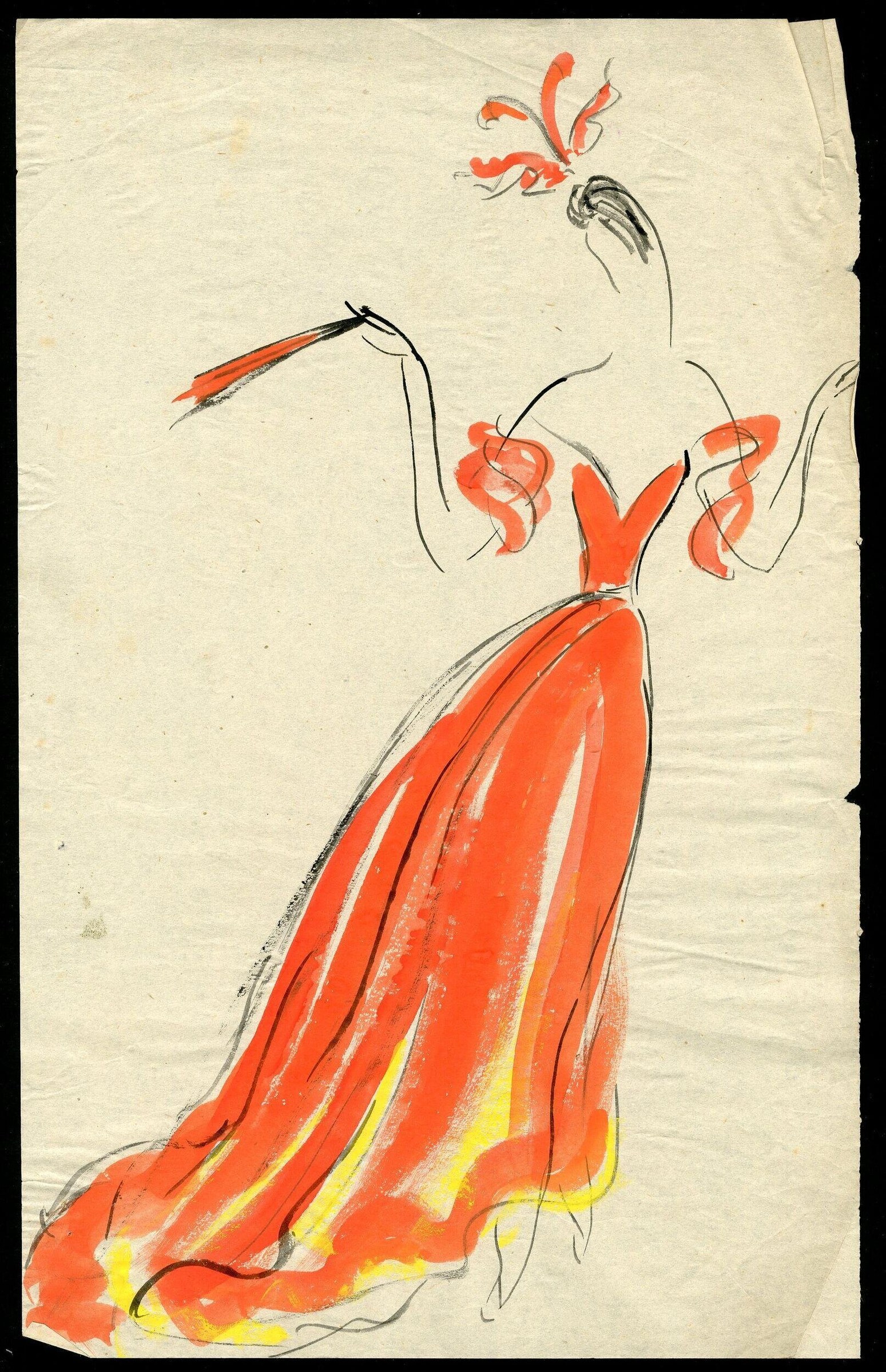
A figure in a brilliantly rendered flowing red-orange gown dominates the composition, the fabric rendered in watercolor or gouache with carefully modulated tones of orange, red, and yellow to create volume and movement. The skirt billows and sweeps with considerable force, suggesting rapid rotation or a dramatic gesture caught mid-motion. The figure is headless or the head is outside the frame; instead, there are four delicate flowering stems or plant forms emerging from the neckline area, each bearing small red blossoms with black line details. The drawing style combines precise ink outlining with fluid watercolor washes, on what appears to be aged paper with visible foxing. A second, smaller floral form floats independently at upper left. The composition is minimalist—a blank cream ground with no setting, scenery, or other figures—making the costume and its movement the sole subject.
The dancing
A single dancer is shown in profile or three-quarter view, the body suggested primarily through the architecture of the costume rather than visible limbs. The gown's sweep implies a turning or swinging motion, with the weight of the fabric suggesting centrifugal force. The arm line is indicated by a thin ink stroke extending upward and to the side. The posture suggests an upright, controlled deportment typical of trained theatrical dance, though the lower half of the figure is obscured entirely by the costume's volume. The florals emerging from the neck area break naturalistic representation and suggest either a stylized headdress or a surreal compositional choice.
The dance depicted
This is a costume design, not a depiction of an actual dance moment. The gown's dramatic sweep and the dancer's upright carriage suggest romantic or classical ballet of the late nineteenth or early twentieth century, possibly a solo or principal role. The presence of floral elements—whether as a bodice ornament, headdress, or conceptual addition—may reference a specific ballet narrative involving flowers or nature, though the design's avant-garde stylization resists easy identification with a known work. The costume prioritizes visual drama and fluid line over anatomical clarity, typical of modernist design practice in the 1930s.
How it was made
This is a mixed-media work on paper: ink outline drawing combined with watercolor or gouache wash. The technique allows rapid blocking-in of color while maintaining crisp contour through the ink line—a standard method for costume design proposals in the theatrical world. The visible paper support, foxing, and creasing indicate this is an original sketch on paper, not a print. The efficiency of the technique—bold color fields applied over linear structure—was well-suited to the fast turnaround required of working designers and would have been presented to directors, choreographers, and seamstresses as a working document.
About this work
This is a costume design sketch by Sophie Fedorovitch for a theatrical work titled or associated with *Nocturne*, dated 1936. Fedorovitch was a significant figure in British theatre and ballet design in the mid-twentieth century, known for her collaborations with the Ballet Russe and her refined approach to color and silhouette. The sketch captures a single costume—a voluminous evening gown in warm oranges and reds—worn by what appears to be a principal dancer. The work exemplifies the designer's practice of creating striking visual statements through color harmony and fabric drama rather than literal representation of the moving body.
The design belongs to an era of significant innovation in ballet design, when Russian and European modernists were reshaping what ballet costumes could express. Rather than serving merely as a wrapper for the dancer's body, the costume becomes a sculptural form in itself, its movement inseparable from the choreography. Fedorovitch's work sits at the intersection of fine art and applied design—technically a working document for production, but composed with the care and vision of a visual artist.
How to look at it
Attend first to the cascade of the skirt—the way Fedorovitch has rendered the fabric in multiple tones of red and orange to suggest both weight and transparency. Note how the silhouette tapers at the waist and explodes below, creating a shape that reads as both graceful and structurally daring. The four floral forms are unexpected and unsettling; they break the illusionism of the costume and ask the viewer to see the costume as a design object rather than clothing. The absence of the dancer's head and visible limbs invites you to imagine the movement filling the space the costume occupies—to understand that in performance, the dancer's body would animate this form into three-dimensional motion.
The artist
Sophie Fedorovitch (1893–1953) was a Russian-born stage and costume designer who became a central figure in mid-century British ballet and theatre. She trained in graphic arts and worked for the Ballets Russes before establishing herself as a leading designer for the Sadler's Wells Ballet (later the Royal Ballet) and other major companies. Known for her sophisticated color sense, geometric clarity, and ability to enhance choreography through costume design, Fedorovitch collaborated with some of the era's most significant choreographers. Her designs prioritized the dancer's movement and the visual architecture of the stage over decorative excess.
The period
The 1930s saw ballet design in a state of productive ferment. The Ballets Russes, under Diaghilev, had established design as a primary artistic element, equal to music and choreography. By the mid-1930s, as new companies formed in Britain and continental Europe, a second generation of designers—including Fedorovitch—was developing a more restrained, modernist aesthetic that moved away from Sergei Goncharova's lavish orientalism and toward cleaner lines and subtler color relationships. Simultaneously, theatrical modernism in painting and graphic arts was influencing stage design; artists trained in fine art were bringing formal innovation to costume and set. *Nocturne* was likely created during a period of active innovation at one of the major British ballet companies.
Where it lives
The work is held as part of a costume design collection in the Victoria and Albert Museum, London (indicated by 'va' in the source field). It is a working sketch, the type of document created by designers during the conceptual and planning stages of theatrical production, and would typically be accompanied by notes on fabric, color notations, or construction details now lost.
Dance in this work
Questions about this work
Is this a finished artwork or a sketch?
It is a sketch—a working design document created for theatrical production. However, Fedorovitch worked with considerable care, and the line and color are deliberately composed; the distinction between 'sketch' and 'finished work' is blurred in design practice. For the Museum, it is preserved as a significant historical document and a work of artistic merit in its own right.
What is *Nocturne* and who danced it?
The record lists only the title and artist; without additional archival research, the specific ballet cannot be identified with certainty. However, the year 1936 and Fedorovitch's known collaborations suggest it may be associated with the Sadler's Wells Ballet or a touring company of that period. The floral imagery and the costume's elegance suggest a lyrical or romantic role, possibly a solo.
Why are there flowers coming out of the costume?
The flowers may be integral to the costume design—a bodice ornament, a headdress, or part of a larger visual conceit in the choreography or narrative. Alternatively, they may represent Fedorovitch's exploratory thinking about how to extend the dancer's form into space. The modernist design practice of the 1930s often blended practical function with poetic or abstract ideas.
More dance artwork





