49 works in this view — arrow keys or swipe to move between them.
Dance in Art
Nocturne
Fedorovitch, Sophie
- Collection:
- Costume design
- Source:
- Victoria and Albert Museum
- Rights:
- Rights vary by item — check the source record before reusing this image. Source record ↗
- Recorded as:
- V&A — check rights per item
Fedorovitch's designs were formative to the aesthetic of mid-twentieth-century ballet; her work influenced generations of designers and defined how choreographers visualized Romantic and modernist ballets on stage. This sketch is a primary document of her creative process and of the visual culture of 1930s European ballet at a moment when the form was being radically reimagined by dancers and artists in exile from the Russian Revolution.
What you are looking at
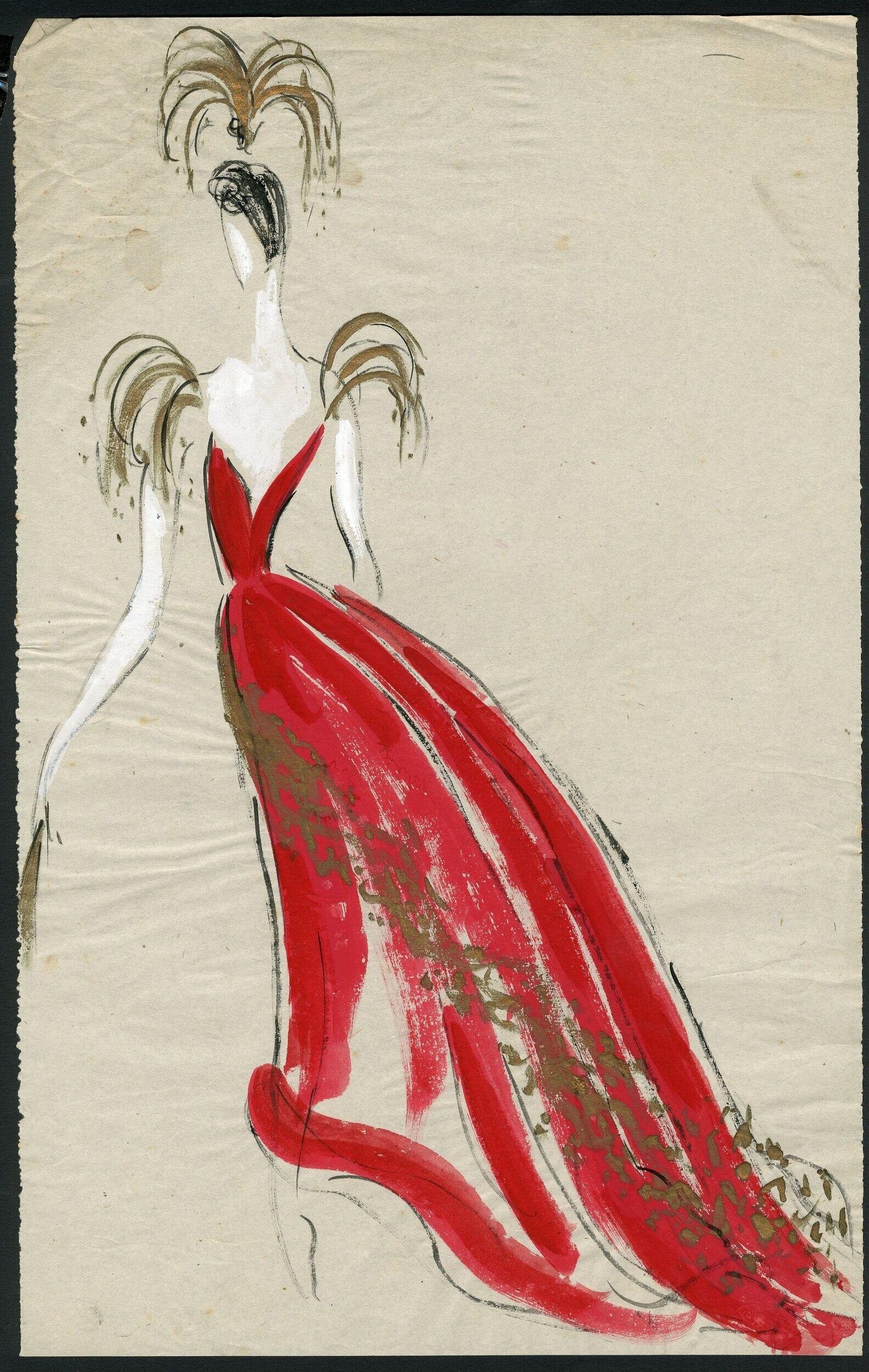
A single female figure dominates this costume design sketch, rendered in pen and watercolor on cream paper. She stands in a graceful contrapposto pose, her elongated neck and small head crowned with an elaborate headdress of drooping feathers or plumes rendered in tan and brown ink. Her upper body is bare and pale, catching light; her lower body is swathed in a voluminous red skirt of extraordinary sweep and drama. The skirt fabric is layered and textured with green or gold overlay details, suggesting brocade or embroidered material, and trails behind and around her in cascading folds that dominate the lower two-thirds of the composition. The figure is delicate and attenuated, characteristic of 1930s fashion illustration, with the proportions exaggerated to emphasize the spectacular costume rather than anatomical realism. The background is plain cream, throwing the figure into sharp focus. There is a sense of nocturnal elegance and theatrical excess.
The dancing
The dancer's body is extremely slender and elongated, depicted in a classical contrapposto stance with weight shifted onto one leg. Her arms hang naturally at her sides with minimal gesture. The neck is exceptionally long and graceful, supporting the small, delicately rendered head. There is no evident partner or ensemble; this is a solo study focused entirely on the silhouette and costume profile. The posture is upright and dignified rather than dynamic—a presentational stance suitable to a court or formal theatrical setting, rather than an action pose mid-movement.
The dance depicted
This is a costume design for theatrical ballet or court dance, most likely created for a specific production. The title *Nocturne* suggests an evening or nighttime theme, possibly a Romantic-era ballet or contemporary 1930s modernist work drawing on Romantic conventions. The exaggerated plumage of the headdress, the formal silhouette, and the voluminous trained skirt are consistent with early 20th-century ballet costume aesthetics. Without additional production records, the specific ballet cannot be named with certainty, but the style and period point toward a work in the interwar avant-garde or neo-Romantic ballet tradition. The sketch itself is a working design document, likely intended to communicate costume specifications to seamstresses or to present the concept to choreographers and producers.
How it was made
This is a mixed-media drawing on paper: pen or ink outline work combined with watercolor washes in red, gold, tan, and black. The technique allows rapid notation of the costume silhouette and key fabric details while maintaining the delicacy of the figure line. The hand-drawn nature indicates this is a preliminary or presentation design rather than a reproduced print, intended for a small, professional audience of theater practitioners. The particular style of annotation and execution is characteristic of mid-20th-century ballet design practice, where such sketches served both as artistic vision and practical manufacturing instruction.
About this work
This is a costume design by Sophie Fedorovitch for a theatrical ballet titled *Nocturne*, dated 1936. Fedorovitch was a prolific Russian-British designer whose work defined the visual language of ballet design in the interwar period, collaborating with major choreographers and companies across Europe. The sketch presents a single figure in an extraordinary red trained gown with elaborate feathered headdress, rendered in a style that captures both the romantic silhouette and the modernist sensibility of 1930s dance theater. The work is held as a costume design, part of the broader archive of theater design documentation. It exemplifies the designer's characteristic approach: elongated figuration, attention to fabric texture and drape, and the marriage of historical costume vocabulary to contemporary theatrical vision.
How to look at it
Observe how the artist has composed the figure: the small head and elongated neck are exaggerations from life anatomy, deliberate choices that serve the costume design by making the body a vehicle for the spectacular gown. The real visual drama is in the skirt, which occupies most of the composition and is rendered with careful attention to texture, fold, and the interplay of red with underlying gold and green tones. The contrapposto stance is a classical theatrical pose—a presentation rather than a dance action—which allows the full silhouette to be legible. Notice the restraint in the rendering of the face and upper body relative to the labor expended on the skirt fabric: this hierarchy of attention reflects the designer's priorities and what she needed the seamstresses and producers to understand.
The artist
Sophie Fedorovitch (1893–1977) was a Russian painter and stage designer who became one of the most influential ballet designers of the twentieth century. Born in Minsk, she fled Russia after the Revolution and settled in Britain, where she became a central figure in London's avant-garde theater world. She designed costumes and sets for the Ballets Russes, the Vic-Wells Ballet (later the Royal Ballet), Frederick Ashton's early companies, and numerous other productions. Her work synthesized modernist painting principles with historical costume knowledge, creating designs that were both visually striking and dramatically coherent. She was known for her ability to work across styles—from Romantic pastiche to abstract modernism—while maintaining a distinctive personal vision marked by elongated proportions, bold color, and meticulous attention to fabric and silhouette.
The period
The mid-1930s was a period of intense ferment in European ballet. The Ballets Russes, though past its first glory, remained a site of innovation; simultaneously, the Vic-Wells Ballet in London was establishing itself as the foundation of what would become the Royal Ballet. Designers like Fedorovitch were central to these developments, translating avant-garde painting and sculpture into costume and scenic form. The Romantic ballet was being actively revived and reinterpreted during this period, with designers drawing on nineteenth-century aesthetics but infusing them with modernist sensibility. The title *Nocturne*, with its evocation of the Romantic era and French literary culture, sits squarely within this moment of neo-Romantic theater. Simultaneously, 1930s fashion illustration—which this sketch resembles—was reaching new heights of sophistication and influence.
Where it lives
This work is held in the collection of the Victoria and Albert Museum (indicated by the source designation "va") as a costume design. It belongs to the significant archive of twentieth-century theater and dance design in the V&A's collection, part of the museum's documentation of the visual culture of British theater in the twentieth century.
Dance in this work
Questions about this work
What ballet is this costume from?
The record lists the work as *Nocturne*, dated 1936, but does not provide the name of a specific ballet or production. Additional documentation would be needed to establish whether this design was executed for a named premiere or whether it represents a design concept that may or may not have been produced. The V&A's collection records may contain additional contextual information.
Was Sophie Fedorovitch Russian or British?
She was Russian-born (Minsk, 1893) but became a central figure in British theater after emigrating in the 1920s. She worked across European companies and is best known for her contributions to British ballet, though her sensibility remained shaped by her Russian training and the aesthetic world of the Ballets Russes.
Why is the figure so elongated and thin?
This is a deliberate choice of theatrical fashion illustration style in the 1930s, not anatomical realism. The exaggeration serves the costume design by emphasizing the silhouette and the spectacular drape of the gown. The tiny head and long neck also allow the headdress to read clearly and elegantly against the body.
What do the marks and colors on the skirt mean?
The green and gold overlay marks likely indicate embroidery, brocade, or appliqué details on the red fabric. They are both design notation—communicating to the seamstress what surface embellishment is required—and a visual choice that breaks up the red expanse and suggests luxury and theatrical opulence.
More dance artwork





