49 works in this view — arrow keys or swipe to move between them.
Dance in Art
Nocturne
Fedorovitch, Sophie
- Collection:
- Costume design
- Source:
- Victoria and Albert Museum
- Rights:
- Rights vary by item — check the source record before reusing this image. Source record ↗
- Recorded as:
- V&A — check rights per item
Costume designs are primary sources for understanding how dance was visually presented and marketed in a given period; they document the silhouette, color palette, and mood of productions that may no longer exist in performance form. Fedorovitch's designs, in particular, are recognized as influential in establishing a modern aesthetic for theatrical dance during the interwar years. This work shows the designer's method of capturing both the dancer's body and the dramatic presence of the costume in a single, economical image.
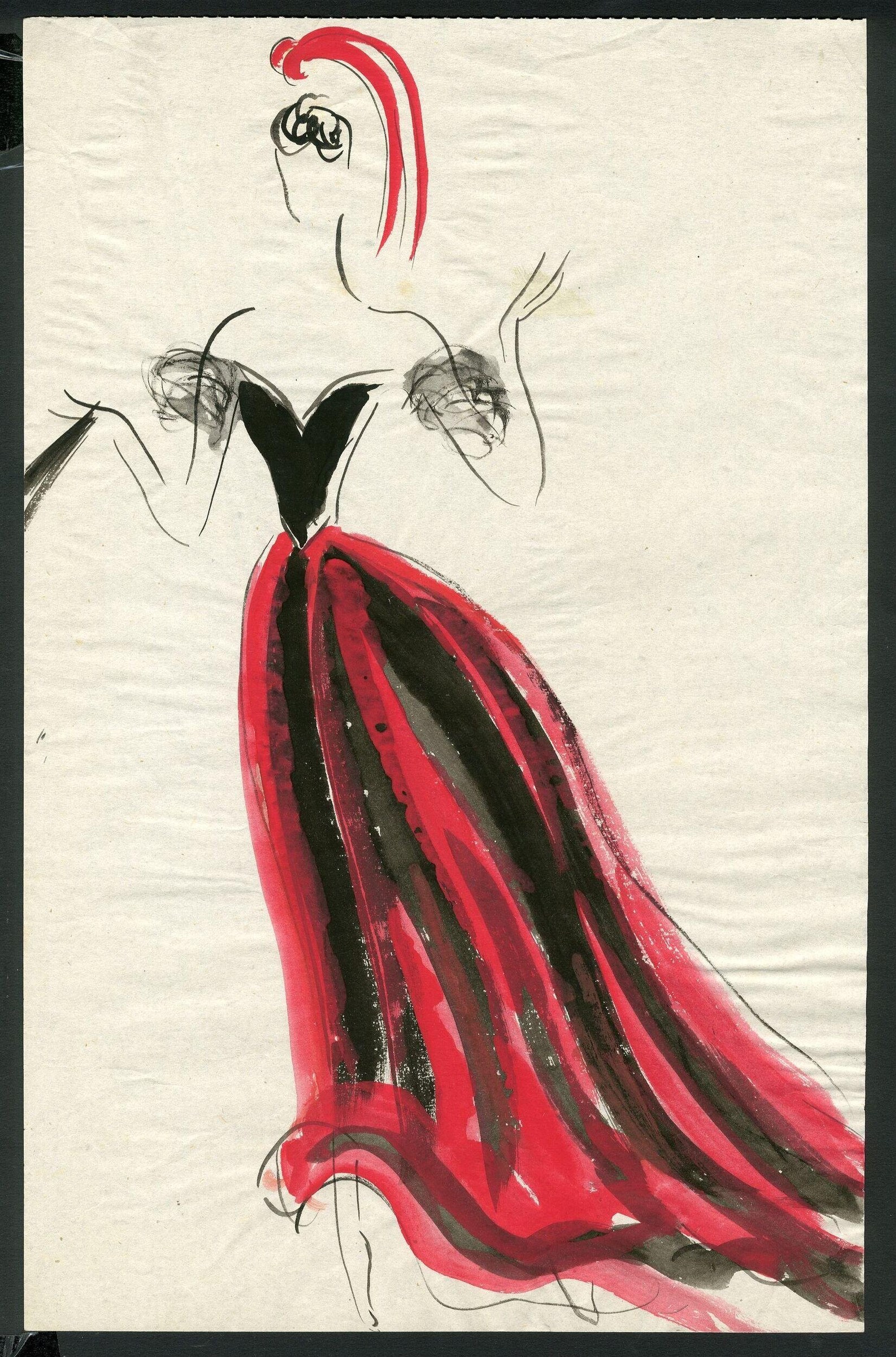
What you are looking at
A single figure stands in a graceful, elongated pose against a plain background. The dancer wears a striking costume: a fitted black corset or bodice with a deeply cut sweetheart neckline, and a full skirt of brilliant red that falls in sweeping folds to the ground, darkened with black shading to suggest volume and movement. The hair is rendered in bold strokes of red, pulled up and styled in a fashionable wave. The figure's arms are extended in an expressive gesture—the left arm raised and curved, the right extended outward—suggesting both balletic poise and dramatic presentation. The drawing technique combines precise linear work for the body contours with loose, gestural marks defining the voluminous skirt, creating a sense of arrested motion. The composition emphasizes verticality and the play of the costume against the body.
The dancing
The single figure demonstrates a classical balletic frame: the torso is held upright with apparent ease, one arm raised to shoulder height in a curved line, the other extended at roughly waist level. The legs appear to be in a standing position, possibly with a slight weight shift that suggests the dancer is about to move or has just finished a movement. The head is turned slightly away, creating a three-quarter view that adds dimension. The artist has captured the balletic convention of elongation and control through the extended line of the neck and the careful placement of the limbs.
The dance depicted
The costume and pose strongly suggest classical ballet or theatrical dance of the early twentieth century. The red skirt and black corset are characteristic of Romantic or neoclassical ballet costume, particularly of the sort featured in society or commercial dance productions in the 1930s. The design is sophisticated enough to suggest a principal or featured role rather than ensemble work. Without further documentation, the specific ballet cannot be identified with certainty, but the style of costume and the period of the drawing (1936) place this within the world of European theatrical ballet during the interwar period. Sophie Fedorovitch's role as costume designer suggests this was executed as a design study for an actual production.
How it was made
The work combines ink or black pen for the linear drawing of the body and face with watercolor or gouache in red for the hair and skirt, creating a design study typical of costume design practice. The loose, exploratory quality of the arm gestures and the more carefully finished treatment of the face and upper body suggest this is a working design rather than a finished presentation piece. The technique is economical: essential contours are stated in dark line, while color is used strategically to define the silhouette and primary visual interest. This mixed-media approach was standard for theatrical costume design of the period, allowing the designer to indicate color and volume while preserving the precision of line needed for construction.
About this work
This is a costume design for an unnamed theatrical dance production, executed by Sophie Fedorovitch in 1936. It depicts a single dancer in performance attire—a red skirt and black bodice—captured in a graceful, classically-inflected pose. The work belongs to the tradition of European theatrical design, where the designer's task was to visualize the performer's appearance in space and movement. Fedorovitch was a significant figure in twentieth-century dance design, and this sketch represents her practice of combining precise draftsmanship with bold color to convey both the practical and aesthetic dimensions of costume.
How to look at it
Attend to the balance between the drawing of the body and the rendering of the costume. The artist has used line to establish the dancer's formal posture and grace, then superimposed color and volume to show how the skirt extends that verticality while adding visual drama. Note the expressiveness of the arm positions: the raised arm suggests aspiration or preparation, while the extended arm conveys openness and control. The three-quarter turn of the head and the slight asymmetry of the pose prevent the figure from feeling static, even in this moment of pause. The loose, gestural marks in the skirt suggest movement and textile drape rather than attempting photographic precision.
The artist
Sophie Fedorovitch (1893–1977) was a Russian-born stage designer who became one of the most influential costume and scenic designers for British and European dance in the twentieth century. She worked extensively with the Ballets Russes and later with the Vic-Wells Ballet (later the Royal Ballet), designing for choreographers including Frederick Ashton and Michel Fokine. Her design aesthetic favored clarity of line, bold color, and a modernist simplification of form while maintaining elegance and theatrical impact. Her costume designs were prized for their understanding of how fabric moves on the body and how color reads from the stage.
The period
In the 1930s, European theatrical ballet was in transition. The Ballets Russes, which had dominated avant-garde dance since 1909, was fragmenting, and national ballet companies were becoming established institutions. There was a movement toward a more austere, streamlined aesthetic in design, reacting against the orientalism and decorative excess of earlier decades. At the same time, red and black remained powerful colors for dramatic effect—signifying passion, modernity, and theatrical intensity. Fedorovitch's work exemplified the interwar modernist turn in design: sophisticated, economical, and focused on the line of the body and the essential silhouette.
Where it lives
The work is catalogued as a costume design held in the collection of the Victoria and Albert Museum (indicated by the source tag 'va'). Costume designs in theatrical collections document the material and visual culture of production and serve as evidence for reconstructing historical performances.
Dance in this work
Questions about this work
What ballet is this costume design for?
The catalogue record does not identify a specific ballet. The title 'Nocturne' suggests it may have been for a work with that name, but without additional documentation or production records, the specific ballet cannot be confirmed. The costume style is consistent with classical or neoclassical ballet of the 1930s.
Who was Sophie Fedorovitch?
Fedorovitch was a highly respected Russian-born stage designer who worked primarily in Britain from the 1920s onward. She designed for the Ballets Russes and the Vic-Wells Ballet, and her work was influential in establishing a modernist aesthetic for twentieth-century theatrical dance. She understood both the visual and practical demands of stage costume.
Why is red such a common color in ballet costume?
Red reads powerfully on stage under theatrical lighting and carries strong symbolic and emotional associations—passion, drama, and vitality. From Romantic ballet onward, red has been used to signify female characters of intensity or allure. It was also a practical choice that would be visible from the back of a large theater.
Is this a finished design or a sketch?
This appears to be a working design study rather than a fully finished presentation drawing. The loose, exploratory quality of the arm gestures and the strategic use of color suggest it was made to work out ideas and communicate key information about silhouette and mood, rather than to serve as a formal presentation to producers or the public.
More dance artwork





