49 works in this view — arrow keys or swipe to move between them.
Dance in Art
Nocturne
Fedorovitch, Sophie
- Collection:
- Costume design
- Source:
- Victoria and Albert Museum
- Rights:
- Rights vary by item — check the source record before reusing this image. Source record ↗
- Recorded as:
- V&A — check rights per item
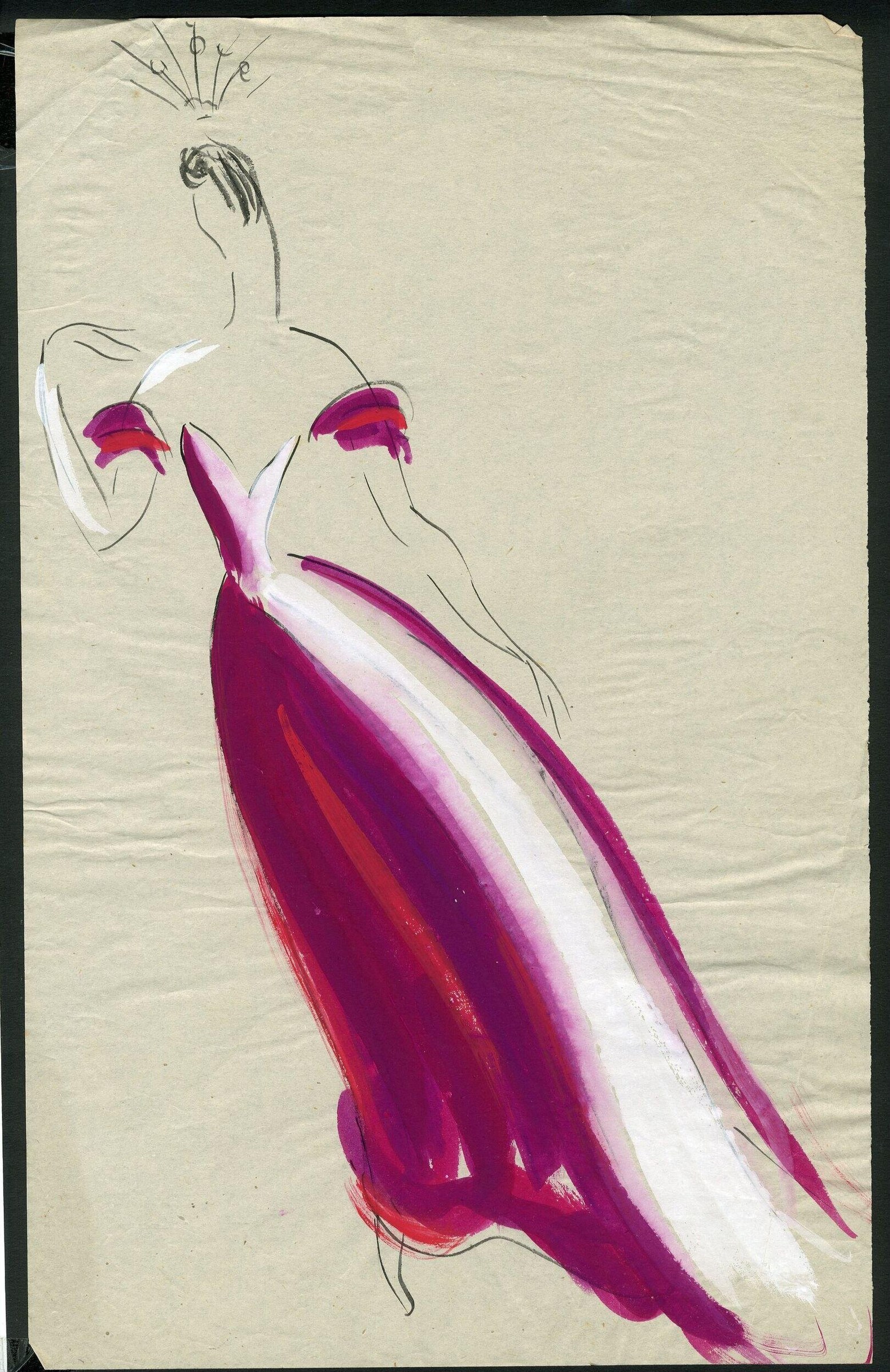
Fedorovitch's costume designs were instrumental in shaping the visual language of British ballet in the 1930s and beyond. This sketch demonstrates the intimate relationship between costume and movement: the dress is not merely clothing but a collaborator in dance, its weight and drape helping to articulate the body's line and intention. For historians of dance design, this drawing is evidence of how 20th-century theatre used costume as a compositional element, equal to music and choreography.
What you are looking at
A single figure in dramatic evening dress dominates the composition, rendered in fluid watercolor or gouache with expressive ink line-work. The dancer is shown in a lunging or kneeling pose, weight thrown forward into the movement, head tilted upward with a gestural arm raised above. The costume is a stunning magenta-to-wine evening gown with striking white-edged trim or panel running vertically down the front, creating a dramatic color contrast. The silhouette suggests a sleek, high-waisted design typical of 1930s fashion. The figure's head is drawn with minimal but expressive ink lines suggesting upswept hair. The background is plain cream or off-white paper, which focuses all attention on the costume and the body's dynamic line. The painting style is economical—the body rendered in sketchy ink, the dress articulated through careful watercolor gradations that suggest weight, movement, and the play of stage light on fabric.
The dancing
A single dancer, shown from roughly waist-to-head height. The body is pitched forward in a deep forward lunge or falling motion, with weight committed to the extended leg. The upper body twists, and one arm gestures upward and back, fingers splayed expressively. The pose suggests effort and emotional intensity rather than classical repose. The artist has captured a moment of extension and release—a body moving through space, not posed for display.
The dance depicted
The identity of the specific dance cannot be determined from the image alone, but the costume, date, and pose point toward theatrical dance of the 1930s—likely ballet or contemporary dance performed in an evening gown rather than traditional tutu or leotard. The magenta silk evening dress, the dramatic upward arm gesture, and the forward-falling momentum suggest a romantic or dramatic passage, possibly from a ballet divertissement or modern dance piece. The title *Nocturne* evokes the lyrical, nighttime mood of romantic ballet, and the gesture reads as emotionally expressive rather than purely narrative. This is a costume study for performance, not documentation of an existing choreography.
How it was made
The work is executed in watercolor and ink on paper, a standard medium for costume design in the 1930s theatre world. The technique is economical and assured: the dress is rendered in controlled watercolor washes using magenta, crimson, and white pigment to suggest volume and the directional fall of fabric; the body is sketched in quick, confident ink lines that convey movement and anatomy without overworking. This method allowed rapid iteration and clear communication of design intent to seamstresses and directors. The white reserve of the paper serves as highlight, suggesting stage lighting.
About this work
This is a costume design by Sophie Fedorovitch for a 1930s theatrical production, likely a ballet or modern dance work titled *Nocturne*. It shows a woman's evening gown—a striking bias-cut design in wine-red silk with a white-trimmed front panel—paired with a gesture of dramatic uplift and forward momentum. The drawing style is confident and economical, the mark of a designer who understood both the movement vocabulary of dance and the expressive power of costume. Fedorovitch was a Russian-born designer working in London during this period, known for collaborations with the major British ballet companies and for costumes that were sculptural, modern, and deeply responsive to choreography. This single figure study would have been one of many sheets in the design development for a complete production.
How to look at it
Observe how Fedorovitch has positioned the figure: not in a classical line, but in a moment of emotional turbulence, weight forward, arm reaching. The costume is not incidental—the vertical white panel has been placed to emphasize the twist of the torso and the forward pitch of the movement. The saturated magenta draws the eye and would read powerfully on stage, especially in gaslight or early electrical lighting. Notice that the artist has not drawn feet or lower legs; she was a designer, not a figurative draftsperson, and has concentrated her effort on the parts that would be silhouetted on stage and visible to an audience. The expressive ink line conveys a dancer's body; the watercolor conveys the costume.
The artist
Sophie Fedorovitch (1893–1980) was a Russian-born costume and set designer who emigrated to London in the 1920s and became a central figure in British theatrical modernism. She designed for the Ballets Russes, the Vic-Wells Ballet (later the Royal Ballet), and numerous West End theatrical productions. Her style was marked by an economy of line, bold use of color and texture, and an intuitive understanding of how costumes move with dancers. She was known for collaboration—working closely with choreographers and dancers—and for designs that were simultaneously modern and deeply theatrical. Her archive is held in the Victoria & Albert Museum.
The period
The 1930s was a period of formal innovation in ballet and modern dance. In Britain, the Vic-Wells Ballet (founded 1931) was establishing a national repertory, commissioning new work and assembling a resident company. Costume design was becoming a recognized art form in its own right, no longer merely the domain of seamstresses. Fedorovitch's generation of designers—including Oliver Messel and Rex Whistler—were trained as visual artists and brought painterly sophistication to theatre dress. The bias-cut evening gown was a fashion innovation of the 1930s, and its use in dance costume reflected modernism's appetite to collapse the boundary between fashion and theatrical dress. A work titled *Nocturne* in this context likely invokes the romantic ballet tradition (the nocturne as a lyrical divertissement), but rendered through contemporary design.
Where it lives
The work is held in the Victoria & Albert Museum's Theatre Collection as a costume design. Such designs typically form part of a production archive and may be accompanied by related sketches, swatches, photographs, or records of the production itself.
Dance in this work
Questions about this work
Who was Sophie Fedorovitch?
A Russian-born costume and stage designer (1893–1980) who worked extensively in London from the 1920s onward. She designed for the Ballets Russes, the Vic-Wells Ballet, and numerous theatrical productions, and was instrumental in establishing costume design as a serious visual art. Her style combined modernist simplicity with deep understanding of how costumes move in performance.
What is a nocturne in ballet?
Traditionally, a lyrical solo or pas de deux of romantic character, named after the piano form. It typically appears as a divertissement in a longer work and is marked by soft, flowing movement and emotional expressiveness rather than dramatic narrative. Many ballets include a nocturne as a moment of intimacy or reverie.
How do costume designers work with choreographers?
Designers typically attend rehearsals, discuss the mood and movement vocabulary of the choreography, and create designs that enhance rather than constrain movement. Fedorovitch was known for this collaborative approach—she would sketch dancers in motion and shape her designs to the body's line. A good costume should move with the dancer as a second skin.
What dance style does this show?
The specific work cannot be identified from the sketch alone, but the evening gown costume and the expressive gesture suggest theatrical dance—most likely ballet or contemporary dance of the 1930s rather than a folk or social dance form. The title *Nocturne* and the emotional intensity of the pose point toward romantic ballet tradition.
More dance artwork





