49 works in this view — arrow keys or swipe to move between them.
Dance in Art
Nocturne
Fedorovitch, Sophie
- Collection:
- Costume design
- Source:
- Victoria and Albert Museum
- Rights:
- Rights vary by item — check the source record before reusing this image. Source record ↗
- Recorded as:
- V&A — check rights per item
This is a primary-source document of how professional ballet costumes were conceived and communicated in the 1930s, showing the designer's direct engagement with the dancer's body and its possibilities. Fedorovitch's approach—studying the figure from multiple viewpoints to understand the total silhouette in motion—reveals how costume design and choreography were inseparable practices in theatrical ballet.
What you are looking at
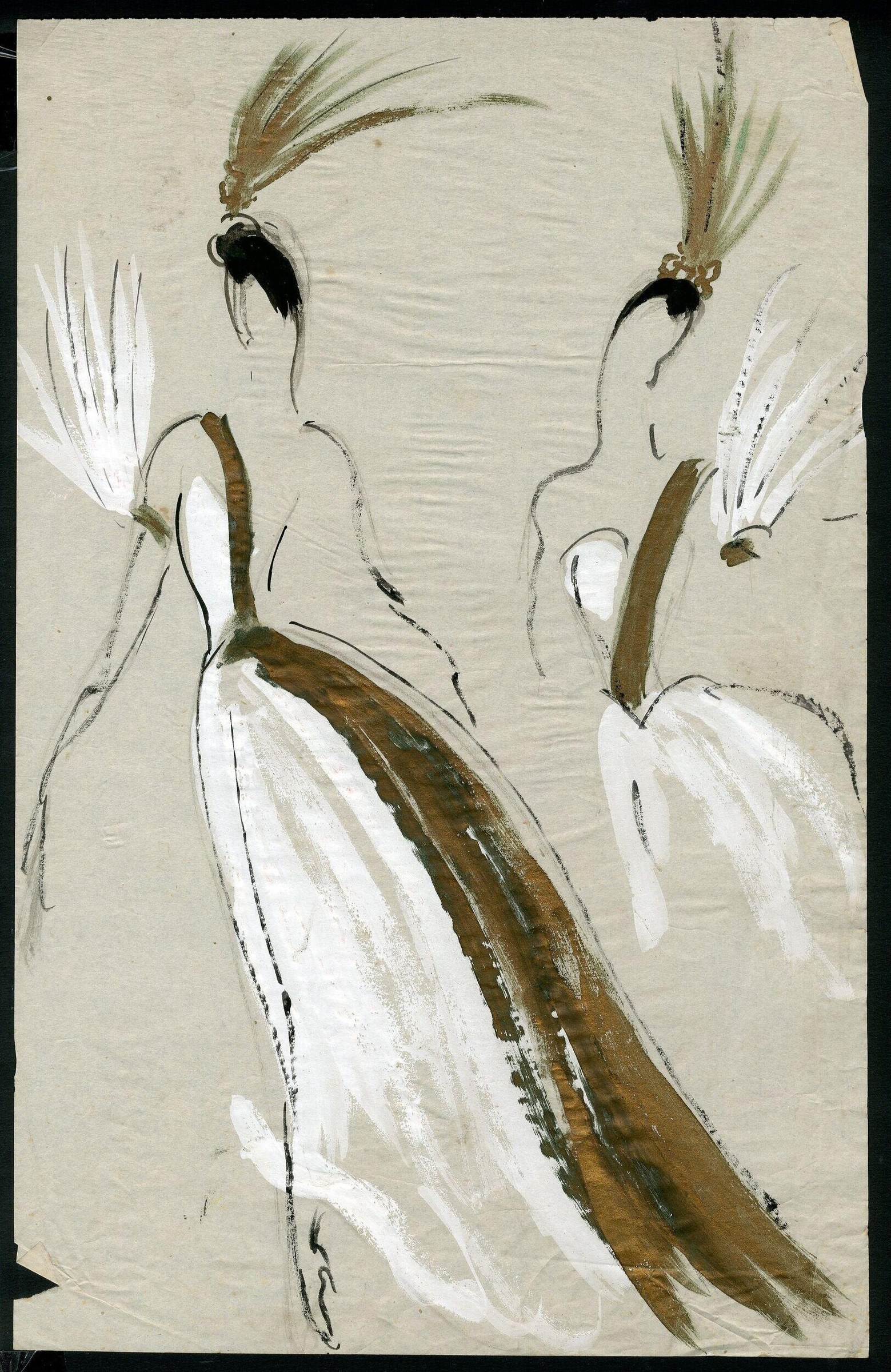
A costume design rendering in mixed media shows four female dancers in romantic-era pointe work, arranged vertically on the page. The two central figures are positioned back-to-back in matching white tulle skirts with brown bodices, their arms raised and angled in classical ballet positions. The upper pair of figures repeats this composition in miniature above, while the lower pair shows the same configuration below. All four dancers wear feathered headdresses—the upper two with brown and white plumage, the lower pair with white—and pose en attitude or in similar épaulement. The white paint defining their skirts is applied thickly and luminously, creating volume and movement, while the brown bodices and green-tinged drapery are rendered in subtle washes. Delicate line work indicates the dancers' limbs and the feathered headdresses. The composition reads as a study of a single pose from multiple views or a repeated motif, typical of costume design work where a designer documents the line and silhouette of a figure in action.
The dancing
All four dancers hold a consistent classical ballet carriage: head lifted, shoulders back, arms positioned in third or fifth positions with graceful épaulement. The weight appears to be lifted and centered, characteristic of pointe work. The dancers are shown in profile or three-quarter view, allowing the designer to capture the line of the lifted torso and the silhouette of the tulle skirt in motion. No floor contact is visible; the figures appear weightless and ethereal, hovering within the composition.
The dance depicted
This is a costume design for romantic-era ballet, most likely for a solo or small ensemble within a classical ballet work. The pointe work, the white tulle skirts (likely intended as a *corps de ballet* or principal role costume), and the feathered headdresses suggest either a fairy or sylph role, or possibly a scene from a classical repertory work such as a variation in *Swan Lake* or *Nutcracker*. The repetition of the same figure suggests the designer was exploring how the costume reads from different angles and in different moments of a phrase, a common approach in costume design where the silhouette and movement of fabric matter as much as the garment's construction. The feathered headdresses add a touch of decorative fantasy consistent with romantic ballet aesthetics.
How it was made
This is a costume design rendered in watercolor and ink on paper. The artist has used translucent washes for the drapery and bodices, allowing the underlying paper to show through and create delicacy, while the white tulle is rendered in opaque watercolor or gouache applied with thicker brushwork to create volume. Ink line work defines anatomical structure and the feathered details of the headdresses with precision. The technique is typical of early twentieth-century theatrical design practice, where designers worked on paper to show producers, directors, and seamstresses exactly how a costume should read on stage in motion.
About this work
This is a costume design study by Sophie Fedorovitch for a classical ballet work, likely created for theatrical production or rehearsal purposes in the 1930s. The title *Nocturne* suggests a night or dream-scene context, fitting the ethereal quality of the design. Fedorovitch was a significant figure in twentieth-century theatrical design, known for her sensitive understanding of how costume and movement interact. This drawing demonstrates the practical and artistic tradition of costume design as a form of choreographic notation—a way of thinking through how a dancer's body and its movement would be framed and enhanced by fabric, color, and ornament. The work belongs in a dance archive as both a historical record of theatrical practice and as evidence of how designers approached the problem of making movement visible and beautiful on stage.
How to look at it
Study how Fedorovitch positions the dancer's body across the four repetitions. Notice how the feathered headdress sits relative to the lifted head and upper back—the designer is solving the problem of keeping the ornament in harmony with the dancer's carriage. The thicker white paint of the tulle is not random; it shows where the fabric would catch light and create volume during a turn or lift. The repeated composition is not lazy design but systematic investigation: each angle reveals a different aspect of the costume's interaction with the moving body.
The artist
Sophie Fedorovitch (1893–1977) was a Russian-born costume and set designer who became a central figure in British ballet and theatrical design from the 1920s onward. She designed for the Ballets Russes, the Sadler's Wells Ballet (later the Royal Ballet), and major theatrical productions, developing a distinctive aesthetic that combined Russian modernist sensibility with sensitivity to classical form and the dancer's body. Her design practice was notable for its restraint and elegance, and for the care with which she studied movement and costume as a unified whole. She was equally comfortable with romantic repertory, neoclassical works, and contemporary commissions.
The period
By 1936, European ballet was in a period of consolidation and expansion following the decline of Diaghilev's Ballets Russes in 1929. British ballet, particularly the Sadler's Wells Ballet (founded 1931), was establishing itself as a major force, with a repertory that mixed classical Russian training with new British choreography. Costume design in this period was increasingly understood as a distinct discipline; designers like Fedorovitch, Oliver Messel, and Cecil Beaton elevated it to an art form that shaped how audiences understood choreography. The romantic-era aesthetic—tutus, pointe work, ethereal subjects—remained central to ballet identity even as choreographers experimented with modernist form.
Where it lives
This design is held in a collection designated as costume design and sourced as part of the VA (Victoria and Albert Museum) collection. It represents the kind of working drawing—neither fully finished presentation piece nor rough sketch—that formed the operational backbone of theatrical production, used to communicate ideas between designer, director, and technical staff.
Dance in this work
Questions about this work
Is this a finished design or a sketch?
It is a working design—refined enough to show the client or director a clear vision, but not a final presentation drawing. The multiple repeated figures suggest the designer was thinking through the costume in motion, a typical intermediate stage in the design process.
Why are the four figures the same pose?
Costume designers often drew the same figure from multiple angles on a single sheet to show how the costume reads from different viewpoints during performance. This helps the designer and maker understand the silhouette from all sides.
What ballet was this costume for?
The title *Nocturne* suggests it may have been for a dream or night-scene ballet, but the specific work is not confirmed by the record. The romantic-era aesthetic—pointe work, white tulle, feathered ornaments—was used across many classical and contemporary works of the period.
What is Fedorovitch known for?
Fedorovitch was renowned for costume and set designs that combined elegance with a deep understanding of how fabric moves with the dancer's body. She worked with major companies including the Ballets Russes and the Royal Ballet, and was influential in establishing costume design as a major art form.
More dance artwork





