49 works in this view — arrow keys or swipe to move between them.
Dance in Art
Nocturne
Fedorovitch, Sophie
- Collection:
- Costume design
- Source:
- Victoria and Albert Museum
- Rights:
- Rights vary by item — check the source record before reusing this image. Source record ↗
- Recorded as:
- V&A — check rights per item
Costume designs like this one are essential documents of twentieth-century dance history; they show us what dancers wore, what choreographers and designers imagined for them, and how the visual and kinetic aspects of a work were conceived together. This particular sketch is a record of a specific moment in theatrical fashion—the height of the romantic revival in 1930s ballet—and of the refined taste of a working designer creating for the stage.
What you are looking at
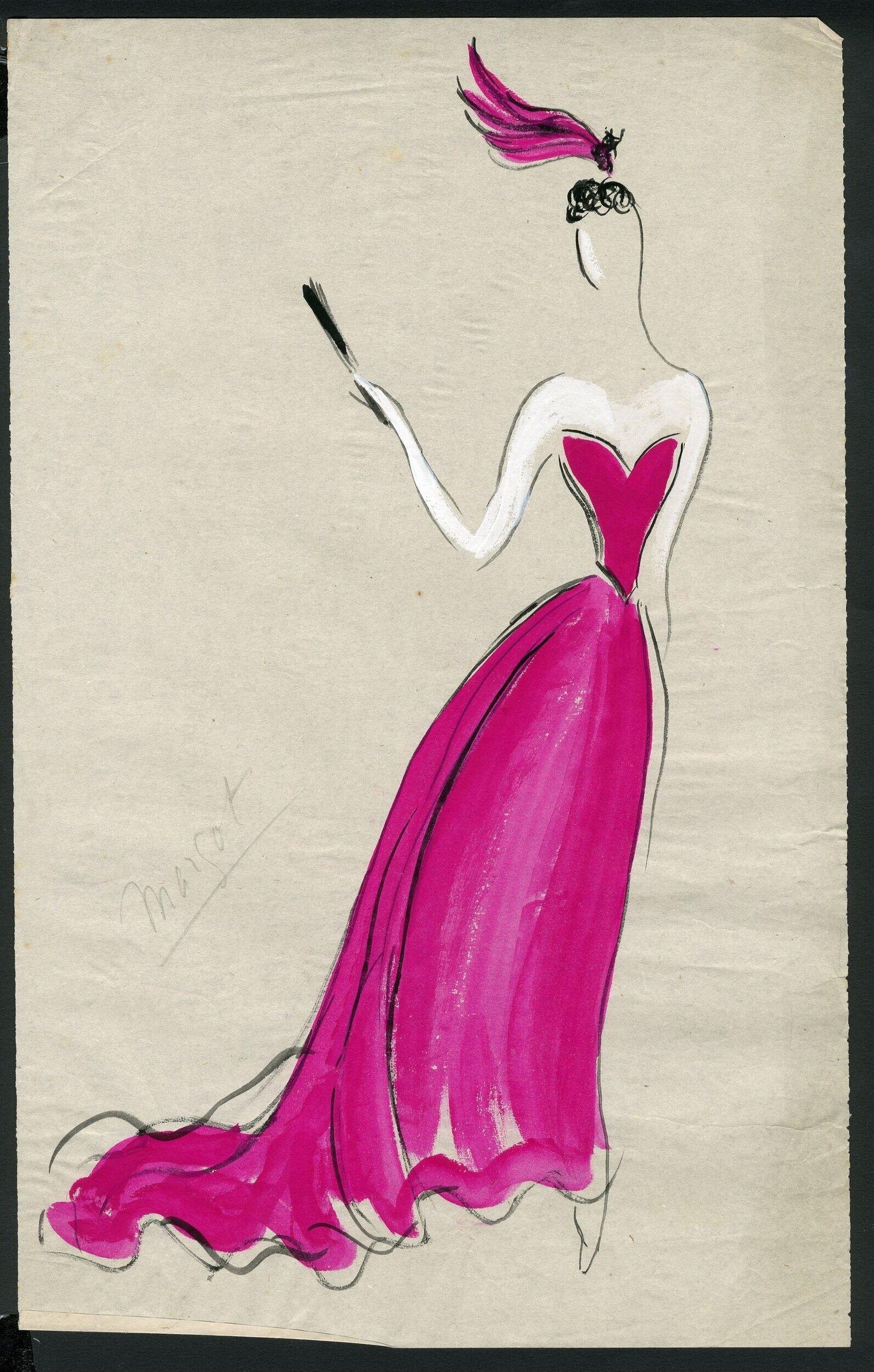
A single figure in an elegant evening dress dominates the composition, rendered in a spare, linear style against cream paper. The dancer wears a strapless sweetheart-neckline bodice in white, beneath which flows a voluminous skirt in deep magenta or fuchsia pink, its fabric gathered and pleated to suggest movement and weight. The skirt extends into a long train that pools at the figure's feet. The dancer's left arm is raised and extended in a graceful gesture; the right arm hangs at her side. Her head is small and delicate, rendered in profile or three-quarter view, topped with an ornate tiara or headdress from which a plume of magenta feathers rises dramatically. The figure stands in contrapposto, the weight seemingly on one leg, creating an elegant, elongated silhouette. The design is executed in black ink with watercolor or gouache in magenta and white, the magenta applied with visible brushstrokes that follow the fabric's form. The background is bare and neutral, placing all emphasis on the costume and pose.
The dancing
A single dancer fills the frame, standing in a refined, balletic posture with the torso erect and the raised arm extended in a lyrical line. The arm gesture is open and expressive rather than technical—the elbow soft, the hand relaxed. The lower body is suggested rather than detailed; the dancer's stance implies a slight sway or shift of weight that creates a sense of elegant repose or the moment just before or after a movement. The silhouette emphasizes verticality and grace, with the costume's volume and the feather plume creating an impression of weightlessness.
The dance depicted
This appears to be a costume design for theatrical ballet, likely from a romantic-era work or a 1930s evocation of that aesthetic. The extreme emphasis on luxurious fabric, the feathered headdress, the balletic posture, and the ethereal color palette are all consistent with the design vocabulary of ballet theatre. The dress and styling suggest a principal dancer in a narrative role—possibly a swan, sylph, or other romantic heroine—though the costume is too generic to tie to a specific ballet. The figure's grace and restraint, and the artist's focus on the architectural elegance of the gown rather than on dynamic movement, suggests this is a design meant to flatter the wearer and showcase the costume's beauty in stillness and in the softer moments of performance.
How it was made
This is a costume design sketch, executed in ink and watercolor or gouache on paper. The technique is economical and assured: the silhouette is established in quick black pen lines, and the magenta is applied in loose, gestural brushstrokes that model the fabric's folds and suggest its weight and drape. The artist has left much of the paper bare, allowing the elegance of the line and the saturation of the color to do the work. This approach is characteristic of mid-20th-century fashion and costume design practice, where sketches were made rapidly to communicate concept and visual impression rather than to render every detail. The technique would have been circulated among dancers, directors, and makers to inform costume construction.
About this work
This is a costume design for a female dancer, most likely created for a ballet production in the 1930s. The work showcases the refined aesthetic of early-twentieth-century theatrical design—an era in which the costume itself was understood as a partner in the dancer's art, and in which luxury of material and elegance of silhouette were paramount. The sketch captures a single moment: the dancer at rest, allowing the gown and its ornamentation to define the character and mood. The work is a fine example of the designer's hand in the theatre, and reveals the visual thinking that preceded rehearsal and performance.
Sophie Fedorovitch was a designer working in this tradition, and this sketch would have been one of many preliminary ideas developed for a production. The notation "Nocturne" in the title suggests a work of quietude and intimacy—a night scene or a dance of dreaming—and the costume's romantic languor and the softness of its color support that reading. The sketch is at once a practical document and a small artwork in its own right.
How to look at it
Look first at the outline: the designer has created a clear silhouette in a few confident lines, establishing the dancer's posture and the drape of the skirt. Notice how the raised arm and the plume of feathers create a line that carries the eye upward and outward, suggesting grace and lightness. Observe the way the magenta color is applied: it follows the folds of the skirt, suggesting depth and movement within stillness. The design communicates luxury and elegance without fussy detail; the costume is meant to move, and the sketch suggests that movement through the fluidity of the brushwork rather than through depicting the dancer in action. The feathered headdress is the final flourish—a touch of exoticism and theatre that signals the work's belonging to the romantic tradition.
The artist
Sophie Fedorovitch (1893–1953) was a British costume and set designer who worked extensively in theatre and ballet. She trained in Paris and worked with major European companies including the Ballets Russes and later British and American theatres. She was known for her refined taste, her economy of line, and her ability to create designs that were both beautiful and practical for the stage. Her sketches, like this one, are characterized by their confidence and restraint; she suggested form and fabric with minimal means, trusting the viewer (and the dancer) to complete the picture.
The period
This sketch dates to 1936, a moment when ballet was at the height of its cultural prestige in Europe and was beginning to establish itself in America. The romantic revival was in full swing: choreographers and designers looked back to the classical ballets of the nineteenth century for inspiration, and created new works in a romantic or neo-romantic idiom. Costume design in this era was influenced by modernist graphic design and fashion illustration; designers like Fedorovitch drew on both traditions to create sketches that were economical, elegant, and immediately communicable to makers and dancers. At the same time, the economic depression and the rise of fascism in Europe lent a poignancy to the escapism and beauty that ballet offered.
Where it lives
This sketch is held in the Victoria and Albert Museum's collection as a costume design, part of the documentary record of theatrical practice in twentieth-century Britain. It represents the working tradition of stage designers in this period, and would have been used to communicate design concepts to costume makers, dancers, and artistic directors.
Dance in this work
Questions about this work
What dance is this costume for?
The sketch is titled 'Nocturne' and is dated 1936, but the specific ballet or dance for which it was designed is not recorded in the available information. The costume itself—a romantic-style ball gown with feathered headdress—is generic enough that it could have been used in several different works. The title suggests a work of nighttime reverie or quiet emotion.
Who was Sophie Fedorovitch?
She was a British designer (1893–1953) who created costumes and sets for ballet and theatre, working with major European companies including the Ballets Russes. She was admired for the refinement and economy of her designs, and for her ability to create sketches that were both beautiful and practical for performance.
Why is a costume sketch important?
Costume sketches like this are primary historical documents. They show us exactly what dancers wore, reveal the visual intentions of choreographers and designers, and demonstrate how theatre artists worked. This sketch also illustrates the mid-twentieth-century fashion illustration tradition and the graphic language that designers used to communicate their ideas.
What technique was used?
This is a mixed-media sketch in black ink and watercolor or gouache on paper. The lines are drawn quickly and confidently to establish the silhouette, and the magenta color is applied in loose, gestural brushstrokes that suggest fabric and form rather than rendering every detail.
More dance artwork





