49 works in this view — arrow keys or swipe to move between them.
Dance in Art
Poster
Stannard, Michael
- Collection:
- Poster
- Source:
- Victoria and Albert Museum
- Rights:
- Rights vary by item — check the source record before reusing this image. Source record ↗
- Recorded as:
- V&A — check rights per item
This poster is a window into the ecosystem of mid-twentieth-century British ballet outside London's major houses. The existence of a professional ballet production in Scarborough, the touring model, and the investment in professional graphic design for promotion all tell us about how dance was distributed and valued in regional theaters. For historians of Alexander Roy or the London Ballet Theatre, this poster may be the only surviving image of the production itself.
What you are looking at
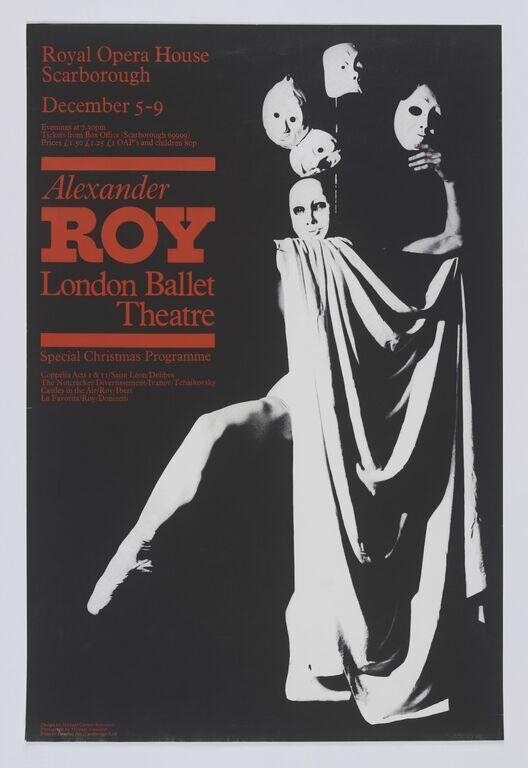
This is a promotional poster for a Christmas season production of Alexander Roy's ballet at the London Ballet Theatre, performing at the Royal Opera House Scarborough December 5–9. The composition is dominated by a single female dancer in white against a dark ground, her body arranged in an elegant, theatrical pose. She is shown from approximately the waist down, her leg extended in a controlled line, the weight of her body supported by a single point. Around her float four masklike faces in white against the black, each a study in expression: one serene and frontal, one in profile, one turned away. The dancer's torso is draped in a dark fabric—a cape or shawl—that sweeps across the frame with balletic grace. The typography is bold and spare, printed in red-orange capitals and lowercase sans-serif, positioned to the left and lower portions of the frame. The overall effect is one of classical restraint crossed with modernist economy: the human figure reduced to essential line and gesture, the masks suggesting narrative depth or psychological complexity beneath the surface of the dance.
The dancing
A single female dancer occupies the central vertical axis, positioned in what appears to be an attitude derrière or similar sustained extension. Her supporting leg is hidden; her extended leg reads as a controlled line from hip to pointed foot. The torso is upright but softened by the draped cape, which creates diagonal movement across an otherwise classical frame. The arm position is not fully visible, but the shoulder line suggests an open, frontal presentation. The four surrounding masks—detached from bodies—operate as a visual chorus, their expressions ranging from peaceful to withdrawn, creating a psychological surround around the dancer's physical moment.
The dance depicted
This is a theatrical ballet production, most likely mid-twentieth-century neoclassical or contemporary ballet in style. The sustained extended leg, the pointe work implied by the foot position, and the formal theatrical presentation all confirm a ballet idiom. The masks and the psychological register suggested by the surrounding faces point toward a narrative or thematic ballet exploring interior states or mythological material rather than pure abstraction. The work was created by or for Alexander Roy, a figure not extensively documented in standard ballet histories; this poster itself is a primary record of the work's existence. The emphasis on a solitary female figure with supporting psychological imagery suggests a work exploring a singular consciousness—possibly a classical heroine, a tragic figure, or a study in isolation.
How it was made
This is a lithographic poster, printed in a two-color process: black and red-orange. The technique is visible in the crisp separation of the figure from the ground and the economical use of white space created by the dark paper itself. Lithography allowed for bold, graphic forms and the subtle modeling of the dancer's body through value gradation; the faces are rendered with less detail, almost sculptural in their abstraction. This printing method was standard for mid-twentieth-century theatrical promotion and allowed for relatively inexpensive mass production of advertisements for touring productions. The poster's design—attributed to Michael Stannard—shows the influence of modernist graphic design, where the image serves both aesthetic and commercial function.
About this work
This is a Christmas season advertisement for a ballet production by the London Ballet Theatre at the Royal Opera House in Scarborough in 1967 or a nearby year (the exact date is not recorded). It documents a work choreographed by or associated with Alexander Roy, a figure whose contributions to British ballet are not widely catalogued. The poster is a lithograph, printed in two colors, and exemplifies mid-twentieth-century theatrical promotion design. What makes it significant for dance history is that it is often the only surviving visual record of a production—a work that may have been performed only once or twice, in a provincial venue, and was never documented in film or notation. The poster itself becomes an archival artifact, evidence that the work existed and was considered worth advertising.
How to look at it
The viewer should attend to the moment of suspension the artist has chosen: the dancer is not in motion but held in a sustained position, a moment of maximum extension and control. The masks surrounding her are not incidental decoration but a structural element—they ask whether we are looking at a literal character or at an interior state made visible. The absence of color (aside from the printed red) and the reduction of the figure to essential line and gesture are deliberate choices that emphasize abstraction over narrative realism. The cape suggests both classical ballet tradition and something more modern: a garment that obscures even as it frames.
The artist
Michael Stannard was a mid-twentieth-century British graphic designer working in the modernist idiom. His poster work is characterized by bold typography, economical use of color, and a formal sophistication that elevated commercial design to fine art. Little biographical information is readily available, but his work for theatrical productions places him within the broader movement of British design of the 1950s–1970s, when graphic design became a respected discipline and posters became collectible artworks in their own right.
The period
This poster dates to the mid-twentieth century, a period when ballet in Britain was experiencing significant growth beyond London. The Royal Ballet was establishing itself as a national institution, but regional theaters and smaller companies were also creating opportunities for ballet performance. The modernist graphic vocabulary of the poster—sparse, geometric, psychologically resonant—reflects the influence of continental European design and the post-war embrace of abstract and expressionist aesthetics. In dance, the 1950s–1970s saw increasing experimentation with narrative ballet and psychological themes, moving away from pure classicism toward more complex dramatic exploration.
Where it lives
This poster is held as part of a theatrical design collection (source: VA, likely the Victoria & Albert Museum). It is a printed advertisement for a touring production and represents the category of ephemeral theatrical materials that are often lost; its survival in a public collection ensures its preservation as a historical record.
Dance in this work
Questions about this work
What is Alexander Roy known for?
Alexander Roy appears to have been a choreographer or ballet director associated with the London Ballet Theatre in the mid-twentieth century. This poster is one of the few surviving records of his work. He is not extensively documented in major ballet histories, but this production poster indicates he was active in regional British ballet during a period of significant growth outside London.
What was the London Ballet Theatre?
The London Ballet Theatre was a mid-twentieth-century British ballet company that performed in provincial venues as well as London. This poster documents a Christmas season production at the Royal Opera House in Scarborough, indicating the company's touring model and regional reach.
Why are the masks in the poster?
The four surrounding faces suggest a psychological or narrative dimension to the ballet, possibly referencing classical or mythological material. In theatrical design, such imagery often signals interior states, multiple identities, or a chorus of witnesses. Without access to the ballet itself, the exact meaning remains open to interpretation.
How do I know this is a ballet and not another form of dance?
The extended leg position, the pointe foot, the theatrical dress, and the formal presentation all align with ballet idiom. The modernist graphic style and the psychological register suggested by the masks point toward mid-twentieth-century contemporary or narrative ballet rather than classical repertory ballet.
More dance artwork





