49 works in this view — arrow keys or swipe to move between them.
Dance in Art
Dress
Stevenson, Hugh
- Collection:
- Dress
- Source:
- Victoria and Albert Museum
- Rights:
- Rights vary by item — check the source record before reusing this image. Source record ↗
- Recorded as:
- V&A — check rights per item
This costume reveals how mid-twentieth-century theatrical dance was dressed: the investment in texture, colour, and handcrafted ornament; the way the skirt was engineered for movement within a visually defined silhouette. For historians, it documents both the formal vocabulary of stage costume and the specific practice of a significant British theatre designer during a period of ballet and musical theatre expansion.
What you are looking at
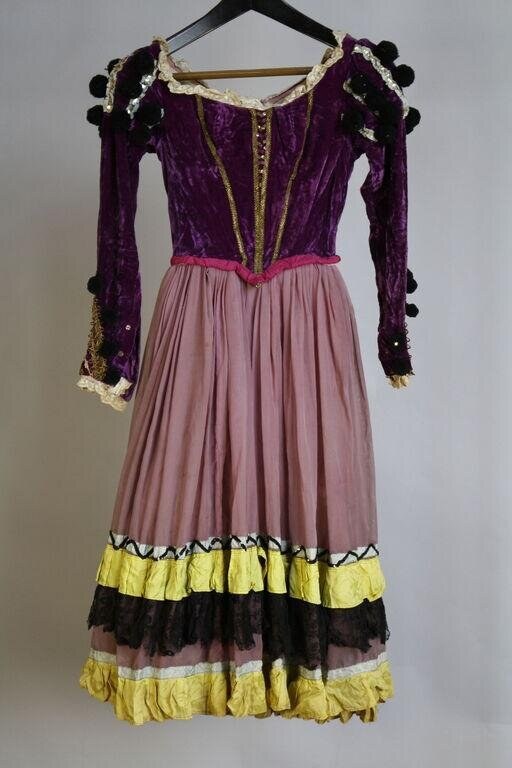
A theatrical costume displayed on a hanger against a neutral grey wall. The dress is a striking composition of rich, contrasting fabrics arranged in horizontal bands of colour. The bodice is fashioned from deep purple velvet, cut with a modest neckline and finished at the shoulders with elaborate puffed sleeves decorated with large black velvet pompoms and gold braid trim. The upper bodice features an ornate gold-braided front panel in a decorative pattern. The skirt transitions from a mauve or dusty pink chiffon gathered at the waist, through a band of butter-yellow silk, to a lower tier of black net or tulle, finishing with a final deep yellow silk ruffle at the hem. The overall effect is richly theatrical and densely ornamented, with the stacked colour zones creating a visual rhythm from shoulder to floor. The construction suggests this is a stage costume rather than a historical reconstruction or everyday dress.
The dancing
No figures are present; this is a costume object displayed static on a hanger. The dress's proportions and construction can be read as designed for a dancer or theatrical performer: the fitted bodice with structured armholes, the gathered skirt allowing for movement, and the careful balance of weight distribution in the layered lower garment all suggest active wear rather than a standing portrait garment.
The dance depicted
This is a theatrical dance costume, almost certainly from a European stage production of the mid-twentieth century. The style—particularly the puffed sleeves with pompoms and the structured velvet bodice—suggests Russian or Central European ballet or operetta traditions. The voluminous gathered skirt and the stacked horizontal bands of contrasting colour are consistent with Romantic-era ballet revival costumes or with modernist theatrical dance of the 1940s. Without a named character or production context, the specific dance form cannot be firmly identified, but the ornament and construction point toward classical ballet or a related theatrical dance genre staged in a European theatre during the 1940s.
How it was made
This is a three-dimensional costume object: tailored fabric garment combining velvet, silk chiffon, and tulle with applied trimmings (braiding, pompoms, and decorative edging). The construction visible in the image—hand-finished seams, careful draping of the gathered skirt, and applied ornament—indicates professional theatre costume construction, likely made for repeated use in performance. The photograph documents the costume in a state of preservation, hung in controlled conditions, suggesting it has been kept as a museum or archive object.
About this work
This is a stage costume from 1946, attributed to designer Hugh Stevenson. The dress combines jewel-toned fabrics and ornate trimmings in a style consistent with twentieth-century European theatrical dance, particularly ballet and operetta. The deep purple velvet bodice with black pompom-trimmed sleeves and the voluminous skirt of gathered pink, yellow, and black tiers create a visually complex silhouette suggesting a character role rather than corps work. Stevenson was known for costume design across British theatre, including ballet and musical theatre, and this piece exemplifies the richly decorative approach to stage costume that characterised post-war European dance production.
How to look at it
Look at how the costume is constructed to move: the gathered skirt is full enough for active footwork but shaped to hold form; the puffed sleeves allow arm movement; the fitted bodice sits high and defined. The choice to stack four distinct horizontal colour zones—purple, pink, yellow, black—is neither random nor merely decorative: it creates visual rhythm and emphasises the dancer's verticality and the division of the silhouette into distinct theatrical registers. The pompoms and braid are placed to catch light and draw the eye to the shoulders and arms in motion.
The artist
Hugh Stevenson (1910–1957) was a British designer who worked extensively in theatre, particularly in ballet and musical theatre. He was associated with influential London theatrical productions during the 1940s and 1950s and contributed to the visual language of British ballet during a formative period. His costume work combined historical reference with contemporary theatrical sensibility, and he was known for resourcefulness and attention to movement and colour.
The period
In 1946, European theatre was beginning recovery after World War II. The Romantic ballet revival was well established, and designers were drawing on nineteenth-century ballet vocabulary while adapting it to contemporary performance. The ornamental, richly coloured approach visible in this costume reflects the opulence and escapism valued in post-war theatrical entertainment. Concurrently, modernist approaches to costume and stage design were emerging, but this piece represents the more decorative tradition of ballet and operetta costuming.
Where it lives
This costume is held in the collection identified in the catalogue record as part of the Victoria and Albert Museum's holdings (indicated by the source designation 'va'). It was accessioned as a stage costume object, where it remains preserved as a document of twentieth-century theatrical design practice.
Dance in this work
Questions about this work
Who would have worn this costume?
The dress was made for a performer in a theatrical dance production—most likely a principal or soloist role in a ballet or musical theatre production in Britain around 1946. The ornamental style and fitted construction suggest a named character rather than an ensemble dancer.
What is this costume from?
The catalogue record does not identify the specific production. The style suggests a ballet or operetta from the 1940s, but without additional documentation, the exact work cannot be named. Museum costume collections often retain individual pieces whose original production context has been lost or forgotten.
How was a costume like this made?
The dress was hand-tailored by theatre costume workshops: the bodice was constructed from structured velvet, the skirt gathered and sewn to a waistband, and trimmings (braid, pompoms, edging) were applied by hand. Each layer—bodice, skirt foundation, chiffon, tulle, ruffle—was individually cut and assembled, and seams were hand-finished for durability under repeated performance.
Why so many layers and colours?
The stacked horizontal bands serve multiple purposes: they create visual spectacle under stage lighting, they divide the silhouette in a way that flatters active movement, and they allow the costume to read as a coherent character design from a distance. The colour contrast also helps the dancer remain visible against stage sets and lighting.
More dance artwork





