49 works in this view — arrow keys or swipe to move between them.
Dance in Art
Illustration
Diaghilev Ballets Russes
- Collection:
- Illustration
- Source:
- Victoria and Albert Museum
- Rights:
- Rights vary by item — check the source record before reusing this image. Source record ↗
- Recorded as:
- V&A — check rights per item
The image documents the Ballets Russes' approach to reimagining classical ballet through visual and physical extremity. For dance historians and dancers, it provides evidence of how early 20th-century avant-garde choreography challenged the canon: not by abandoning classical positions but by pairing them with unexpected flexibility, props, and theatrical framing. The juxtaposition of the two figures asks viewers to reconsider what classical ballet could express.
What you are looking at
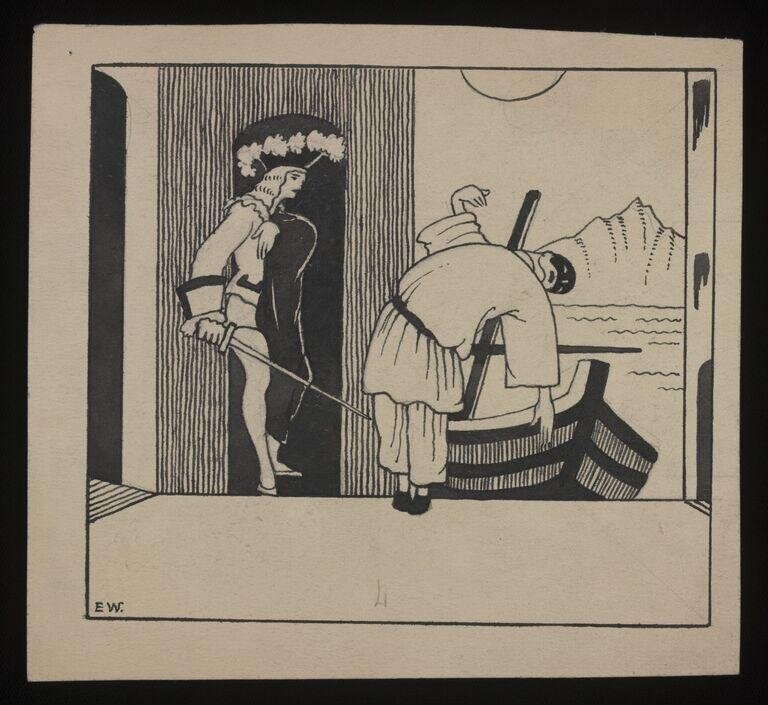
A young woman in classical dress stands against a fluted backdrop, crowned with a laurel wreath and posed in profile with one leg extended in a balletic attitude. She wears a light, high-waisted garment and holds a thin rod or wand. In the middle distance, another figure bends deeply forward over what appears to be a low platform or bench, wearing a fuller skirt and leaning into the frame. The setting is spare and theatrical, with minimal props and a stark division between the figures and the neutral ground. The line work is controlled and linear, with fine parallel hatching creating depth and volume. The composition emphasizes the contrast between the upright, controlled pose of the crowned dancer and the dramatically flexed, almost horizontal line of the second figure.
The dancing
The primary figure maintains a classical ballet posture—weight centered, one leg lifted in a controlled extension, upper body held erect. The arm position is restrained and geometric. The second figure adopts a deep forward fold with the torso nearly parallel to the ground, hips over what may be a prop, suggesting extreme flexibility or an acrobatic element. The crowned figure's stillness and formal bearing contrasts sharply with the dynamic stretch or backbend of the second dancer. Both figures are isolated within the frame, with no physical contact or formal partnership evident.
The dance depicted
This appears to document classical ballet, likely from an early 20th-century avant-garde production. The laurel crown references neoclassical or Greco-Roman themes common in Diaghilev's Ballets Russes aesthetic. The extreme flexibility and unconventional pose of the secondary figure—whether a backbend, deep forward fold, or assisted extension—suggests the artistic experimentation characteristic of the company's choreographers, who pushed classical technique toward new expressivity. The composition reads as a study of contrasting movement vocabularies within a single work: classical restraint against physical extremity.
How it was made
This is a black-and-white line engraving or etching, executed with fine parallel hatching to model form and create spatial recession. The technique is precise and economical, relying entirely on line weight and density to convey volume, drapery, and the texture of the stage environment. The stark graphic quality and controlled line suggest professional illustration, likely created for circulation in theater programs, periodicals, or design collections. The medium's portability and reproducibility made it ideal for documenting and promoting avant-garde dance to a broader audience.
About this work
This is an illustration documenting a classical ballet composition from the Diaghilev Ballets Russes era. The work captures two contrasting moments or poses within a single frame—a neoclassically posed figure holding a formal vertical line and a second dancer in a dramatically extreme horizontal extension. The image belongs in a dance history collection because it preserves a specific artistic vision about how classical technique could be re-imagined: the crowned figure invokes the heritage of court ballet, while the secondary figure's extreme flexibility and unconventional frame suggest the choreographic innovation that defined the company's aesthetic. This is not straightforward classical ballet but a conceptual study in contrasts, using the human body as a visual and kinetic argument.
How to look at it
Attend to the two different movement vocabularies on display: the first figure's formal, vertical classicism and the second figure's horizontal, flexible extremity. The artist has chosen to freeze a moment of maximum contrast, asking the viewer to compare two aesthetic positions simultaneously rather than showing a transition between them. Notice how the fluted background and spare setting focus all attention on the bodies themselves—no narrative context or ensemble, just the direct study of movement and form. The line quality changes subtly between the two figures, with the crowned dancer rendered in cleaner, more linear strokes and the flexed figure rendered with more modulation, suggesting different kinetic energies.
The artist
The work is attributed to the Diaghilev Ballets Russes company. While individual artists are not identified in the catalogue record, this illustration style and compositional approach align with design and documentation practices of the company's circle, which included collaborations between Sergei Diaghilev, choreographers, visual artists, and theater designers. Diaghilev's practice of commissioning and preserving visual documentation of his works was central to the company's legacy and circulation.
The period
This work dates from the height of the Ballets Russes' influence (approximately 1909–1929), a period when classical ballet was being radically reconceived through collaboration with visual modernism. The company championed choreographers like Vaslav Nijinsky and Michel Fokine, who stretched classical vocabulary into new forms. Neoclassical and Greco-Roman imagery, as referenced by the laurel crown, were fashionable across European modernism and signaled a turn toward primitivism and timeless themes. Illustrations such as this one circulated widely and shaped international taste in dance design and technique.
Where it lives
The work is held in a collection described as 'Illustration' within a source marked 'va' (likely a visual arts database or institutional archive). The catalogue record identifies it as associated with the Diaghilev Ballets Russes but provides no accession number, acquisition date, or artist signature visible in the reproduction.
Dance in this work
Questions about this work
Is this a photograph or a drawing?
This is a black-and-white engraving or etching, a printmaking technique that creates images through fine parallel lines (hatching). It is not a photograph. The medium allowed the image to be reproduced and circulated widely—through programs, magazines, and collectors' portfolios—making it an economical way to document and promote dance.
Who are these dancers?
The catalogue record does not identify the specific dancers or the work from which this illustration derives. However, the style and the Ballets Russes attribution suggest this documents a work from the early 20th-century company, possibly from a neoclassical or mythologically themed ballet.
What is the object in the second dancer's hand, or under her body?
The secondary figure appears to be arched or flexed over a low platform or prop. Without additional context or a full program, its exact function is unclear—it could be a dance prop, a support for a backbend or extreme extension, or part of the set design. The composition emphasizes the flexibility required to achieve this position.
What does the laurel crown mean?
The laurel crown signals a neoclassical or Greco-Roman theme, common in Ballets Russes productions. It references both ancient Greek theater and the company's interest in reimagining classical forms through visual and choreographic modernism. The crown positions this figure as timeless or heroic.
More dance artwork





