49 works in this view — arrow keys or swipe to move between them.
Dance in Art
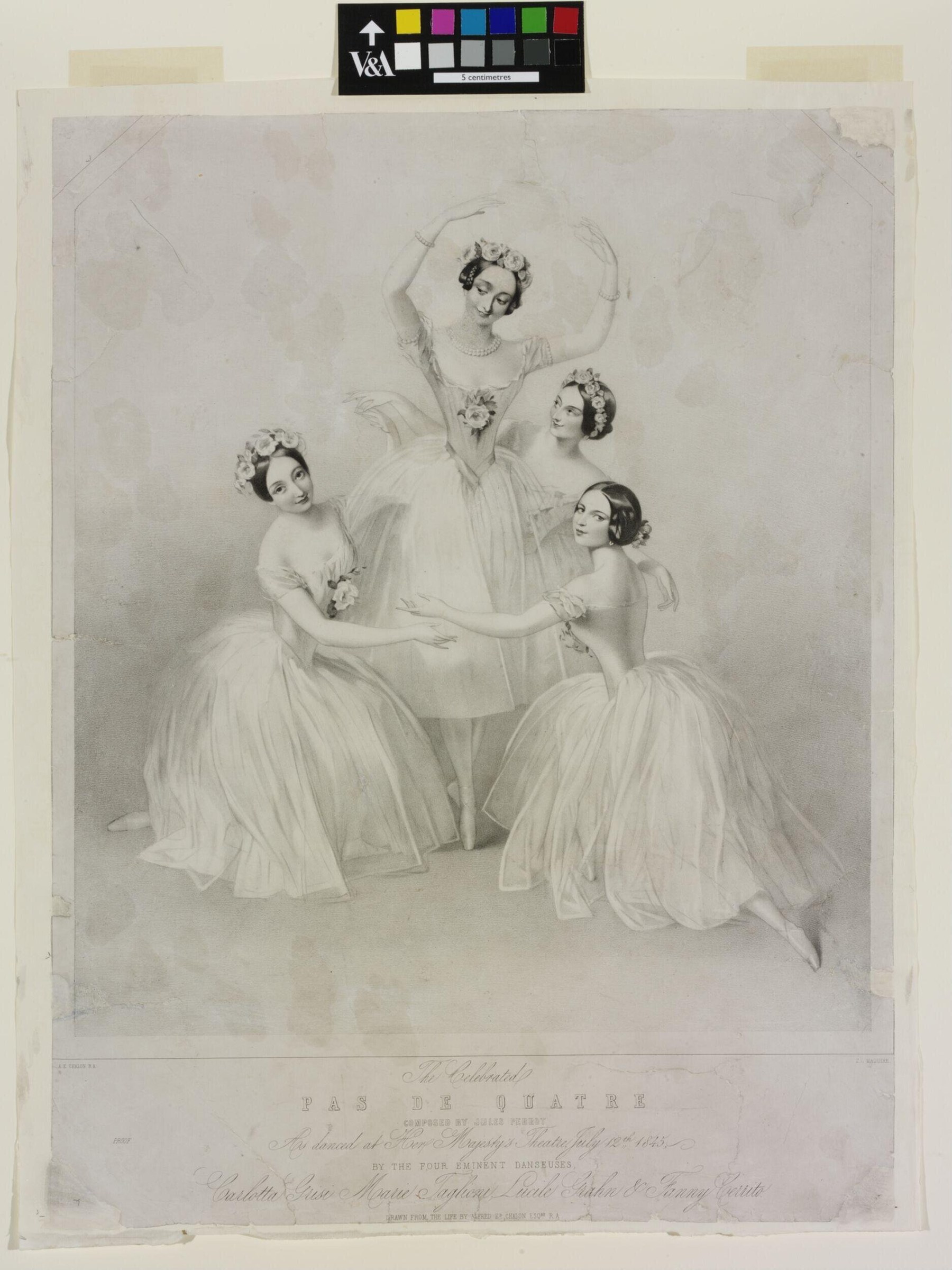
The Celebrated / PAS DE QUATRE / COMPOSED BY JULES PERROT / As danced at Her Majesty's Theatre July 12th 1845, / BY THE FOUR EMINENT DANSEUSES, / Carlotta Grisi, Marie Taglioni, Lucile Grahn & Fanny Cerrito
Chalon, Alfred Edward (RA)
- Collection:
- Source:
- Victoria and Albert Museum
- Rights:
- Rights vary by item — check the source record before reusing this image. Source record ↗
- Recorded as:
- V&A — check rights per item
This print is a primary document of one of the most storied moments in ballet history, and one of the few visual records created at or near the time of the performance itself. It reveals how Romantic-era ballet was marketed, consumed, and remembered: not primarily as movement to be studied, but as beauty and celebrity to be admired and possessed—a shift from dance as technique to dance as image.
What you are looking at
A refined lithograph or engraving depicting four female dancers in classical ballet dress arranged in a formal pyramidal composition. The central figure stands elevated, one arm raised gracefully overhead, while three kneeling or seated figures surround her at different levels, each wearing a flower crown and holding a small bouquet. All wear pale, gossamer tulle skirts rendered in delicate shading, with classical ballet bodices. The background is plain and atmospheric, rendered in soft grey tones that emphasise the figures' luminosity. The work is inscribed below with text identifying it as a record of the famous *Pas de Quatre* performed at Her Majesty's Theatre in July 1845, naming the four "eminent danseuses." The composition is decidedly theatrical and commemorative rather than narrative, presenting the dancers as objects of beauty and artistic study arranged for maximum visual harmony.
The dancing
The four bodies create a unified sculptural group through staggered spatial placement rather than interactive gesture. The uppermost figure, in contrapposto stance with one arm elevated and one lowered, commands the composition; her companions below gaze upward or inward in attitudes of reverence or contemplation. The arm positions are soft and decorative, the bodies without tension or obvious exertion. All four dancers are rendered with equal anatomical care and similar face-types, suggesting this is a formal record rather than character portrayal. The kneeling or sitting poses—unusual in contemporary ballet practice—create a deliberately composed, almost allegorical effect.
The dance depicted
This is a historical record of the *Pas de Quatre*, the most celebrated ensemble piece of the Romantic ballet era, choreographed by Jules Perrot for four international ballet stars: Carlotta Grisi, Marie Taglioni, Lucile Grahn, and Fanny Cerrito. The image does not depict an actual moment from the performance but rather a commemorative arrangement celebrating these four dancers' legendary gathering. The absence of any male partner, the formal stillness, the symbolic flower crowns, and the elevated central figure suggest a posed allegory of female artistic achievement rather than a document of movement. The softness of pose and the classical balletic vocabulary visible in arm carriage confirm the Romantic ballet idiom, but the work's primary purpose was to preserve memory and market celebrity rather than document choreography.
How it was made
This is a lithographic print, identifiable from the fine tonal gradations, the characteristic soft edges, and the inscription cartouche. The technique allowed large-scale circulation and relatively affordable reproduction, making this a commercial print for public distribution—likely sold as a souvenir or commemorative record in London following the July 1845 premiere. The delicate use of grey tones and the careful rendering of fabric texture show accomplished printmaking. This medium confirms the work's purpose: not a fine-art study but a widely circulated theatrical document intended for dancers, patrons, and enthusiasts.
About this work
The *Pas de Quatre* of 1845 stands as a watershed moment in ballet history: the first time four of Europe's greatest Romantic-era ballerinas appeared together in a single work. This lithograph by Alfred Edward Chalon—a society portraitist and illustrator well-known for theatrical subjects—commemorates that historic event not as a scene of dancing but as an allegorical apotheosis of the four artists. Rather than capture a step or phrase, Chalon presents an idealized, quasi-sculptural image of four exemplars of the Romantic ideal: ethereal, graceful, interchangeable in their perfection, united in a timeless moment. The work belongs in a dance collection not because it documents choreography, but because it documents how the Victorian public understood and valorized ballet: as a display of feminine grace, beauty, and artistic virtue, inseparable from celebrity and commercial spectacle.
How to look at it
Look first at the composition's geometry: the deliberate staggering of the four figures creates a pyramid with the central dancer's raised arm as its apex. This is not a moment captured from movement but a formal arrangement designed to display four bodies harmoniously within a frame. Note the careful equivalence of the surrounding three figures—despite being named individuals, they are rendered nearly interchangeable, as if serving a collective idea rather than representing distinct personalities. The flower crowns and bouquets are allegorical attributes of artistic virtue. The soft, luminous rendering of the tulle emphasises immateriality and ethereal beauty—the aesthetic ideal of Romantic ballet made visible. Finally, observe that no one is actually dancing: all are posed in stillness or repose, confirming that the print's purpose was commemoration and the perpetuation of an image, not documentation of choreography.
The artist
Alfred Edward Chalon (1780–1860) was a prolific painter and lithographer specialising in society portraits, theatrical scenes, and historical subjects. He was particularly known for illustrations and prints documenting London's theatrical world, making him a natural choice to commemorate the *Pas de Quatre*. His work sits at the intersection of fine art and commercial illustration, and he was skilled at translating stage spectacle into refined domestic prints for middle-class consumption.
The period
The mid-1840s marked the height of the Romantic ballet era in Europe. Taglioni, Grisi, Grahn, and Cerrito represented different national schools (Swedish, Italian, Danish, Italian respectively) and rivalries; their appearance together was a sensation and a carefully managed diplomatic and commercial event. The lithographic print trade was at its peak, making theatrical commemoration a standard practice. At the same time, ballet was becoming increasingly feminised and spectacularised—the male dancer had retreated from prominence, and the ballerina's beauty and technical refinement were the primary subjects of both performance and art.
Where it lives
This is a commercial lithographic print held in the V&A's theatrical collections. It was published in 1845, likely soon after the July performance, and would have been available for purchase by the theatre-going public.
Dance in this work
Questions about this work
Did this image show what the Pas de Quatre actually looked like on stage?
No. This is a commemorative arrangement, not a performance document. The four dancers are posed in stillness to display beauty and celebrate the historic event, not to show the choreography or any actual moment from the piece. While the ballet dress and arm positions are authentic to Romantic ballet, the composition is allegorical—an artistic fantasy rather than a stage view.
Why are the dancers arranged in this pyramid with one above the others?
The arrangement is entirely formal and symbolic. It elevates one dancer (likely Taglioni, the oldest and most senior) as the apex, while the other three surround her. This visual hierarchy was not part of the actual ballet; it is a graphic device to create artistic harmony and to honour the collaborative genius of four rivals united in a single work.
Could Chalon have seen the actual performance before making this print?
Possibly, and likely—the print was published the same summer as the July premiere. However, the print is not a scene from the ballet. It is a formal portrait of four dancers in their ballet costumes and roles, arranged as an allegorical apotheosis. Chalon's innovation was translating stage spectacle into a timeless, decorative image suitable for framing and display in a drawing room.
What does the flower crown symbolise?
The wreaths and bouquets are classical and allegorical attributes marking the dancers as figures of artistic virtue and beauty rather than as characters in a dramatic narrative. They align with 19th-century artistic conventions for representing the muse or the personification of art itself.
More dance artwork





