49 works in this view — arrow keys or swipe to move between them.
Dance in Art
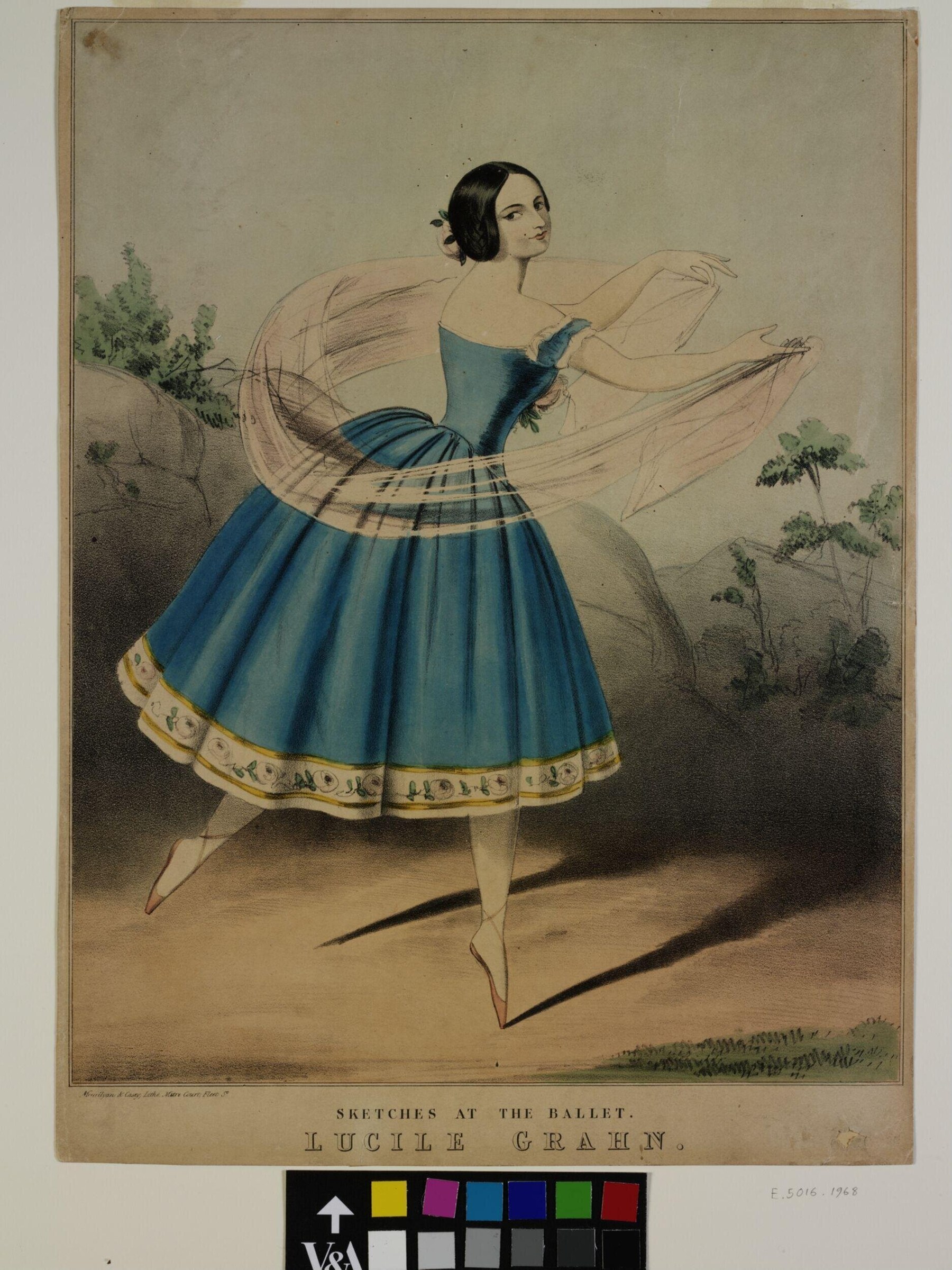
Sketches at the Ballet. Lucile Grahn.
Mourilyan & Casey
- Collection:
- Source:
- Victoria and Albert Museum
- Rights:
- Rights vary by item — check the source record before reusing this image. Source record ↗
- Recorded as:
- V&A — check rights per item
Lucile Grahn was a major figure in Romantic ballet history, and this image is a primary-source record of how she was marketed, celebrated, and remembered by her contemporaries. For dance historians, the image documents the precise costume and aesthetic ideal of the Romantic period with far more clarity than written description can convey. For viewers, it captures the central visual fantasy of the age: the transcendence of the human female body through dance.
What you are looking at
A young female dancer in theatrical costume stands alone in a landscape setting, captured mid-movement in a pose of dynamic grace. She wears a deep blue off-shoulder dress with a voluminous skirt trimmed in pale gold or cream-colored decorative banding; the skirt is caught in swirling motion around her legs. Her dark hair is styled close to her head in the fashion of the 1840s, and she gazes upward and to the side with an ethereal expression. Her left arm extends outward and backward, while her right arm curves across her body. She stands en relevé or nearly so, with her legs stretched in an elongated line. The setting is minimal but atmospheric: rocky terrain in the foreground, sparse vegetation and distant trees rendered in soft greens and browns, creating a romantic, otherworldly landscape that recedes into pale sky. Diaphanous fabric—part of her costume or a prop—billows around her in a long, graceful arc, emphasizing the upward lift and weightlessness of her pose. The overall composition and staging convey the Romantic ballet aesthetic of the period.
The dancing
The dancer's frame is upright with an extended, elongated carriage typical of Romantic ballet technique. Her weight is carried high, on or nearly on the balls of her feet, creating the characteristic ethereal lightness prized in this era. The arm extensions are soft and flowing rather than sharply held; her raised left arm sweeps backward while her right rests gently at her torso, creating an open, skyward-reaching silhouette. The stretched line of her legs—one supporting, one extended—and the angle of her torso convey controlled balance and the illusion of effortless suspension. A single soloist is shown, isolated and vulnerable, a composition emphasizing the individual performer rather than ensemble or partnered work.
The dance depicted
This is undoubtedly Romantic ballet of the 1840s. The costume—low-cut bodice, full skirt of mid-calf length with decorative trim, hair confined close to the head—is the unmistakable dress of the Romantic ballet dancer, and the pose embodies the central visual language of that style: upward lift, weightlessness, elongation, and a sense of otherworldly grace. The artist has captured the moment of suspension at the apex of a jump or relevé, the frozen instant where the dancer appears to defy gravity. Lucile Grahn, to whom the title attributes this work, was a celebrated Danish ballerina who danced throughout Europe in this period, particularly famous for roles in La Sylphide and similar works. The image conveys not technical virtuosity in the modern sense but rather the Romantic ideal of the female dancer as ethereal, ethereal, and spiritualised—closer to sylph than mortal woman.
How it was made
The work is a hand-colored lithograph or engraved print, a reproductive medium typical of theatrical publicity and artistic dissemination in the 1840s. The delicate rendering of fabric, the careful tonal gradations in the landscape, and the precision of the figure suggest professional reproductive engraving or lithography, likely printed in black and then colored by hand or in separate color passes. This technique allowed multiple impressions to be made and distributed to theaters, opera houses, and print sellers across Europe, making the image of a celebrated performer accessible to a wide audience. The softness of the color transitions and the flatness of the picture plane are consistent with the hand-coloring process.
About this work
This is a theatrical publicity print depicting Lucile Grahn, one of the great Romantic ballet dancers of the 1840s, in a pose that epitomizes the aesthetic of Romantic ballet: weightless, ethereal, spiritualized, and utterly controlled. The image was created by the printmaking firm Mourilyan & Casey and distributed as a souvenir of theatrical performance, allowing admirers and fellow dancers to study and admire the dancer's famous roles and technique. It belongs in a dance archive as both a historical document of a celebrated performer and a visual record of how Romantic ballet imagined the female dancer: not as an athlete or technician, but as a supernatural being, suspended between earth and air, human and sylph. The print is also a valuable artifact of 1840s theatrical commerce and the culture of celebrity that surrounded major ballet dancers in this era.
How to look at it
Attend first to the moment of suspension the artist has chosen: the dancer is caught at the peak of her lift, where the illusion of weightlessness is strongest. Notice how little the artist emphasizes musculature or effort; instead, the focus is on extension, line, and the flow of the drapery. The landscape setting is deliberately vague and dreamlike—it does not ground the dancer in reality but rather enhances her ethereality. The upward gaze and the billowing fabric all work together to create a single visual message: transcendence. This is not realism but idealization, and that is precisely what the Romantic ballet aesthetic demanded.
The artist
Mourilyan & Casey were London-based printmakers and lithographers specializing in theatrical subjects and portraits, active primarily in the mid-19th century. They produced numerous celebrity portraits and theatrical scenes for the burgeoning mass market of theater-goers and print collectors. The firm was part of a broader industry of theatrical publicity and performance documentation that flourished with the rise of the modern theater and the cult of celebrity that attended it.
The period
The 1840s were the high summer of Romantic ballet. La Sylphide (1832) and Giselle (1841) had established a new aesthetic in which the ballerina was imagined as otherworldly, tragic, and spiritualized—often playing a ghost, a sylph, or a maiden driven mad by supernatural forces. Male dancers receded into the background as partners and supports; the female dancer, en pointe and weightless, became the focus of fascination. Grahn was a leading interpreter of these roles, and her image circulated widely in Europe through prints like this one. Simultaneously, lithography and hand-colored engraving had become the dominant media for theatrical publicity, making the faces and bodies of celebrated performers visible to a mass audience for the first time. This democratization of celebrity coincided with the professionalization of ballet and the rise of the ballerina as a cultural icon.
Where it lives
The work is held by the V&A Museum in London (accession F.5016, dated 1843). It is a theatrical print from a period when such images were produced in quantity for sale to theater-goers and collectors, making it a common artifact of 19th-century dance culture despite its celebration of an exceptional performer.
Dance in this work
Questions about this work
Who was Lucile Grahn?
Lucile Grahn (1819–1907) was a Danish ballerina and one of the most celebrated performers of the Romantic era. She trained at the Royal Theatre in Copenhagen and became known for her technical refinement and expressive grace. She danced throughout Europe—in Paris, London, Milan, and Russia—and was particularly admired for her roles in La Sylphide and Giselle. She later became a teacher and choreographer, and her legacy influenced the development of ballet technique in Scandinavia.
What does 'en relevé' mean?
En relevé (or sur la pointe, when on pointe shoes) means rising onto the ball of the foot or the tip of the toe. In Romantic ballet, rising onto the toes created the illusion of weightlessness and ethereality that defined the aesthetic. Dancers in Romantic ballet spent much of their time en pointe or en relevé, which was still a relatively new and prized technique in the 1840s.
How do we know this is a lithograph or engraving rather than a painting?
The flatness of the color, the precision of the line work, the way the image is composed in distinct areas of tone and hue, and the signature elements of hand-coloring all point to a reproductive print medium. Also, the small scale and the distribution of such images as theatrical souvenirs makes a painted original unlikely. The print medium allowed multiple copies to be made and sold, which was the economic model of theatrical publicity in this period.
Why is her pose so ethereal and ungrounded?
The ethereal, weightless quality was the entire point of Romantic ballet. The goal was to make the dancer appear supernatural, as close as possible to a spirit or a sylph. The pose—high on relevé, arms extended softly, fabric billowing—creates the visual illusion of defying gravity. This was not about showing off technical difficulty or strength, but about creating beauty, mystery, and transcendence. It reflected Romantic-era fascination with the otherworldly and the supernatural.
More dance artwork





