49 works in this view — arrow keys or swipe to move between them.
Dance in Art
Illustration
Diaghilev Ballets Russes
- Collection:
- Illustration
- Source:
- Victoria and Albert Museum
- Rights:
- Rights vary by item — check the source record before reusing this image. Source record ↗
- Recorded as:
- V&A — check rights per item
This work is a primary document of the Ballets Russes' mission to unite dance with modern visual art and to legitimize dance as a serious avant-garde practice. For dancers and historians, it reveals how the company's choreographers and designers conceived of the moving body—as an abstract, sculptural form to be framed, distorted, and juxtaposed with modern architecture and graphic language, not as a narrative or decorative presence.
What you are looking at
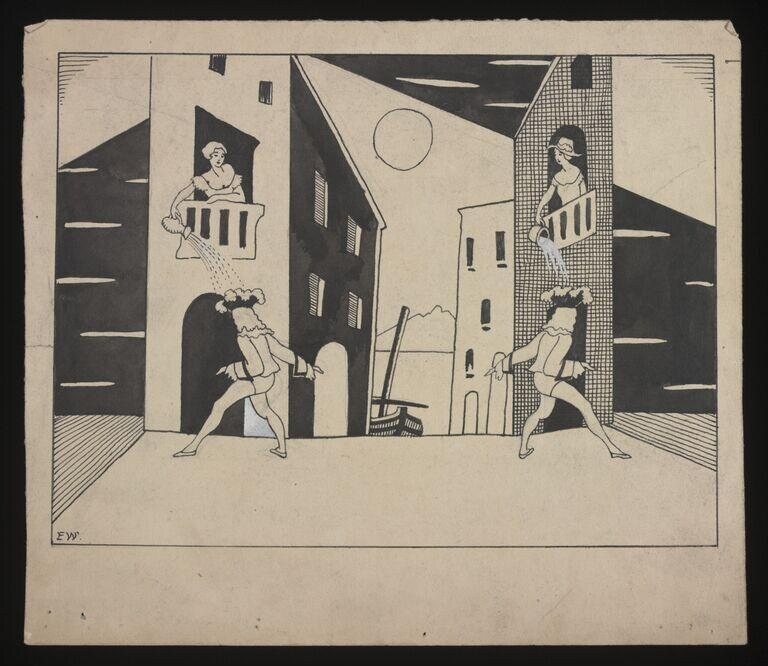
Two male dancers in a stark modernist street scene face each other in athletic, near-naked poses across a geometric urban landscape. Each stands with legs spread in a wide lunge, torsos twisted, one arm raised and one lowered in a mirrored asymmetry. The architecture around them is rendered in sharp linear perspective—tall buildings with a crosshatched pattern on the right, flat austere forms on the left, a circle (possibly sun or moon) in the background—creating a sense of compressed urban space. Two figures appear at upper windows of the buildings, leaning out from what look like baskets or cages, watching the dancers below. The entire composition uses bold black line work and hatching against a cream ground, with strong contrasts of solid black and white that emphasize the angular geometry of both bodies and setting. The moment is one of tension and opposition: the dancers mirror each other but are separated, framed by the city as both stage and constraint.
The dancing
Both dancers occupy a wide, grounded stance with legs in a deep lunge position and feet planted firmly apart. Each figure has one arm raised above the head or extended outward, while the other hangs down or reaches across the body, creating a rotational twist through the torso. The bodies are rendered with strong musculature, nearly unclothed, suggesting athletic capability. The pose is symmetrical in concept but reversed in execution—a mirror image that emphasizes geometric relationship rather than partnership. There is no contact between the dancers; they exist in spatial opposition.
The dance depicted
This appears to be a work associated with the Ballets Russes, depicting an athletic, modernist movement vocabulary that breaks from classical ballet vocabulary entirely. The wide, grounded stance and muscular, sculptural quality of the bodies suggest an interest in acrobatic or geometric abstraction rather than narrative ballet. The pose resembles adagio partnering or acrobatic forms, but rendered here as solo opposition rather than support. Without costume, narrative context, or the signed work itself, the specific choreography cannot be identified with certainty, but the style is consistent with early 20th-century theatrical modernism and Diaghilev's interest in sculptural, non-pantomimic movement.
How it was made
This is a line engraving or etching executed with bold linear marks and extensive cross-hatching to build tone and shadow. The technique creates a stark, graphic quality that emphasizes the angular geometry of both bodies and architecture. The use of solid black areas and white ground produces high contrast, which was economical for reproduction and circulation. The style is characteristic of modern graphic art of the early 20th century, suggesting a design or illustration for publication or promotion rather than a fine art print, which is consistent with Ballets Russes ephemera—posters, programmes, or designs meant to reach a broad audience.
About this work
This is a graphic illustration from or associated with the Diaghilev Ballets Russes, depicting two athletic male dancers in a modernist urban setting. The work exemplifies the company's avant-garde aesthetic: rejection of classical ballet's verticality and ethereality in favor of sculptural, geometric bodies; incorporation of architectural and abstract visual language; and an interest in acrobatic and experimental movement forms. The Ballets Russes (1909–1929) revolutionized dance by collaborating with visual artists, composers, and choreographers to create total theatrical works that challenged both movement and design conventions. This illustration documents that aesthetic impulse—the marriage of dance with modernist visual art.
The work belongs in a gallery of dance in art because it shows how dance was experienced and promoted in the early 20th century: not as a documented event, but as a designed visual concept, a graphic argument for a new way of moving the body in space. The illustration is as much an artwork as the movement it promotes.
How to look at it
Notice first the radical departure from classical ballet: these dancers are grounded, muscular, asymmetrical, and separated rather than in the supported, vertical, ethereal poses of 19th-century ballet. The engraver has chosen a moment of maximum geometric tension—the bodies twisted and opposed, the legs splayed. Attend to how the building frames and dwarfs the dancers, turning them into elements of a larger abstract composition; the figures in the windows create a vertiginous sense of spectatorship and danger. The bold black hatching on the right building creates visual weight that pushes the dancers forward. This is not a snapshot of a moment in a recognizable story; it is a manifesto in line—an argument for what modern dance should look like.
The artist
The work is attributed to the Diaghilev Ballets Russes as an institution rather than a named artist. The company (1909–1929) was a collaborative enterprise founded by impresario Sergei Diaghilev that brought together choreographers including Michel Fokine, Vaslav Nijinsky, and George Balanchine; composers including Igor Stravinsky and Manuel de Falla; and visual artists including Pablo Picasso, Henri Matisse, and Natalia Goncharova. The graphic style of this illustration—bold line and hatching, modernist abstraction—is consistent with the visual design vocabulary of the company's programmes and promotional materials from the 1910s–1920s, though the specific artist or designer is not identified in the catalogue record.
The period
This work was made during the height of the Ballets Russes' influence and after the company's early experimental phase (1909–1914), which included landmark works like *The Rite of Spring* (1913) and *Afternoon of a Faun* (1912). By the 1920s, the company's aesthetic had evolved toward neoclassicism and a renewed interest in athleticism and sculptural form in dance—exemplified in works by Balanchine. The graphic language of the illustration—the sharp geometry, the bold contrasts, the architectural framing—reflects broader modernist movements in visual art: Constructivism, Cubism, and the machine aesthetic. The image of naked or near-naked male bodies in powerful, asymmetrical poses also reflects the period's interest in athletic and acrobatic movement as worthy of serious artistic treatment, not merely entertainment.
Where it lives
The catalogue record identifies this work as part of a Ballets Russes collection and notes its source as 'va' (likely a holding institution, possibly a dance or visual arts archive). It is catalogued as an illustration rather than a fine art print, suggesting it may be a programme design, a promotional graphic, or a study for a theatrical project rather than an independent artwork. No accession number or date is recorded.
Dance in this work
Questions about this work
Is this a real dance or a designer's fantasy?
It is likely both. The Ballets Russes consistently collaborated with visual artists and designers to develop movement vocabularies together. This illustration may document an actual choreographic work, serve as a design proposal to inspire a choreographer, or exist as a theoretical statement of what modern dance could be—the boundaries between these categories were deliberately blurred by the company. Without the original programme or choreographic record, we cannot say which, but the style is consistent with actual works the company produced.
Why are the dancers almost naked?
The near-nudity emphasizes the body as a sculptural and geometric form rather than a decorated or narrative figure. This was radical for 1910s–1920s theatre and reflected modernism's interest in the body as raw material for artistic experimentation. It also signals athleticism and power—a rejection of classical ballet's ethereal, corseted ideal of the female body and an embrace of male physicality and strength as worthy of the stage.
What does the architecture mean?
The modern, geometric buildings situate dance in the contemporary moment—not in a romantic fairy-tale setting or a historical past. The Ballets Russes often used avant-garde visual art and design to align dance with other modernist practices in painting, sculpture, and architecture. The oppressive, angular buildings also create a sense of danger or confinement, suggesting that this is not a comfortable or decorative moment but a confrontation or struggle.
Who danced this?
The catalogue does not identify the specific work or dancer. The athletic, acrobatic quality and the emphasis on male bodies suggest it may have been created during Balanchine's period with the company, or during the earlier experimental phase when Nijinsky was creating roles, but this is speculation. The work remains unattributed in the collection record.
More dance artwork





