49 works in this view — arrow keys or swipe to move between them.
Dance in Art
Poster
Dominic, Zoe
- Collection:
- Poster
- Source:
- Victoria and Albert Museum
- Rights:
- Rights vary by item — check the source record before reusing this image. Source record ↗
- Recorded as:
- V&A — check rights per item
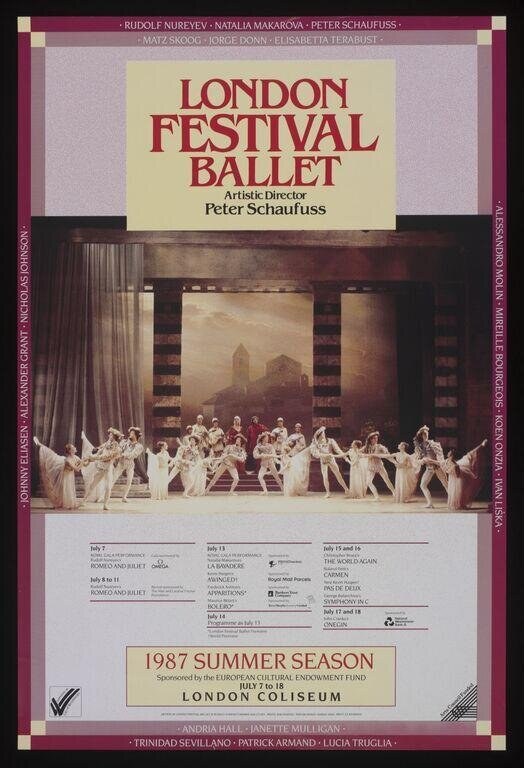
This poster documents classical ballet production at a major European venue during a significant moment in the company's history—the early years of Peter Schaufuss's directorship. It shows how ballet was advertised to the public and what aesthetic values (formal beauty, grand scale, classical architecture as metaphor) were considered marketable and central to the art form's identity in the 1980s.
What you are looking at
A large ensemble of ballet dancers in white tutus and pointe shoes occupy a grand classical stage set suggesting an Italian Renaissance piazza. The stage features a recessed backdrop depicting an architectural vista in warm, muted tones—a campanile and buildings rendered in atmospheric perspective. The dancers are arranged in a formal, symmetrical composition across the stage floor: two central figures stand elevated or prominent, flanked by pairs of dancers in balletic poses, with additional corps de ballet members distributed to either side and behind. Billowing drapes frame the stage left. The lighting is warm and even, typical of theatrical production photography or documentation from the 1980s. The overall impression is of a large-scale classical or neoclassical ballet during a moment of ensemble formation or repose, possibly from the opening or a key group scene.
The dancing
The dancers maintain strict classical ballet alignment: erect spines, extended limbs, and turned-out positions throughout. Arms are largely in épaulement or classical port de bras—some held in preparatory or first positions, others extended with balletic grace. The dancers appear to be in standing poses rather than mid-leap; weight is distributed through the supporting leg with evident control. The composition emphasizes symmetry and formation: pairs mirror each other across the stage center. The tutus—full, classical, knee-length or slightly longer—suggest a traditional or romantic aesthetic. Approximately fifteen to twenty dancers are visible, arranged in a hierarchy that suggests this is a formal ensemble moment rather than a solo or pas de deux.
The dance depicted
This is classical theatrical ballet, almost certainly from a major nineteenth-century or early twentieth-century work given the formal vocabulary, the scale of the ensemble, and the architectural stage design. The London Festival Ballet's 1987 summer season poster references multiple canonical works including Romeo and Ballet, La Bayadère, Coppelia, Swan Lake, and others. The stage composition—a formal geometric arrangement of corps dancers with a classical Italian villa or plaza backdrop—is consistent with the opening or tableau scenes of major classical works, particularly those with ensemble formations set in civic or palatial spaces. Without additional context from the program, the specific ballet cannot be identified from the image alone, but the artistic vocabulary and production values are unmistakably classical ballet of the highest order.
How it was made
This is a theatrical poster printed by color lithography or offset printing, typical of 1980s theatrical production marketing. The photograph of the stage scene was taken under theatrical lighting during performance or dress rehearsal and then transferred to the printing medium. The technique allowed for high-fidelity color reproduction and large-scale circulation to audiences. The borders and typography—printed separately—indicate professional theatrical advertising design. The warm color palette and soft focus are characteristic of theatrical documentation photography from this era before digital imaging.
About this work
This is a 1987 promotional poster for the London Festival Ballet's summer season at the London Coliseum, featuring Peter Schaufuss as artistic director. The image documents a scene from a classical ballet production, emphasizing the scale, formal beauty, and architectural grandeur of professional classical dance as it was being performed in London at a major arts venue. The poster served to advertise the company's full season, which included multiple classical and modern works. It belongs in a dance art gallery as evidence of how classical ballet was marketed, staged, and understood as a visual and theatrical art form in the 1980s. The image captures the essential grammar of classical ensemble ballet: symmetry, formal beauty, architectural space, and the subordination of individual bodies to a unified aesthetic design.
How to look at it
Attend to the geometric precision of the ensemble's formation and the calm, poised quality of the dancers' stillness—this is a moment of repose or formal tableau rather than dynamic action. Notice the symmetry: how the composition divides and mirrors itself around the stage center, creating visual harmony. Look at the architectural backdrop and how it grounds the dancers in a specific place (a classical plaza or palazzo interior), which was typical of story ballets from the nineteenth century. The lighting and the quality of the tutus tell you this is a major professional production with substantial resources.
The artist
Zoe Dominic (1913–2010) was a British theatrical and dance photographer best known for her extensive documentation of British ballet and theater from the 1950s onwards. She photographed major productions by the Royal Ballet, English National Ballet, and other companies, and her photographs became canonical images of British dance history. She worked in close collaboration with major choreographers and directors. Dominic's photographs are held in major archives including the V&A and the National Portrait Gallery, and her work is central to the visual archive of twentieth-century British ballet.
The period
By 1987, classical ballet was well-established as a prestige art form in the West, yet faced pressure from contemporary and experimental dance movements that had gained prominence in the 1970s and 1980s. The London Festival Ballet (founded 1950) was a major company competing with the Royal Ballet for audiences and funding. Peter Schaufuss, a prominent Danish ballet master, brought renewed attention to classical ballet technique and repertoire during his tenure as artistic director (1984–1993). The poster's emphasis on formal classical beauty and major canonical works reflects a deliberate reassertion of ballet's classical traditions at a moment when the art form was being renegotiated in the cultural landscape.
Where it lives
This is a promotional poster produced by the London Festival Ballet for their 1987 summer season at the London Coliseum. It is held in the Victoria and Albert Museum's Theatre Collections. Posters of this kind were mass-produced and distributed to theaters, public spaces, and individual patrons to advertise the season.
Dance in this work
Questions about this work
What ballet is shown in this image?
The specific work cannot be identified from the image alone. The poster advertised the London Festival Ballet's entire 1987 summer season, which included multiple classical works (Romeo and Ballet, La Bayadère, Coppelia, Swan Lake, and others). The scene shown—a formal ensemble in classical dress on a Renaissance-style stage—is consistent with several canonical nineteenth-century ballets.
Who was Peter Schaufuss?
Peter Schaufuss is a Danish ballet master and choreographer who served as artistic director of the London Festival Ballet from 1984 to 1993. He is known for his advocacy of classical ballet technique and for bringing renewed attention to the major works of the nineteenth-century ballet canon. He later served as director of the Royal Danish Ballet.
Why does the poster show so many dancers in a formal arrangement?
Classical story ballets often open with grand ensemble scenes that establish place, occasion, or social context—a ball, a marketplace, a civic celebration. These scenes emphasize the beauty of coordinated movement and the power of large groups moving in unison, which is central to the aesthetic of classical ballet.
What was the London Coliseum?
The London Coliseum is a large theater in London's West End, built in 1904. It has hosted major opera, ballet, and theatrical companies throughout the twentieth century. It remains an active performance venue today, serving as the home of English National Opera.
More dance artwork





