49 works in this view — arrow keys or swipe to move between them.
Dance in Art
More Mecca Ballroom Fabric
Eddie Squires
- Collection:
- Design
- Source:
- Victoria and Albert Museum
- Rights:
- Rights vary by item — check the source record before reusing this image. Source record ↗
- Recorded as:
- V&A — check rights per item
This is a rare surviving record of how swing dancing and the Lindy Hop were understood and celebrated in popular culture in the 1960s—not as a living social practice, but as a nostalgic symbol of romance, dynamism, and modernity. The design shows ballroom dancing as a marker of consumer identity and domestic taste, not just a social activity. For dance historians, it documents what visual codes the era associated with swing and how the dance was transmitted through mass-produced goods.
What you are looking at
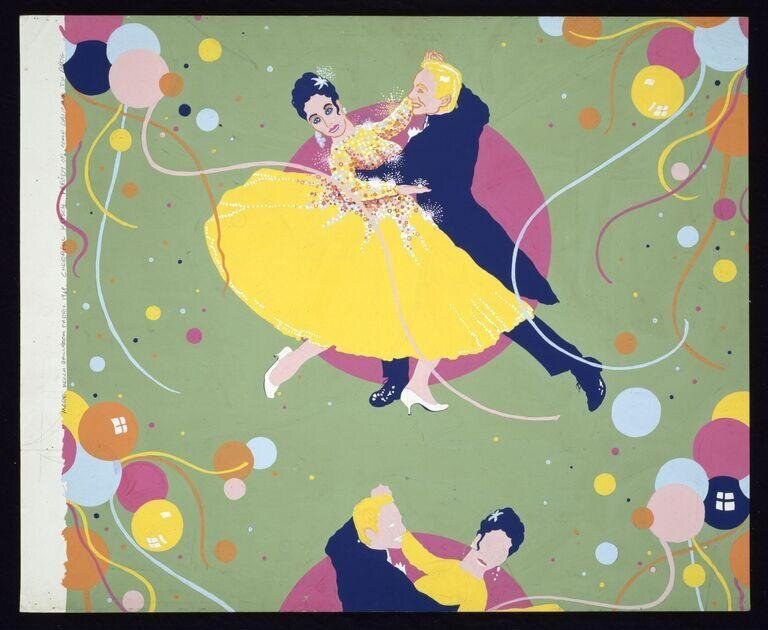
Two couples dance against a sage-green ground scattered with abstract colorful circles and flowing curved lines in yellow, white, and muted tones. The upper couple dominates the composition: a woman in a voluminous canary-yellow skirt is lifted or swung by a man in dark formal dress (black jacket, dark trousers), her body arched and tilted, her skirt billowing outward in a wide arc. The man's posture is bent and dynamic, supporting her weight. Below, a second couple repeats the composition at smaller scale, in the same pose and costume. The decorative background suggests movement and festivity—the circles and streaming lines evoke both ballroom ornamentation and the velocity of the dancers themselves. The style is graphic and flattened, with bold color contrasts; the figures are rendered in simplified forms without anatomical detail, typical of 1960s commercial textile design.
The dancing
Both couples adopt an identical pose: the woman's body is airborne, torso arched backward, one leg extended, weight supported entirely by her partner. The man is bent forward and to the side, his arms encircling the woman's body, taking her full weight in what appears to be a supported lift or dramatic swing. The frame is closed and intimate—the bodies are pressed together, her back against his chest. There is no space between them. The pose emphasizes asymmetry, momentum, and trust; the woman is completely dependent on the man's strength and control.
The dance depicted
This depicts ballroom dancing, most likely the Lindy Hop or a theatrical swing style popular in the 1930s–1950s. The lifted, airborne pose with the woman's body arched and the man in a deep supporting position is the signature final image of the swing-out or aerial—a signature moment in Lindy Hop where the follower is lifted and swung through the air. The doubled composition (two couples in the same pose) suggests this was a pattern or template for commercial use, designed to convey the drama and exhilaration of the dance. The formal attire (dark suit, long skirt) places it in the ballroom or big-band era, not street dance.
How it was made
This is a textile or wallpaper design, rendered in gouache or tempera paint or possibly silkscreen. The surface is flat, the palette is limited and bold, and the composition is repeated vertically—all consistent with commercial fabric or wallpaper production of the 1960s. The technique allows for bright, uniform color areas without shading or perspective; the flattened, graphic style was deliberate and fashionable. The design would have been produced for mass manufacture and domestic consumption, and its survival suggests it was either archived or collected rather than used.
About this work
This is a commercial fabric or wallpaper design from 1968 by Eddie Squires, part of the Mecca Ballroom collection. It celebrates the swing era and the Lindy Hop through a repeated, stylized image of a man and woman in the climactic moment of an aerial lift—the woman airborne, her body arched, her skirt flying, held aloft by her partner. The design is abstract and graphic, not realistic; the goal is to evoke the energy, glamour, and exhilaration of ballroom dancing through color and composition, not anatomical accuracy. The collection name references the Mecca Ballroom in Tottenham, London, a legendary venue for ballroom and jive dancing in the mid-20th century.
How to look at it
Attend to the repeated pose: the artist has chosen the single most dramatic moment of the swing dance—the lift, where the woman leaves the ground entirely and depends on her partner. This is not a neutral moment but the climax of the movement, the visual payoff of trust and technical skill. Notice how the two couples are identical: this is not a narrative scene but a pattern, designed to fill space and repeat across cloth or wall. The pose itself is abstracted—it reads as 'swing dancing' rather than documenting any real dancer's body, because simplification and stylization were the goal.
The artist
Eddie Squires was a British textile and graphic designer active in the 1960s, known for bold, jazz-inflected patterns and commercial designs for home furnishings. He worked in the idiom of mid-century modernist commercial design, using simplified figures, bright colors, and rhythmic repetition. His work bridged fine art and industrial production, a common practice among British textile designers of the period.
The period
By 1968, the Lindy Hop and swing dancing had become nostalgic references rather than current practice; rock and roll and contemporary popular music had displaced swing from the dance floor. However, swing remained a powerful symbol of a romantic past, associated with the Second World War, American cultural dominance, and heterosexual courtship rituals. In design, the swing couple became a motif for celebrations of energy, youth, and mid-century modernity. The Mecca Ballroom itself remained active as a venue, and the design's title suggests it was marketing nostalgia and local identity together.
Where it lives
The work is held in the Design collection and sourced from the Victoria and Albert Museum's records (source: va). It is part of a fabric or wallpaper design series called 'More Mecca Ballroom Fabric,' suggesting it was one of several related designs in a single commercial product line.
Dance in this work
Questions about this work
What is the Mecca Ballroom?
The Mecca Ballroom in Tottenham, London, was a famous venue for ballroom, jive, and swing dancing from the 1930s onward. It was a major center for social dancing in the mid-20th century and remained active into the 1990s. The venue gave its name to this fabric design series, marketing it as a product connected to a real place and a living (or recently living) social culture.
Is this the Lindy Hop?
The pose—an airborne woman with her body arched, supported by a man in a deep forward bend—is the signature aerial or 'throw' position of the Lindy Hop. However, this pose was also used in other swing styles and theatrical ballroom routines. The design abstracts the dance into a symbolic image rather than documenting a specific technique, so certainty is limited. What matters is that the designer associated this pose with excitement, modernity, and ballroom dancing.
Why are there two couples?
This is a repeating pattern designed for textile or wallpaper production. The two couples are identical in pose and size; the artist created a motif that could be repeated across the fabric or paper. This repetition is part of the commercial design strategy—the pattern fills space economically and creates a sense of ongoing rhythm and energy.
When was this made and why?
The design is dated 1968, a time when swing dancing had become a historical reference rather than current practice. The design capitalizes on mid-century nostalgia and the romance of the swing era for a consumer market interested in retro-modern home decor. It reflects a broader 1960s trend of reviving 1940s imagery and aesthetics.
More dance artwork





