49 works in this view — arrow keys or swipe to move between them.
Dance in Art
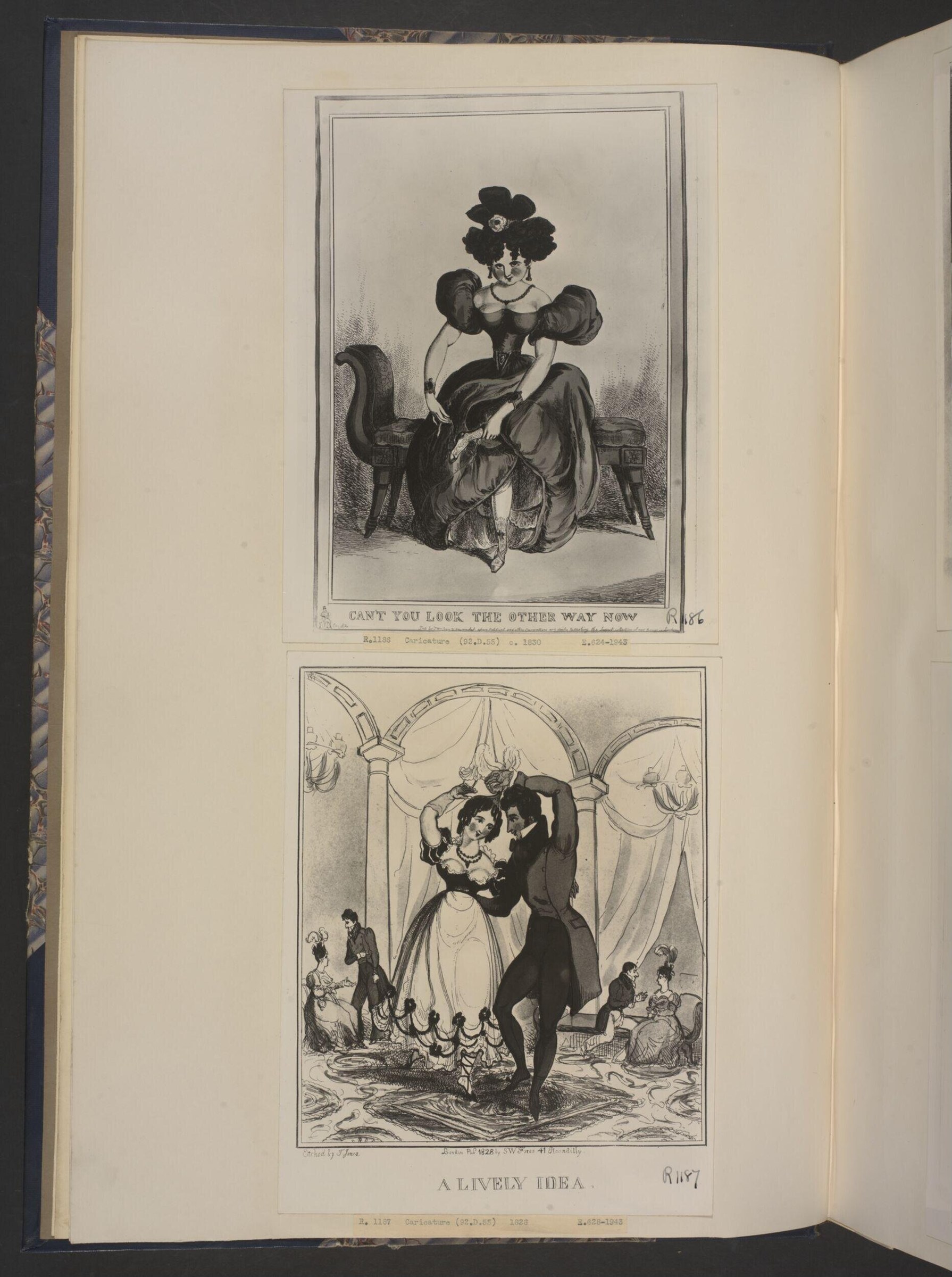
A lively idea
Thomas Howell Jones
- Collection:
- Satirical print
- Source:
- Victoria and Albert Museum
- Rights:
- Rights vary by item — check the source record before reusing this image. Source record ↗
- Recorded as:
- V&A — check rights per item
This print is evidence of the waltz's contested arrival in England and the physical tensions between Regency fashion and the dynamic movement required of ballroom dancers. It also demonstrates how satirical prints functioned as social commentary on dance, using visual caricature to argue points about female agency, propriety, and the body.
What you are looking at
This is a two-panel satirical print satirizing Regency-era ballroom fashion and behavior. The upper panel shows a seated woman in an elaborately puffed-sleeve dress and fashionable headdress, her posture formal and composed while she receives the attention of a gentleman. The setting is a drawing room with minimal furnishings—a chair visible to the left. The lower panel depicts a couple in the midst of a country dance or waltz beneath a draped canopy, surrounded by onlookers in a ballroom setting. The woman's dress billows as she moves, captured mid-spin or turn, while her male partner supports her. The contrast between the static propriety of the upper scene and the dynamic movement of the lower one emphasizes the satire: the title *A Lively Idea* promises animation, but the upper figure is immobilized by fashion while the lower couple performs the liveliness that the title announces.
The dancing
In the upper panel, the woman sits rigidly upright, her massive puffed sleeves extending far from her body, her arms positioned formally at her lap. The male figure stands or leans toward her in conversation, creating a vertical relationship of unequal power. In the lower panel, the couple is in an open or semi-closed ballroom hold typical of early 19th-century partner dance—the man's arm supports the woman's waist as she leans into the motion, her skirt swept outward by centripetal force. Her legs are in motion; his posture is anchored and controlling. The other figures surrounding them are static observers, their stillness contrasting sharply with the couple's kinetic energy.
The dance depicted
The lower panel depicts a Regency-era country dance or waltz, styles that dominated English ballrooms in the 1820s. The woman's swept skirt, the partner hold, and the fluid arm position suggest a waltz—a dance that had recently become fashionable in England and was still considered somewhat risqué for its closeness and the dominance of the male lead. The satire hinges on the irony that fashion (the absurdly oversized sleeves in the upper panel) inhibits the very physical freedom and "liveliness" that the dance demands. The title thus mocks both the impracticality of contemporary women's dress and perhaps the contrast between women's supposed decorativeness and the physical agency required to dance.
How it was made
This is a satirical engraving or lithograph, executed in the manner typical of Regency-era popular prints. The medium—likely a hand-colored or tinted engraving—allowed for wide circulation and rapid response to contemporary fashion and social trends. The technique relies on caricature: exaggerated sleeves in the upper panel and emphasized motion in the lower one. The double composition is a common format in satirical prints of the period, allowing the artist to present a visual argument through contrast. The linear framing around each scene and the inscriptions below establish the work as a public commentary intended for a broad audience familiar with ballroom culture and current fashions.
About this work
This is a two-panel Regency-era satirical print that uses ballroom dance as its subject to critique women's fashion and social behavior in the 1820s. The contrast between a fashionably dressed but immobilized woman (upper panel) and an animated dancer mid-waltz (lower panel) creates the satire: current fashion so constrains movement that women cannot achieve the "lively" physical presence the dance requires. The work is a document of both dance practice and sartorial history, capturing the waltz as a newly fashionable and transgressive form in English ballrooms, and the tension between the ideals of feminine decoration and the physical demands of participation in social dance.
How to look at it
Attend to the contrast between the two panels: the upper woman is locked in position by her garments, while the lower woman is in full motion. Notice the sleeves in the upper panel—so oversized that they would catch on a partner or sweep other dancers. In the lower panel, observe the woman's skirt as it spreads from centripetal force; this captures the moment of the turn or spin, the moment when the waltz's speed and closeness are most apparent. The onlookers surrounding the couple create a frame of social judgment, emphasizing that ballroom dance was a public performance of propriety—and this waltz is anything but proper.
The artist
Thomas Howell Jones was an English satirical artist and engraver active in the early 19th century, working in the tradition of Regency social satire. Jones contributed to the popular print culture that documented and critiqued contemporary manners, fashion, and entertainment, including ballroom dancing. His work participated in a broader conversation about the propriety and desirability of new dances like the waltz, which faced moral and practical resistance in conservative circles.
The period
The waltz arrived in England from Continental Europe in the late 1810s and became the subject of both fascination and scandal during the 1820s. Critics objected to its closeness, speed, and the dominance of the male dancer over the female; supporters embraced it as modern and thrilling. Regency fashion, particularly the Empire waist and increasingly dramatic sleeves and skirts, created genuine practical problems for dancers—the very subject of this print. Satirical prints thrived during this period as a means of mocking new fashions and social behaviors; dance was a frequent target because it made visible the contradictions between fashion's ideals and the body's needs.
Where it lives
Held as a satirical print, this work documents early 19th-century popular visual culture and ballroom society. The catalogue record identifies it as part of a collection of satirical prints, a standard format for social commentary in the Regency and later Victorian eras.
Dance in this work
Questions about this work
What is the waltz and why was it controversial?
The waltz was a fast, closed-hold partner dance originating in Continental Europe, arriving in England in the late 1810s. English society found it shocking because the partners stood close together, danced at high speed, and the man led the woman through space with apparent dominance. Satirists and moral critics objected to what they saw as physical impropriety and the loss of female agency.
What does the satirist mean by 'A Lively Idea'?
The title is ironic. The upper panel shows a woman in fashionable dress who is completely static, unable to move—no 'lively' behavior is possible. The lower panel shows the lively movement that the dance demands. The satire argues that current fashion makes liveliness impossible, or alternatively, that the idea of dancing livelily while dressed in contemporary garments is absurd.
How do we know this depicts a waltz and not another dance?
The couple's hold—close, with the man's arm at the woman's waist and their bodies nearly parallel—is characteristic of the waltz. The woman's skirt spread outward and her leaning posture suggest the speed and centrifugal motion of the waltz's rotational figures. The 1828 date and Regency setting confirm that the waltz would have been the most fashionable and controversial partner dance available to satirize.
More dance artwork





