49 works in this view — arrow keys or swipe to move between them.
Dance in Art
Theatre costume
Georgiadis, Nicholas
- Collection:
- Theatre costume
- Source:
- Victoria and Albert Museum
- Rights:
- Rights vary by item — check the source record before reusing this image. Source record ↗
- Recorded as:
- V&A — check rights per item
Georgiadis was a major figure in post-war British theatre design, and his costume work shaped how audiences understood both classical ballet and innovative new work. This object offers material evidence of how designers in the 1960s approached the relationship between graphic pattern, the moving body, and theatrical visibility—questions that remain central to performance costume today.
What you are looking at
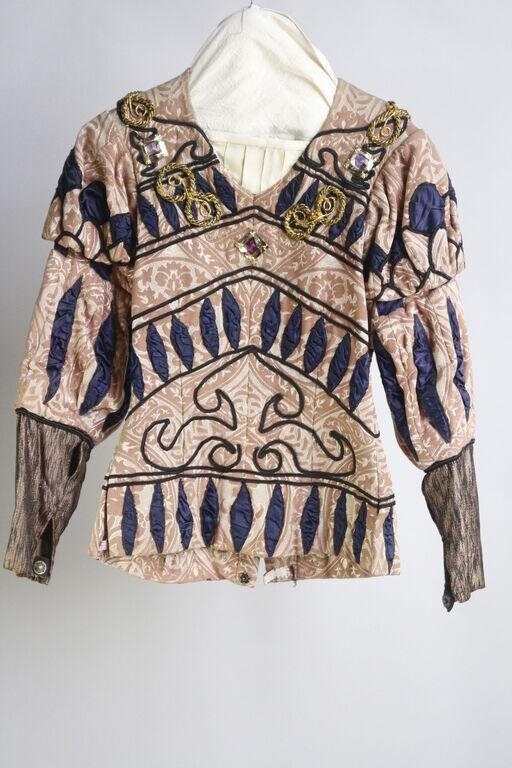
A theatre costume displayed on a dress form against a neutral background. The garment is a tunic-like top with a deep V-neckline and a dramatic draped hood that falls to a point at center back, creating a sculptural silhouette. The fabric is patterned in warm earth tones—cream, tan, and rust—with bold graphic motifs: geometric leaf or feather shapes arranged in vertical bands, and sweeping curved lines that cross the chest and torso like decorative armor. The sleeves are three-quarter length with darker ribbed or pleated cuffs. The overall color palette and geometric patterning suggest a design for classical or mythological theatre—the aesthetic reads as deliberately archaic, evoking ancient dress or historical dance costume.
The dancing
No human figure is present; this is a costume object displayed flat on a dress form. The garment itself creates strong visual drama through its construction: the deep V-opening and layered neckline suggest freedom of arm movement, and the narrowing toward the waist implies the wearer's body would be framed and accentuated. The hood and draped back would move with the wearer, creating a secondary visual element in performance.
The dance depicted
The costume's design suggests a classical or neoclassical theatrical context, though the specific dance cannot be identified from the object alone. The geometric, archaic patterning and the structural emphasis on the torso and back are consistent with 1960s classical dance theatre costume—potentially for ballet, modern dance, or experimental theatrical work. The construction prioritizes visibility of the dancer's line and movement through the torso, and the bold graphic elements would read clearly from stage distance. Without information about the original production or performer, the specific dance form remains uncertain.
How it was made
This is a sewn textile costume, likely created from cotton or linen with applied or woven graphic patterning in multiple colors. The construction includes ribbed or pleated cuffs, suggesting skilled tailoring. The pattern appears to be created through either woven jacquard technique, hand painting, or appliqué—the precise method cannot be determined from the object alone. As a theatre costume, it was made for performance wear and would have required durability for repeated use and movement.
About this work
This is a theatre costume designed by Nicholas Georgiadis in 1965, a period when the London designer was creating distinctive work for classical and contemporary dance and drama. The garment's bold graphic language and sculptural construction—particularly the dramatic hood and strategic patterning across the torso—are characteristic of Georgiadis's approach to costume design: garments that are both visually striking from stage distance and engineered to support the dancer's movement. The costume belongs to a tradition of mid-century theatrical modernism in which designers worked closely with choreographers and directors to create cohesive visual worlds.
How to look at it
Observe how the garment's silhouette frames and accentuates the torso and back. The deep V-neckline and draped hood create visual drama while leaving the shoulders and arms free for movement. The horizontal and diagonal pattern lines draw the eye across the body's surface, likely designed to make the wearer's movement and line more readable from a distance. The color choices—warm earth tones with dark accents—suggest this costume was designed to work in specific lighting, as stage lighting would have activated the pattern and depth.
The artist
Nicholas Georgiadis (1923–2001) was a Greek-born British theatre designer of major significance. He trained at the Royal College of Art and became one of the leading costume and set designers for British theatre, working extensively with the Royal Ballet, the Royal Opera House, and major directors of the era. His practice was grounded in careful study of how garments move with the body and how colour and pattern read at stage distance. He collaborated frequently with choreographers including Frederick Ashton and created designs across classical ballet, contemporary dance, opera, and straight theatre.
The period
By 1965, theatre costume design had become increasingly sophisticated in its understanding of how garments functioned in performance. The 1960s saw growing interchange between classical ballet, modern dance, and experimental theatre, with designers increasingly approaching costume as an integrated part of the visual and kinetic experience rather than as decoration applied after the fact. Georgiadis's work was part of a broader mid-century movement toward bold graphic design, simplified silhouettes, and a modernist aesthetic in theatre—influenced by contemporary art movements and a rethinking of what classical design could mean in a post-war context.
Where it lives
This costume is held in a theatre costume collection. The source is listed as a performing arts archive or institution (marked as 'va' in the catalogue record). As a theatre costume object, it represents the material culture of mid-century British performance and is preserved as evidence of a specific design and production practice.
Dance in this work
Questions about this work
What production was this costume made for?
The catalogue record does not specify the original production. Georgiadis designed for many major productions in the 1960s, including works at the Royal Ballet and Royal Opera House. Additional research in theatre archives or production records would be needed to identify the specific work.
Why is the back of the costume designed with a hood?
The dramatic hood serves multiple functions: it creates a striking visual silhouette on stage, adds movement potential (the fabric would move with the wearer), and may define a character or mythological theme. In classical theatre costume, such elements often referenced ancient dress or created a sense of otherness or formality.
How do you read the pattern on this costume?
The pattern combines bold leaf or feather shapes in vertical bands with sweeping diagonal lines that cross the torso. These elements create a sense of structure and movement on the garment's surface. From stage distance, the geometric pattern would read clearly and help emphasize the wearer's movement through the space.
More dance artwork





