49 works in this view — arrow keys or swipe to move between them.
Dance in Art
The Lady and the Fool
Beer, Richard
- Collection:
- Set design
- Source:
- Victoria and Albert Museum
- Rights:
- Rights vary by item — check the source record before reusing this image. Source record ↗
- Recorded as:
- V&A — check rights per item
Set design sketches are primary documents of how ballets were realized in performance—they show what the choreographer and audience actually saw, yet they are often overlooked in favor of costume designs or photographs of dancers. This sketch demonstrates that *The Lady and the Fool* (which had its premiere in 1953 with choreography by John Cranko) was being performed or revived in 1965 in a production that valued architectural grandeur and neoclassical formality as the dramatic context for the story. Understanding the spatial and visual environment of a dance is essential to interpreting its meaning and effect.
What you are looking at
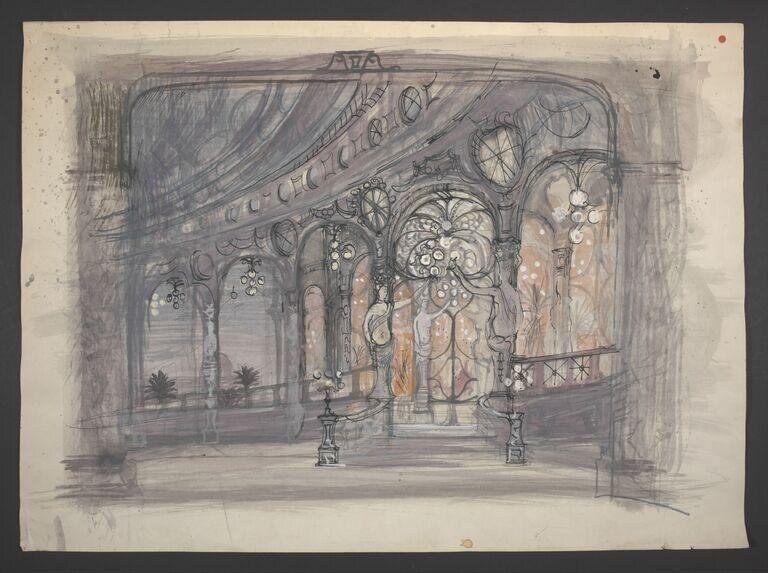
This is a set design sketch for a grand interior architectural space, rendered in pencil and wash with selective watercolor highlights. The composition depicts a theatrical proscenium framing an opulent room with soaring arched ceilings decorated with ornamental coffers and relief work. Tall arched windows or doorways line the back wall, revealing a distant landscape with palm trees, suggesting a Mediterranean or exotic setting. The foreground shows the stage floor with two tall pedestals or lamp stands flanking the central opening. The style is late nineteenth or early twentieth-century Romantic theatrical design: the space conveys aristocratic grandeur through its neoclassical proportions, rich architectural detail, and the warm peachy tones of the upper walls contrasting with cooler blue-gray shadows. The drawing technique—loose structural lines establishing perspective, then layered washes for atmosphere—is characteristic of working designs meant to communicate mood and spatial relationships to builders and lighting designers rather than to be finished artworks.
The dancing
No human figures are depicted in this image. This is a set design rather than a dance scene. The 'figures' are architectural—the pedestals, arches, and decorated surfaces that would form the environment for performers. The vertical emphasis of the space and the framing of the central opening suggest this was designed as a ballroom or palace interior where dancers would move through the composition and across the stage floor.
The dance depicted
The work does not depict dance directly, but is instead the designed environment for dance. Based on the title *The Lady and the Fool* and the aristocratic palatial setting, this was almost certainly a set for a Romantic-era ballet, likely from the mid-nineteenth century or a twentieth-century revival or new work in that idiom. The opulent neoclassical interior would be typical of a ball scene or court scene in narrative ballet, where the corps de ballet would be arranged in geometric formations and principals would perform variations and pas de deux against this architectural backdrop. The design prioritizes sight lines and spatial depth, creating a stage picture where human figures would read clearly against the scaled architectural elements.
How it was made
This is a pencil and watercolor sketch on paper—a working theatrical design rather than a finished artwork. The medium reveals its purpose: the pencil underdrawing establishes proportions and perspective accurately enough for execution, while the selective watercolor washes (blues, grays, warm ochres) communicate the intended atmospheric effect and color palette without laboring over detail. This technique was standard for theatre design of the early-to-mid twentieth century, allowing rapid communication of the designer's vision to the production team. The sketch is loose enough to remain flexible—details could be adjusted during construction—but disciplined enough to serve as a binding specification.
About this work
This is a set design by Richard Beer for a theatrical ballet production titled *The Lady and the Fool*, dated 1965. The work shows a grand neoclassical interior—a palatial ballroom or court room—rendered in the tradition of early twentieth-century Romantic theatre design. Rather than depicting dancers themselves, it documents the spatial and visual framework within which dance would occur, revealing the designer's understanding of how architectural scale, light, and symmetry would frame human movement and support the narrative mood of the ballet. The work belongs in a gallery of dance in art as evidence of the essential collaboration between choreography and design: without sets like this, the aesthetic and storytelling intentions of twentieth-century ballet cannot be fully understood.
How to look at it
Attend to the sight lines: the central archway frames the space and would naturally draw the audience's eye to dancers moving through it or positioned within it. The two pedestals flanking the opening are not mere ornament—they serve as spatial markers and could function dramatically, framing entrances or marking the boundaries of the principal action. Notice how the architectural detail is concentrated on the upper half of the composition (ceiling, frieze) while the lower stage floor is largely open: this is a deliberate choice that keeps sightlines clear for dancers and prevents visual clutter that would compete with movement. The warm upper tones contrasting with cool shadows suggest the designer was thinking carefully about how theatrical lighting would model the space. The distant landscape view—the palm-studded prospect through the windows—adds romantic atmosphere while also providing a visual rest and creating depth.
The artist
Richard Beer was a British theatre designer active in the mid-twentieth century, known for work in ballet and theatrical productions. His design practice belongs to the tradition of early modernist theatre design—influenced by the simplified, architecturally coherent approaches of designers like Gordon Craig and the Ballets Russes tradition, but working within the more conservative conventions of British regional and institutional ballet. Beer's sketches prioritize clarity of spatial composition and atmospheric effect through economical means.
The period
In 1965, British ballet was at a high point of institutional strength and international visibility. The Royal Ballet, under Frederick Ashton's direction, was performing the classics alongside new works. John Cranko's *The Lady and the Fool* (1953), with its combination of romantic narrative and comic character, represented a strand of mid-century ballet that valued storytelling and theatricality alongside pure dance. The neoclassical ballroom setting shown here was a conventional choice for scenes of courtship and social drama in Romantic and neo-Romantic ballet; it provided both a dramatically legible social context and a formally composed backdrop for symmetrical corps formations and the central action of the principals. In design terms, 1965 was the moment when post-war British theatre design was beginning to integrate Modernist spatial ideas (simplified forms, clear sightlines, light as a primary design element) with the decorative and narrative traditions inherited from the nineteenth century.
Where it lives
This work is held in the Victoria & Albert Museum's collection as a theatrical set design. It is catalogued as a design object rather than a finished artwork, reflecting its primary function as a working specification for production rather than an autonomous artistic statement.
Dance in this work
Questions about this work
Is this a real place or a fantasy setting?
It is a fictional architectural interior designed for the stage. The neoclassical style and the distant Mediterranean landscape suggest a European palace or grand house, but the space is entirely a designer's invention, composed to serve the needs of the ballet narrative and the movement of dancers. The precise geography is deliberately vague—what matters is the atmosphere of aristocratic luxury and European civility.
What would have been visible to the audience that isn't in this sketch?
This is only the set—the backdrop and scenic elements. The audience would also see the costumes (which appear to have been Romantic-era ball dress), the dancers' bodies in movement, the orchestral musicians in the pit, the lighting effects (which could transform the mood significantly), and other scenic elements like furniture or properties that might not be fully detailed here. The sketch is a framework, not the complete theatrical picture.
How do you know this was for John Cranko's *The Lady and the Fool*?
The title is inscribed at the top of the sketch. *The Lady and the Fool* premiered in 1953 with choreography by John Cranko and became part of the standard ballet repertory. This 1965 date likely represents a revival or new production of that work, using Beer's design for the ballroom or palace scene that appears in the narrative.
Why is most of the detail in the ceiling rather than the walls?
Practically, because actors and dancers move across the lower stage and would obscure wall detail; ceiling and upper architecture remain always visible. Theatrically, the upward visual emphasis creates a sense of grandeur and elevation—looking up registers as awe and formality. It also mirrors the real architecture of theaters themselves, drawing a parallel between the theatre building and the fictional palace it represents.
More dance artwork





