49 works in this view — arrow keys or swipe to move between them.
Dance in Art
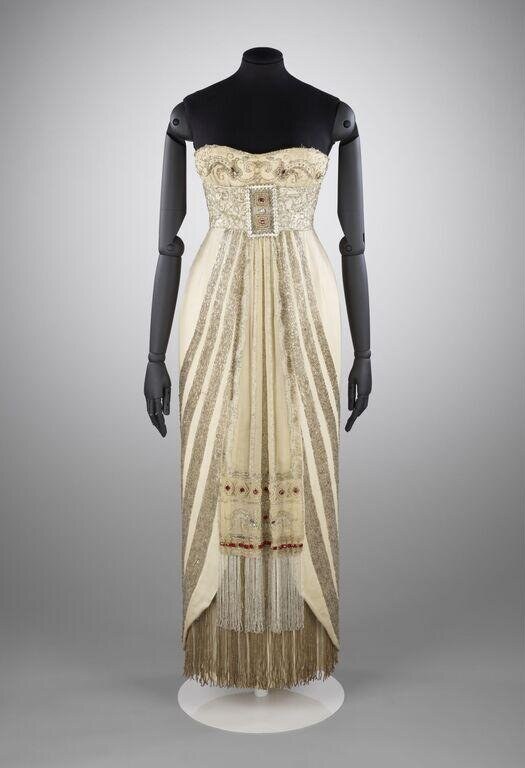
Costume for Eliza Doolittle in <i>My Fair Lady</i>
Beaton, Cecil (Sir)
- Collection:
- Costume
- Source:
- Victoria and Albert Museum
- Rights:
- Rights vary by item — check the source record before reusing this image. Source record ↗
- Recorded as:
- V&A — check rights per item
This is one of the most iconic costumes in Broadway history, worn at the pivotal moment when Eliza proves her transformation is complete. Beaton's design demonstrates how theatrical costume must function simultaneously as character, spectacle, and wearable movement—a lesson still central to dance and theatre design.
What you are looking at
A haute couture evening gown is displayed on a dress form against a neutral backdrop. The costume features a strapless, sweetheart neckline bodice densely embellished with crystal beading and embroidery in a geometric art-deco pattern, cinched at the waist with a jeweled belt. The skirt is constructed from ivory silk pleated in deep, regular vertical folds that fall in a long, columnar line to the floor. Below the knee, the pleating gives way to an elaborately fringed hem in pale gold or silver beads and fringe that creates a tiered, swaying silhouette. The overall effect is one of 1950s luxury: the structured bodice and high-waisted cut are typical of formal evening wear of the era, while the heavily draped and fringed lower skirt would have created dramatic movement in performance. The costume reads as a transformation or celebration dress—the kind worn in a pivotal theatrical moment.
The dancing
The dress is displayed flat on a form; no dancer is visible. However, the costume's construction reveals much about how it would move and be worn. The fitted bodice sits high on the torso, suggesting an upright, elegant carriage. The deep, regular pleats in the skirt would swing and flow with each step, and the heavy fringe at the hem would shimmy and sway independently of the body, amplifying and extending the dancer's movement. The vertical emphasis of the pleating creates a sense of length and fluidity.
The dance depicted
This is the costume for Eliza Doolittle in the musical theatre production *My Fair Lady*, designed by Cecil Beaton. The dress appears to be from the famous embassy ball scene (Act II, scene iv), where Eliza makes her transformed debut in high society. In performance, this costume would have been danced and moved through—musicals of this era, especially Lerner and Loewe's, featured significant choreography integrated into dramatic moments. The heavy beading and fringe allowed for visual spectacle during any movement or stage business, catching light and amplifying gesture.
How it was made
This is a museum costume: an actual garment worn in performance or created for production design. The construction is haute couture hand-tailored work—the beading and embroidery are applied by hand, and the pleating is sewn with precision. The costume survives in the Victoria and Albert Museum collection, one of the world's premier holdings of theatrical dress. Such pieces are typically preserved flat or on forms to prevent stress to seams and beadwork.
About this work
*My Fair Lady* (1956 musical, 1964 film) was a cultural phenomenon, and Beaton's costume design was central to its aesthetic and commercial success. Eliza's transformation from flower girl to society lady is the emotional and visual heart of the show, and this dress—glamorous, expensive-looking, and thoroughly constructed for theatrical impact—embodies that transformation. Beaton was a master of costume design for theatre and film who understood how garments move and photograph; every detail here serves both the dramatic moment and the spectacle of musical theatre.
This costume matters as a record of mid-century musical theatre practice and of the role of design in creating character and telling story. It represents a moment when Broadway design was at its height of influence, setting standards for glamour that shaped fashion beyond the theatre.
How to look at it
Notice the contrast between the fitted, heavily decorated bodice and the fluid, pleated skirt. This is a costume designed to show both stillness and movement: the upper body is controlled and elegant, anchored by the jeweled belt; the lower body is liberated and will move with every gesture. The deep, regular pleats are not accidental decoration—they are engineered to swing and sway, making even a standing figure dynamic on stage. The fringe at the hem would catch light and move independently, creating a sense of transformation and freedom. This is sophisticated costume engineering, not mere decoration.
The artist
Cecil Beaton (1904–1980) was a British photographer, designer, and decorator of extraordinary range and influence. He designed costumes and sets for theatre and ballet throughout the mid-twentieth century, including work for the Royal Ballet and numerous Broadway productions. He was known for his meticulous attention to detail, his understanding of how costume photographs and moves under stage light, and his ability to synthesize fashion, historical reference, and theatrical storytelling. His work on *My Fair Lady* won him the Academy Award for Best Costume Design in 1965.
The period
The mid-1950s were a golden age for musical theatre on Broadway, and *My Fair Lady* (1956) was the apex of that tradition. The show's design, choreography (by Hanya Holm), and music-theatre integration set the standard for the genre. Post-war glamour and luxury were central to the cultural mood; expensive-looking costumes signaled both the show's ambition and the audience's appetite for spectacle. In fashion, the mid-1950s favoured the structured, waist-emphasizing silhouettes visible here—the influence of Christian Dior's 'New Look' from 1947 persisted. In theatre, Beaton's approach to costume as integral to character and narrative was exemplary of how the best Broadway designers worked.
Where it lives
The costume is held in the Theatre Collection of the Victoria and Albert Museum, London, one of the world's largest and most significant repositories of stage design and costume. It is catalogued as a costume object and is preserved as a record of theatrical practice and design history.
Dance in this work
Questions about this work
Was this costume worn in the original 1956 Broadway production?
The record does not specify whether this is an original Broadway costume, a costume from the 1964 film adaptation (for which Beaton won the Academy Award), or a recreation. The V&A holds both theatrical and film costumes. The condition and construction suggest it was either worn in performance or created as a closely matched recreation for archival purposes.
Why is this dress so heavily beaded?
The beading serves multiple purposes: it catches stage light and creates visual glamour befitting the embassy ball scene; it weights the skirt, allowing the pleats to hang and move with authority; and it signals wealth and transformation—Eliza's ascent into high society. In musical theatre, costume is visual storytelling, and this dress tells the story of luxury and change through its materials.
How much does a costume like this weigh?
Hand-beaded costumes of this era were substantial—easily 10–15 pounds or more, depending on the extent of beading and the fabric weight. The performer had to be trained to move fluidly despite the costume's weight, and theatrical movement had to be precisely choreographed to ensure the dress moved as designed.
More dance artwork





