49 works in this view — arrow keys or swipe to move between them.
Dance in Art
Costume design
Howard, Andree
- Collection:
- Costume design
- Source:
- Victoria and Albert Museum
- Rights:
- Rights vary by item — check the source record before reusing this image. Source record ↗
- Recorded as:
- V&A — check rights per item
For a dancer or choreographer, this drawing is evidence of how the classical ballet silhouette was realized in practice at a specific moment—the proportions of the tutu, the treatment of the sleeves, the way the waist was marked. For a historian, it is a primary document of English ballet production, showing the working methods of a designer who collaborated with the major companies and choreographers of her time and shaped the visual language of British dance.
What you are looking at
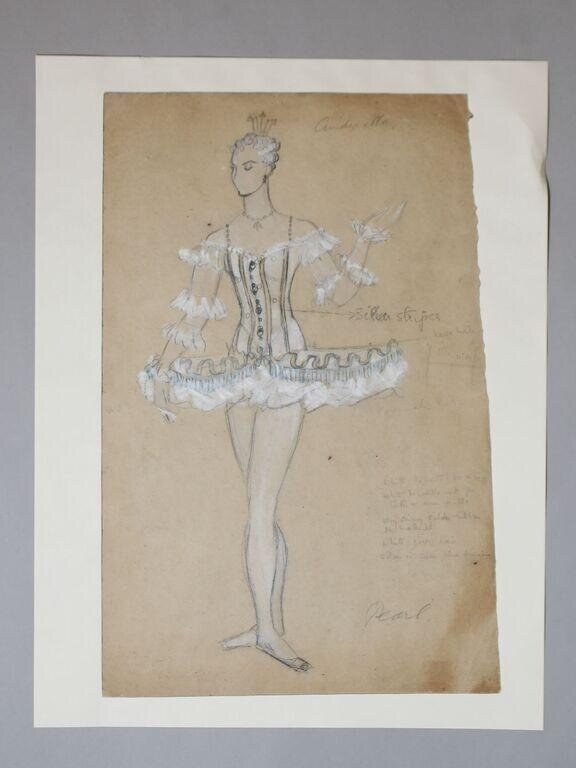
A single female figure stands against a pale ground, drawn in a refined linear style with selective watercolor wash. She wears an elaborate theatrical costume: a fitted corset bodice with decorative vertical elements, topped by an off-shoulder neckline draped with voluminous white fabric arranged in a series of puffed sleeve-like formations that extend down the arms. The skirt is a short, structured tutu of classical proportions, with a deep ruffle at the hem finished with a scalloped or serrated edge. Her hair is styled up and back, crowned with what appears to be a small tiara or ornamental headdress. The figure's pose is upright and frontal, with legs extended in a neutral stance; her body alignment and the way the costume sits suggest an expectation of motion rather than a captured moment. The drawing itself is economical—spare pencil lines define form, while strategic white gouache creates texture and volume in the costume's decorative elements, particularly in the gathered sleeves and skirt ruffle. The overall effect is that of a costume blueprint or design proposal for a named dancer or role.
The dancing
The dancer is shown in a frontal, stationary pose with no weight shift or tilt visible. Her frame is upright and formal, arms hanging naturally at her sides with hands just visible. The posture conveys the formal bearing expected of a classical ballet dancer, yet the design brief allows no reading of active footwork or movement quality. The figure occupies most of the compositional space, rendered at near life scale, suggesting this is a direct study for a specific performer.
The dance depicted
This is a costume design for classical ballet, almost certainly for a romantic or neoclassical-era role. The short tutu, off-shoulder neckline, and light, airy construction are characteristic of mid-to-late 19th-century ballet aesthetics—the period of *La Sylphide*, *Giselle*, and Petipa's Imperial Russian ballets. The scalloped skirt edge and puffed sleeve arrangement suggest a fairy, spirit, or sylph role rather than a human character, placing this within the romantic ballet tradition. The design itself has the directness of a working costume sketch prepared for a dressmaker or wardrobe department.
How it was made
This is a costume design drawing, executed in pencil with selective application of watercolor or gouache, primarily white and gray. The technique is economical—outlines and structural lines are set down in pencil, while the white pigment is used sparingly to indicate the gathered, dimensional qualities of the fabrics, particularly in the neckline and skirt. This method of drawing was standard in theatrical design practice of the period: it allowed rapid revision and clear communication of both overall silhouette and surface texture to makers and performers. The paper has aged to a tan-beige, typical of early 20th-century documents of this type.
About this work
This is a costume design drawing by the mid-20th-century British ballet designer Andree Howard, dated 1935. It shows a single figure in a classical ballet tutu, rendered in a precise, linear style with selective use of white pigment to define the volume and texture of the dress. The design belongs to the tradition of theatrical design documentation—it is neither a finished artwork nor a technical pattern, but a proposal and record of an intended costume, prepared for performance and manufacture.
Howard was an important figure in British ballet during the decades when ballet itself was establishing a national identity in the UK. Her designs appear across the archive of the major companies and independent choreographers of her era. This particular sketch is exemplary of her working method: economical in line, clear in silhouette, attentive to the specific demands of the moving body and the visibility required on stage. It documents not only a costume but an assumption about what dancers needed and what audiences should see.
How to look at it
Look first at the silhouette—the proportions of the tutu, the placement of the waistline, the treatment of the neckline. These are working specifications, as important as the figure inside them. Notice how the pencil line is used to define structure, while the white pigment is reserved for the sculptural, gathered elements of the fabric—a design technique that distinguishes between the body (which stays still) and the costume (which moves and reflects light). The figure's stillness is intentional: it is a template, not a performance, and the costume is drawn to be understood as something that will be worn and moved in, not as a static object.
The artist
Andree Howard (1910–1968) was a dancer, choreographer, and designer who became one of the most significant figures in British ballet. She danced with the Vic-Wells Ballet (later the Royal Ballet) and also founded her own company. As a designer, she worked across multiple companies and was known for her sensitivity to both the visual and functional requirements of dance costumes. She designed for Frederick Ashton, for her own choreography, and for many of the major productions of the 1930s and 1940s. Her approach combined theatrical sophistication with a practical understanding of the dancer's body.
The period
In 1935, British ballet was in a formative period. The Vic-Wells Ballet had been founded only in 1931; it would eventually become the Royal Ballet. Classical ballet design in this period drew on the Russian Imperial tradition—the silhouettes and techniques of late 19th-century Petipa—but British designers and choreographers were developing a distinctly English interpretation. The classical tutu and the lighter, airier style visible in this sketch reflect the international dominance of the romantic and neoclassical aesthetic, which by the 1930s had been established for nearly a century. Howard's design is conservative in form but refined in execution, showing no modernist intervention—it is an essentially classical object.
Where it lives
The drawing is held in a costume design collection (likely a museum or archive of dance and theatrical history). The catalogue record identifies the holding as 'Costume design' and the source as 'va' (likely meaning a UK institution, possibly the V&A Museum or a similar archive). No accession number or detailed provenance is recorded in the available catalogue entry.
Dance in this work
Questions about this work
Is this a finished artwork or a working document?
It is a working document—a costume design proposal prepared for a dressmaker, wardrobe department, or dancer. It communicates the intended silhouette, key structural features, and material qualities of the costume, and it likely accompanied written notes or further discussion about construction and fittings. It is not signed or dated on the visible surface, and it has no frame or exhibition history visible in the record.
What ballet or role was this costume for?
The catalogue record does not specify which ballet or which dancer. The design itself points to a fairy, spirit, or sylph role in a romantic or classical ballet—the short tutu and ethereal treatment of the neckline are hallmarks of those character types. Without additional archival information or inscription on the drawing itself, we cannot narrow it further.
Why is so much of the costume rendered in white pigment?
The white is used to indicate texture and dimension—gathered fabric, puffing, and three-dimensionality—rather than to depict color. A printed or applied white would stand out on stage; the designer has used white pigment on paper to show the maker what effects of volume and light the costume should achieve. This is a common technique in 19th and 20th-century costume design drawing.
How do I know this is by Andree Howard?
The catalogue record attributes it to her. No signature is visible in the image. The style of drawing and the costume aesthetic are consistent with Howard's known work in this period, but definitive identification would depend on archival records, inscriptions on the reverse, or other institutional documentation.
More dance artwork





