49 works in this view — arrow keys or swipe to move between them.
Dance in Art
Costume design
Howard, Andrée
- Collection:
- Costume design
- Source:
- Victoria and Albert Museum
- Rights:
- Rights vary by item — check the source record before reusing this image. Source record ↗
- Recorded as:
- V&A — check rights per item
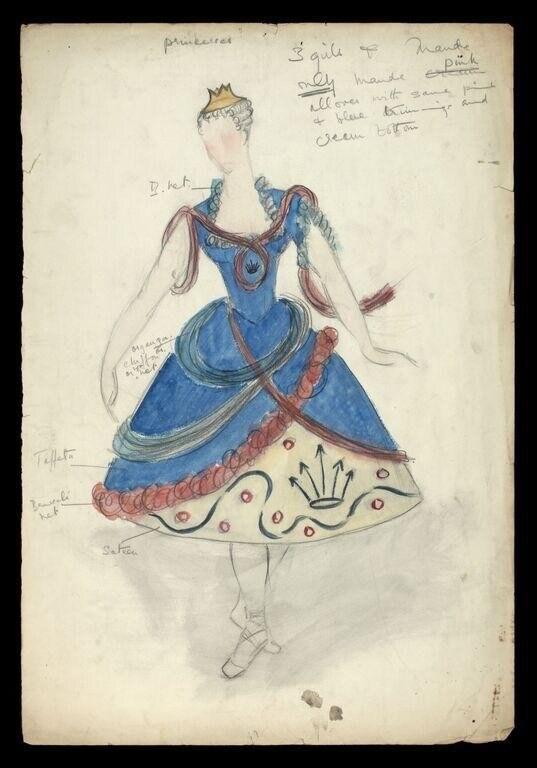
This drawing records how a major twentieth-century choreographer and designer conceived of female classical ballet roles: the materials, proportions, ornamentation, and silhouette she considered essential. It is evidence of the labor and specification required to mount a classical ballet production before standardized dancewear, and it shows Howard's hand in shaping every element of a dancer's visual presence on stage.
What you are looking at
This is a costume design drawing for a solo female dancer, rendered in watercolor and ink on paper. The figure stands in a three-quarter frontal pose, her body upright and poised. She wears a striking blue bodice with decorative red and gold embroidery across the chest and shoulders, from which extend short puffed sleeves. The most distinctive element is the voluminous skirt: a deep blue silk with an ornate scalloped hemline trimmed in red, decorated with a repeating pattern of crowns and jewels in gold and red outline. A red fabric drape or scarf extends from one side of the waist. The dancer wears pale tights and heeled shoes appropriate to ballet. Her hair is styled up with a small crown or tiara. The drawing includes scattered pencil annotations in the margin—fragmentary notes on color, construction, and detail—typical of a working design sheet. The overall impression is of a classical or romantic-era theatrical costume, ornate and regal in bearing.
The dancing
The dancer is depicted in a neutral standing position, weight evenly distributed, arms hanging naturally at her sides with slight extension. There is no indication of a specific step or active movement; this is a costume display rather than a captured dance action. The body is elongated and graceful, characteristic of ballet training. The proportions and stance suggest a prima ballerina or principal female role. The emphasis throughout is on the costume itself—its construction, ornamentation, and silhouette—rather than on demonstrating technique or virtuosity.
The dance depicted
This is a costume design for classical ballet, most likely from the romantic period (roughly 1830s–1850s) or a work in that idiom created later. The regal crown, jeweled ornaments, and elaborate drapery suggest a fairy-tale or courtly role—a princess, queen, or magical being. The formal three-quarter pose and the absence of active choreography are consistent with design practice: this is a template for a costume maker or wardrobe department, not a record of performance. The annotations indicate the designer was tracking specific color and material choices for the seamstress or embroiderer.
How it was made
The work is drawn in pencil, watercolor, and ink on paper, a standard medium for theatrical costume design of the period. The colored washes establish the dominant hues (blue, red, gold) while the ink lines define structural details and embroidery patterns with precision. This technique allowed for rapid iteration and clear communication of color and trim to workshop craftspeople, and the drawing could be kept as a record in a company's archive. The paper shows age and handling, consistent with a working document consulted during costume construction.
About this work
This is a costume design drawing by Andrée Howard, created in 1935 for a classical ballet role. It records a complete vision of a formal female character costume—bodice, skirt, accessories, and footwear—at the moment when Howard was establishing herself as both choreographer and designer in the British ballet world. The work is a practical tool, not a finished artwork for exhibition, yet it preserves detailed information about theatrical dress, construction method, and the aesthetic priorities of early-to-mid twentieth-century classical ballet production. As a design document, it sits at the intersection of dance history, fashion history, and theatrical practice.
How to look at it
Attend first to the silhouette and how it frames the body: the fitted bodice emphasizes the torso and shoulders, while the full skirt creates a broad, stable base. Notice the jeweled scalloped hem—an ornamental feature that serves no movement function but creates visual richness and implies wealth and pageantry. The crown and the geometric decoration on the skirt suggest a character of rank or otherworldly status. Look at the marginal notes: they reveal the designer thinking through practical questions—what shade of red, how to attach the drape, where the embroidery falls. This is the image of a working artist solving problems, not a finished fantasy.
The artist
Andrée Howard (1910–1968) was a British choreographer, dancer, and costume and set designer who helped shape the aesthetic of British ballet from the 1930s onward. She was trained in classical ballet and eurythmics and worked across multiple companies, including the Vic-Wells Ballet (later The Royal Ballet). Howard was known for creating works that blended classical and contemporary idioms, and she took close control of visual design—costume, set, and lighting—as integral to her choreographic vision. She frequently designed or co-designed costumes for her own works, treating dress as a choreographic element. This drawing exemplifies her hands-on approach to production.
The period
In 1935, British ballet was undergoing rapid professionalization and institutional formation. The Vic-Wells Ballet, founded in 1931, was establishing itself as a company of international standard, and choreographers like Howard were central to defining a distinctly British ballet aesthetic—neither purely Russian Imperial nor French. The 1930s saw renewed interest in classical and romantic ballet repertoire, and designers were tasked with recreating or reimagining costumes for historical works alongside creating new designs for contemporary pieces. Howard's generation of choreographers took design seriously as part of artistic authorship, and it was common for them to sketch or specify costume details directly.
Where it lives
The drawing is held in the V&A collection (identified by the source code 'va' in the record). It is catalogued as a costume design but lacks a specific title, production, or date confirmation beyond 1935. It may be one of Howard's sketches for a work in her own choreography, or it may record a design for a role in an existing ballet she was mounting or revising.
Dance in this work
Questions about this work
What role was this costume for?
The drawing does not specify. The regal crown, jeweled trim, and formal bearing suggest a princess, queen, or magical female character in a classical or romantic-era ballet—possibly from a new work by Howard, or possibly a design for a revival or new production of an existing classic.
How would a dancer have worn this?
The bodice would be boned and fitted tightly to the torso, attached to a full skirt at the waist. The puffed sleeves sit off the shoulder. The red drape or scarf would be pinned or attached at the waist and allowed to flow. Underneath would be ballet tights and heeled pointe shoes or soft ballet shoes, depending on the choreography.
Why are there pencil notes on the drawing?
These are design annotations—reminders to the designer and instructions to the costume maker about color, trim, construction, and materials. They indicate this is a working document, consulted during the building of the costume, not a finished presentation drawing.
Who was Andrée Howard?
A pioneering British choreographer and designer (1910–1968) who was instrumental in establishing the classical and contemporary ballet repertoire in Britain. She choreographed original works, revived historical ballets, and designed sets and costumes for her own productions and for other choreographers' works.
More dance artwork





