49 works in this view — arrow keys or swipe to move between them.
Dance in Art
Poster
Dewynters Ltd
- Collection:
- Poster
- Source:
- Victoria and Albert Museum
- Rights:
- Rights vary by item — check the source record before reusing this image. Source record ↗
- Recorded as:
- V&A — check rights per item
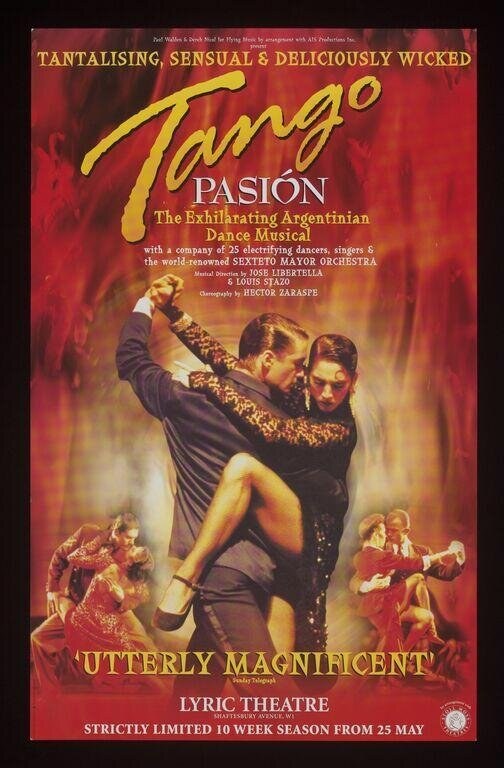
This poster is a primary document of how Argentine tango was packaged and sold to British theatre audiences in the 1990s, at the peak of the international tango boom. It shows us what theatrical tango looked like at that moment—the aesthetic choices, the costume, the body language—and how that spectacle was advertised. For dancers and historians, it is evidence of tango's cultural translation: how a social dance form from Buenos Aires became a theatrical export and part of the entertainment industry.
What you are looking at
This is a theatre poster for *Tango Pasión*, an exuberant promotional image dominated by a pair of dancers locked in a dramatic tango embrace against a deep red background suffused with golden light. The male dancer, in dark formal dress with a burgundy or maroon jacket, holds his female partner aloft with one arm while she arches backwards, her leg kicked high and her body extended in a classic tango line. She wears a shimmering gold lamé gown that catches the light, and her pose emphasises the characteristic dip and extension of theatrical tango. The composition creates a sense of theatrical spectacle and sensual intensity. Surrounding the central couple are smaller images of ensemble dancers, also in formal evening dress and Spanish-influenced costumes, suggesting group numbers and production scale. The typography announces this as *Tango Pasión: The Exhilarating Argentinian Dance Musical*, performed at the Lyric Theatre, with music by the Sexteto Mayor Orchestra and choreography by Héctor Zaraspe. The poster's language—"tantalising, sensual & deliciously wicked"—and visual treatment emphasise the allure of the dance and the glamour of the production.
The dancing
The central couple demonstrates the hallmark tango frame: the male dancer maintains a closed, commanding frame with his partner held at a slight distance and angle, characteristic of stage tango rather than social dance. The female dancer is in a pronounced back-bend or caída, her body forming an arc with her right leg extended high and behind her, a move that shows flexible partnering and the dramatic presentation of the female form typical of theatrical tango. Her upper body is supported by the male dancer's embrace. The ensemble figures visible around the edges are in similar formal positioning, suggesting the production number style of Argentine tango shows. The poses convey ballroom training and theatrical presentation rather than the grounded, close connection of social milonga dancing.
The dance depicted
This is theatrical Argentine tango, specifically the commercial stage form that emerged in Buenos Aires in the mid-20th century and became an international performance genre from the 1980s onwards. The poster advertises a full-scale musical production, not a dance recital, which marks this as fusion-commercial theatre rather than pure dance. The styling, ensemble numbers, and musical direction by a named orchestra (Sexteto Mayor, a famous tango ensemble) indicate that this production treats tango as part of a broader entertainment spectacle. The 1999 date and the Lyric Theatre venue (London's West End) situate this within the post-*Strictly Ballroom* (1992) and post-*Tango Argentino* Broadway boom that brought Argentine stage tango to European and North American audiences. The choreography credit to Héctor Zaraspe, a leading figure in theatrical tango, confirms the production's roots in the formal Argentine tango show tradition.
How it was made
This is a lithographic theatre poster, a commercial print medium designed for public display and mass circulation. The technique allows for vibrant colour saturation—particularly the deep reds and golds visible here—and the layering of multiple images (the central couple with surrounding ensemble) to create visual hierarchy and movement across the surface. The typography is integrated into the design rather than merely overlaid, suggesting professional theatrical poster design of the 1990s. The poster's scale and placement at the Lyric Theatre would have made it a street-level advertisement and a collectible for dance and theatre enthusiasts, ensuring wide visibility for the production.
About this work
This 1999 theatre poster documents a moment when Argentine tango had become a global stage spectacle, performed in London's West End as a full production rather than confined to specialist venues or social dance halls. The image captures the theatrical aesthetic of late-20th-century tango show dancing: formal, sensual, and designed for visual drama. Posters like this one circulated in the public sphere and shaped how non-specialist audiences understood and imagined tango—as glamorous, passionate, and fundamentally a performance art. The work is significant because it documents tango's transformation from a social dance into a branded theatrical commodity, and because it embodies the marketing and visual language used to sell that transformation to Western audiences.
How to look at it
Look at the body language of the central couple: the female dancer is not balanced on her own feet but entirely dependent on her partner's frame, a theatrical choice that emphasises partnering and removes her agency, a convention of 1990s-era stage tango. The extended leg and arched back are designed to create visual spectacle and to display the female body in a traditional heterosexual performance frame. Note too the formal dress and the golden lighting: these signal high-production-value entertainment rather than grassroots social dance. The presence of the orchestra name (Sexteto Mayor) and choreographer (Héctor Zaraspe) suggests this is a curated, authored show, not a jam session. Compare the theatrical poses here with social tango photographs from actual milongas to see how stage tango deliberately exaggerates line, extension, and dip for visual effect.
The artist
Dewynters Ltd is a London-based theatrical and entertainment poster printer and distributor. The company specialises in creating and distributing lithographic posters for West End and touring productions, and has been active since the early 20th century. As a commercial printing house rather than an individual artist, Dewynters' role is to realise the promotional vision of the production company and marketing team. The poster's composition and visual language reflect the conventions of 1990s Broadway and West End promotional design—high-contrast, sensual imagery combined with clear typography and production credits.
The period
This poster dates to 1999, near the end of a tango boom that had begun in the early 1990s. The success of *Strictly Ballroom* (1992), *Tango Argentino* on Broadway (1991–1992), and subsequent stage productions made Argentine tango fashionable among Western theatre and dance audiences. At the same time, ballroom dancing (including competitive tango) was gaining mainstream visibility in the UK, setting the stage for phenomena like *Strictly Come Dancing* (2004). The late 1990s saw multiple tango productions touring major Western cities; *Tango Pasión* was one of several such shows competing for audiences. This moment also coincides with the rise of tango as a partner-dance fitness trend and the globalisation of Buenos Aires's cultural export strategy. In visual culture, the sensual aesthetic of stage tango was heavily marketed to adult audiences; the poster's tagline—"tantalising, sensual & deliciously wicked"—reflects the genre's positioning as sophisticated adult entertainment.
Where it lives
This is a theatre poster held in the Victoria and Albert Museum's theatre collections. Theatre posters are ephemeral printed materials, designed for short-term street display and meant to be discarded or pasted over; their survival in museum collections is somewhat accidental, and most are preserved because they document notable West End or touring productions. This particular poster documents a limited ten-week season at the Lyric Theatre.
Dance in this work
Questions about this work
Is this the same as social Argentine tango that people dance in milongas?
Not quite. This poster shows theatrical or stage tango, which is a performance art form derived from social tango but designed for an audience. The exaggerated poses, high kicks, and dramatic dips are choreographed for visual effect and do not occur in social dancing. Social tango is danced in close embrace at a milonga (dance hall), while theatrical tango is a theatre production with sets, costumes, orchestral music, and ensemble numbers. Both descend from the same Buenos Aires tradition, but they have become quite different practices.
Who was Héctor Zaraspe?
Héctor Zaraspe was an influential Argentine choreographer and director who helped shape the theatrical tango show tradition. He worked extensively in Argentina and toured internationally, creating full-scale tango productions for Western audiences. Zaraspe's work was important in codifying the style and aesthetic of stage tango during the global tango boom of the 1980s and 1990s.
When and why did tango become a stage show?
Tango began as a social dance in late-19th-century Buenos Aires. By the 1950s–60s, it had begun to appear in theatrical and cabaret settings, and dancers began to develop a more theatrical, exaggerated movement vocabulary. The real boom in international tango theatre came in the 1980s–90s, driven by productions like *Tango Argentino* and *Strictly Ballroom*, which brought stage tango to Broadway and international audiences. This poster from 1999 is evidence of that boom at its height.
Why is this poster in a dance collection?
Theatrical posters are primary sources for the history of dance performance and for understanding how dance was marketed to the public. This poster documents what theatrical tango looked like in 1999, what production company thought would appeal to London audiences, and how the dance was branded and sold. It is part of the material culture of dance rather than a dance artwork in itself, but it is still important evidence.
More dance artwork





