49 works in this view — arrow keys or swipe to move between them.
Dance in Art
Fashion illustration
LSCG
- Collection:
- Fashion illustration
- Source:
- Victoria and Albert Museum
- Rights:
- Rights vary by item — check the source record before reusing this image. Source record ↗
- Recorded as:
- V&A — check rights per item
Fashion illustrations that include dancing figures are primary sources for understanding both the technique and the cultural meaning of ballroom dance in the 1920s. This work shows how ballroom was represented to the public as elegant, controlled, and aspirational—visual evidence of what dancers aimed to embody and what fashion designers meant their clothes to support.
What you are looking at
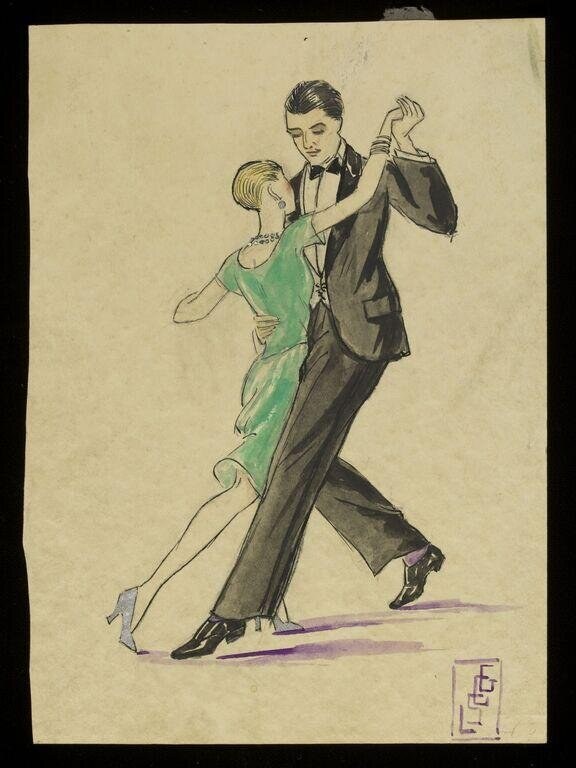
A man and woman in formal evening dress are captured mid-dance against a plain cream background. The man wears a dark tailcoat and bow tie, his posture upright and controlled. The woman wears a sleeveless green dress in a fashionable 1920s silhouette, her blonde hair styled in a short bob. They are shown in a dynamic moment of rotation: the man's frame is nearly vertical, his right arm raised and bent, while the woman leans back into the turn, her body at an angle that echoes his lift. The composition is spare and elegant, with a soft purple shadow beneath their feet the only indication of ground. The drawing technique uses pen line work for the figures with selective watercolor wash—green for the dress, charcoal shading for the man's jacket—creating a sketch-like quality that emphasizes the movement and gesture over decorative detail.
The dancing
The pair are in a closed position with the man leading a dramatic rotation or spin. His right arm is raised to approximately shoulder height, supporting the woman's turn; his left arm position is less clear but appears to support her frame. The woman's weight is transferred into the turn, her body extended and tilted away from the man's center as if caught in momentum. Both figures show the elongated, elegant proportions typical of 1920s fashion illustration. The man's posture is erect and controlled; the woman appears momentarily weightless, suspended in the turn.
The dance depicted
This depicts partner ballroom dancing in the American or International style, most likely the Foxtrot or a similar smooth ballroom dance popular in the early 1920s. The silhouette, the formal evening dress, the closed partner hold, and the smooth rotational movement all point to the ballroom repertoire of the Jazz Age. The image emphasizes the ballroom tradition of the 1920s in which the man leads and the woman follows in a fluid, traveling movement. The artist has chosen to freeze a moment of turn or spin that showcases both the elegance of the hold and the momentum of the movement.
How it was made
This is a sketch in pen and watercolor wash on paper, a common format for fashion illustration in the 1920s. The artist used pen line to establish the figures' outlines and details—face, hands, the tailcoat's cut—then selectively applied watercolor: green for the woman's dress, gray and black wash for the man's jacket. This hybrid technique was economical and quick, suited to commercial circulation in fashion magazines and newspapers. The spare background and emphasis on dress and posture over setting places it squarely in the fashion illustration tradition rather than fine art.
About this work
This is a fashion illustration from the 1920s depicting a couple in ballroom dance pose during the social dancing boom of the Jazz Age. The work documents both fashion—the woman's modern drop-waisted chemise dress, the man's formal tailcoat and bow tie—and the ballroom dancing culture that defined elite social life in the period. Fashion illustration of the era often included dancing figures to showcase how garments moved and hung on the body, making the dance content inseparable from the commercial purpose. This work exemplifies the intersection of fashion and social dance in early twentieth-century visual culture, a moment when ballroom dancing and modern dress were equally markers of contemporary style.
How to look at it
Notice the moment the artist chose: not the beginning or end of the turn, but the apex, when the woman is most extended and the man's control is most visible. The frame is entirely about the turn itself—the vertical axis of the man's body and the woman's angle away from it. The green wash on the dress is not decorative but functional: it shows how the fabric falls and moves during a rotational step, proving the dress's elegance in motion. The slight purple shadow grounds the figures without anchoring them, maintaining the sense of dynamic movement.
The artist
The signature or initials visible in the lower right corner suggest the artist is 'LSCG,' but without further records, the artist's identity and practice remain unclear. The drawing style—economical, focused on silhouette and fashion detail rather than anatomical study—is consistent with commercial fashion illustration of the 1920s, a field that included many uncredited or pseudonymous artists working for magazines and newspapers.
The period
The 1920s saw an unprecedented boom in ballroom dancing among the middle and upper classes, driven by jazz music, new dance halls, and a culture of public social dancing. Simultaneously, women's fashion underwent radical change: the corset was abandoned, hemlines rose, waistlines dropped, and the silhouette became straighter and more androgynous. Fashion illustrators documented this moment by showing dresses in motion, often in dance poses, to prove that modern dress was not only fashionable but functional and graceful. Ballroom dancing—particularly the Foxtrot—was promoted as respectable, refined, and modern, a counterweight to jazz's association with vice. This illustration sits at the intersection of all these currents.
Where it lives
The work is held as part of a fashion illustration collection, identified in the source record as 'va' (likely the Victoria & Albert Museum). Fashion illustration is a commercial rather than fine art genre, typically produced for publication in periodicals or as design reference rather than for exhibition.
Dance in this work
Questions about this work
What dance are they doing?
Most likely the Foxtrot or a similar smooth ballroom dance. The closed partner hold, the rotational movement, the formal evening dress, and the upright posture are all consistent with early 1920s ballroom technique. The artist has captured a moment of turn or spin, emphasizing the elegance of the frame and the woman's extension.
Why is this a fashion illustration and not just a picture of dancers?
The work prioritizes the cut and drape of the garments—especially the woman's dress—over the anatomical study of the dancers' bodies. The pose is chosen to display how the dress moves and hangs; the man's costume is rendered in enough detail to show tailoring; the background is eliminated to focus attention on silhouette. These are the conventions of fashion illustration, where the garment is the primary subject and the figure is the mannequin.
What does the green watercolor tell us?
The selective application of watercolor wash to the woman's dress serves to separate it visually from the man's dark tailcoat and to show how the fabric responds to the turn—falling and flowing around her body. For a fashion illustrator, this color and shading demonstrate the fabric's weight and drape in motion, practical information for a dressmaker or consumer.
More dance artwork





