49 works in this view — arrow keys or swipe to move between them.
Dance in Art
Theatre costume
Leon Bakst
- Collection:
- Theatre costume
- Source:
- Victoria and Albert Museum
- Rights:
- Rights vary by item — check the source record before reusing this image. Source record ↗
- Recorded as:
- V&A — check rights per item
Bakst was one of the few designers of the period treated as an equal to choreographers and dancers; his costume work fundamentally changed how ballet was seen. For a dancer in this garment, the costume itself becomes part of the choreography—the weight and hang of the fabric, the visibility and restriction of the heavy cuffs, the psychological effect of wearing such deliberate and exotic ornament. This object is one of the few ways we can now understand the phenomenology of performing in these revolutionary productions.
What you are looking at
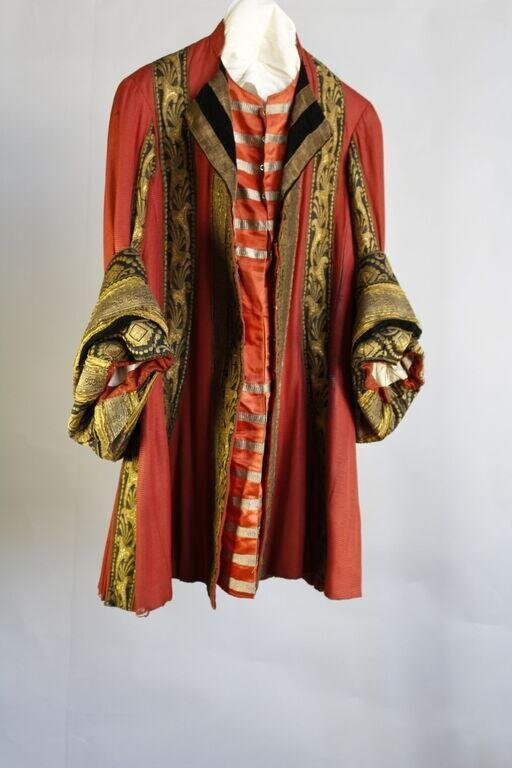
A theatrical costume displayed on a dress form presents a richly ornamented red silk coat or robe, characteristic of early twentieth-century stage design. The garment features bold decorative trim in gold and dark colors—possibly black silk or velvet—running down the front edges and around the deep cuffs. The cuffs are particularly elaborate, with gold embroidery depicting what appear to be stylized birds or mythological creatures with spread wings, set against patterned backgrounds in warm and cool tones. The coat falls to approximately mid-calf length with a relaxed, flowing silhouette. Beneath it, a striped or checked inner garment in warm oranges and reds is visible at the front placket. A cream-colored collar or undergarment shows at the neckline. The costume suggests courtly, exotic, or historical theatrical contexts—the kind of costume a designer would create for a principal dancer in a grand narrative ballet, particularly one drawing on Oriental or fantastical themes. The presentation on a dress form without a performer leaves the work of imagining the body in motion to the viewer.
The dancing
No dancer is present; this is a costume object only. The form it occupies is neutral and featureless, offering no information about how the garment would drape, move, or sit on an actual body. The substantial cuffs and the weight of the embroidery suggest a costume designed for presence and visibility from distance—a performer wearing this would need to move deliberately to show the ornament to advantage, and any gesture of the arms would draw attention to the elaborate cuff decoration.
The dance depicted
This is a costume for theatrical dance, almost certainly for a principal or solo role in a ballet of the early twentieth century. The Orientalist vocabulary—the exotic animal imagery, the rich colour palette, the fusion of European tailoring with ornamental excess—points toward the Ballets Russes aesthetic that dominated European theatre in the 1910s and 1920s. The costume would have costumed a dancer performing a role from one of the many narrative or character dances popular in that period: perhaps a character from an Eastern fantasy, a mythological figure, or a courtier in an invented court. The construction and materials suggest a costume made for a professional company with significant resources.
How it was made
This is a three-dimensional object: a wearable theatrical costume, not a representation of one. It survives as an artifact in textile and hand-embroidery, displaying the tailoring and ornamental techniques of early twentieth-century theatrical costume-making. The construction is high-quality and labour-intensive: the coat appears to be cut and assembled professionally, and the cuff embroidery—depicting narrative figuration—would have been executed by hand or under close supervision. Its preservation suggests institutional care, typical of major theatre collections or museums that document performance history.
About this work
This is a theatrical dance costume attributed to Leon Bakst, the pioneering Russian costume and set designer of the Ballets Russes. Bakst revolutionized stage design in the early twentieth century by treating costumes not as servants to the body but as artworks in their own right—sculptural, chromatic, and narratively autonomous. This costume exemplifies his approach: a garment designed to create visual impact from a distance, to signal character and fantasy through ornament and colour rather than through narrative alone. For dancers and historians, it is a material record of how early twentieth-century dance was made visible—not through steps alone, but through the designer's intervention in clothing, silhouette, and symbolic decoration. Bakst's influence extended across European and Russian ballet and shaped the aesthetics of theatrical spectacle for decades.
How to look at it
Look first at the cuffs: the embroidered creatures are the visual centre of the costume, positioned where a dancer's hands and arms move most expressively. Bakst has designed this costume so that gesture amplifies decoration—any arm gesture would frame and highlight the ornament. Notice the relationship between the saturated red ground and the gold embroidery: this is a design calculated for stage lighting and distance. The undergarment visible at the front suggests that this coat worn open, over layers, creating depth and visual complexity as the dancer moves. Consider too how heavy such a garment would be in practice, and how it would change the way a dancer carries their body, stands, and moves through space.
The artist
Leon Bakst (1866–1924) was a Russian painter, set designer, and costume designer who became the principal visual architect of the Ballets Russes under Sergei Diaghilev. Beginning with the company's founding season in Paris in 1909, Bakst designed costumes and sets for most of its major productions, including Schéhérazade, L'Après-midi d'un faune, and The Sleeping Princess. He approached costume as a synthesis of fine art, ethnography, and fantasy: his designs drew on museum collections, travel, and invention, and treated the dancer's body as a surface for ambitious visual narratives. He was also a prolific painter and illustrator whose work existed independently of theatre. After the Russian Revolution, he continued working in Paris, where he remained until his death.
The period
The 1910s and 1920s saw a radical transformation of theatrical dance design, led by the Ballets Russes. European audiences had been familiar with nineteenth-century ballet, but Diaghilev's company introduced new collaborations between artists, composers, and choreographers, and insisted on visual novelty and artistic seriousness. Bakst's costumes were central to this shift: rather than generic tutus and tights, dancers wore garments that were painterly, sometimes uncomfortable, and often derived from non-European sources—Japanese, Persian, Egyptian, African. This was both creatively exciting and deeply marked by the colonial aesthetics of the period. Simultaneously, modernist artists in Paris, Moscow, and Berlin were experimenting with colour, form, and abstraction; Bakst's theatrical work engaged these movements while remaining rooted in the human figure and narrative. For dancers, Bakst's designs meant new physical challenges: heavier garments, restricted mobility, and costumes that made the body itself a canvas for design.
Where it lives
The object is held as a theatrical costume, catalogued without further provenance detail in the collection. It is identified as a work by Leon Bakst and dated to 1921, a year late in Bakst's career and in the mature phase of the Ballets Russes.
Dance in this work
Questions about this work
Did Bakst design costumes only for the Ballets Russes?
No. Though Bakst is most famous for his Ballets Russes work, he was trained as a painter and designed for Russian theatre before joining Diaghilev. After the Revolution, he worked with other European companies and continued his independent artistic practice in Paris. But the Ballets Russes commissions were the most prestigious and most influential of his career.
How did dancers move in costumes as heavy as this one?
With difficulty and deliberation. Bakst's costumes sometimes restricted movement, and dancers had to adapt their technique to the garment. This was not accidental: the costume was part of the choreography, and the way the fabric moved—or did not move—was essential to how the role was performed. Modern dancers often find these costumes both beautiful and challenging to wear.
What do the creatures on the cuffs represent?
Without more information about which role this costume was made for, we cannot be certain. The imagery suggests fantasy or exoticism—perhaps Eastern mythology, perhaps pure ornament. Bakst frequently drew on museum collections and travel, but also invented freely. The creatures may reference a specific narrative, or they may simply serve the designer's chromatic and formal intentions.
Is this costume wearable, or is it a museum piece?
Theatrical costumes are made to be worn, and this one shows no signs of being made differently. However, after a century in collection storage, it requires careful handling. Museums balance preservation with the desire to show how historical costumes functioned; some are conserved and occasionally worn by trained performers in controlled conditions, while others are displayed as artifacts.
More dance artwork





