49 works in this view — arrow keys or swipe to move between them.
Dance in Art
Poster
Spatt, Leslie E.
- Collection:
- Poster
- Source:
- Victoria and Albert Museum
- Rights:
- Rights vary by item — check the source record before reusing this image. Source record ↗
- Recorded as:
- V&A — check rights per item
For anyone studying how ballet was promoted in Britain in the 1980s, or how the image of the classical dancer was constructed for public consumption, this poster is primary evidence. It shows La Fille mal gardée's visual language being used to sell the ballet to a regional audience, and it captures a moment when classical ballet could still command major theatre space alongside contemporary work.
What you are looking at
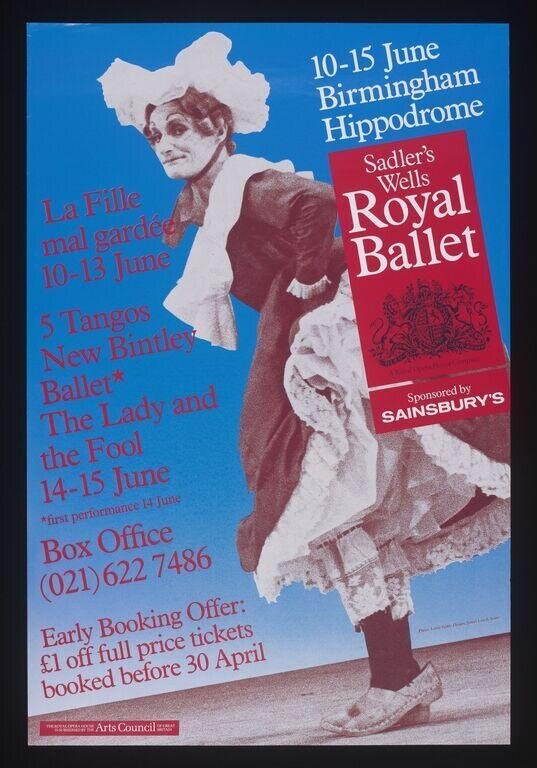
This is a theatrical poster advertising a season of ballet at Birmingham Hippodrome, June 10–15, 1985, sponsored by Sainsbury's. The dominant image is a stylised portrait of a female dancer in three-quarter view against a bold blue background, her face rendered in sepia tones and gazing out with theatrical expression. She wears an enormous cartwheel hat with voluminous white plumes, and a fitted brown jacket or bodice over what appears to be a white skirt or petticoat. The composition captures the dancer mid-movement or mid-pose, with her body angled and her costume billowing. The poster text overlays the image in white and red sans-serif type, listing three works: La Fille mal gardée (10–13 June), 5 Tangos (New Bimboes), and The Lady and the Fool (14–15 June, marked as first performance in June). The Sadler's Wells Royal Ballet logo appears in a red panel at right. The colour separation and graphic style are characteristic of 1980s offset lithography.
The dancing
The single figure is a female dancer captured in a moment of turned, lifted carriage. Her upper body is rotated away from the viewer, her chin lifted, her gaze directed outward with stage presence. The hat and plumage dominate the composition and frame her face as the focal point. The posture suggests classical ballet's upright alignment, though the theatrical costume and exaggerated facial expression belong more to character dance or demi-caractère roles. The artist has emphasised the dancer's stage persona rather than technical detail; the footwork and exact position are not specified by the composition.
The dance depicted
This poster advertises performances by Sadler's Wells Royal Ballet of three distinct works: La Fille mal gardée (a classical comedy ballet), 5 Tangos (a modern piece, likely the Philip Glass collaboration by Forsythe or a similar contemporary work), and The Lady and the Fool (a demi-caractère ballet). The image itself most closely evokes La Fille mal gardée, the 18th-century comedy in which the heroine Lise is often shown in character dress including large hats. The costume—the enormous plumed hat, the fitted jacket, the white skirt—is precisely the kind of demi-caractère dress associated with this ballet's Ashton version. The dancer's expression and carriage suggest theatrical rather than pure classical ballet, consistent with a role requiring both technical facility and comedic character work.
How it was made
This is a colour offset lithographic poster, identifiable by the discrete colour separation and the flat planes of colour characteristic of the medium. The technique allowed for large-scale circulation and bold graphic impact at minimal cost, making it standard for theatre promotion from the 1960s through the 1980s. The sepia-toned face set against the flat blue field is a deliberate graphic choice, using the limitation of colour separation to create contrast and legibility. The typeface—a clean sans-serif for information, a more ornamental serif for the ballet name—reflects 1980s design convention.
About this work
This is a promotional poster for a short season of classical and contemporary ballet at a major British regional theatre in 1985. It advertises three contrasting works spanning classical (La Fille mal gardée, The Lady and the Fool) and modern (5 Tangos) repertory. The image itself is not documentary but theatrical—a stylised portrait of a dancer in character costume designed to attract audiences through visual wit and appeal, not through technical display. The poster belongs to the material culture of late twentieth-century British ballet as a popular entertainment, when companies such as Sadler's Wells Royal Ballet carried classical repertory to audiences outside London. The work demonstrates how ballet was marketed and how the dancer's persona—the character, the costume, the stage presence—could be distilled into a single compelling graphic image.
How to look at it
Look first at the hat and the face: the artist has chosen to frame the dancer's expression and character rather than her body or movement. The enormous plumage is not naturalistic but theatrical costume, exaggerated in size for graphic impact. The brown jacket and white skirt are demi-caractère costume, read by anyone familiar with ballet as a signal of a character role rather than a classical one. The three-quarter turn and lifted carriage of the body suggest both the upright alignment of classical ballet and the sense of performance—this is a dancer onstage, not a figure in a studio. The colour choice—sepia face against a vivid blue field—uses the technical limitation of offset lithography to create a graphic dynamic that would read well at a distance and in newspapers.
The artist
Leslie E. Spatt is credited as the designer of this poster. Beyond this attribution, little is recorded of the artist's practice in the available sources. The work is professional theatrical graphic design of the mid-1980s, created for commercial and promotional circulation.
The period
In 1985, Sadler's Wells Royal Ballet (later renamed Birmingham Royal Ballet) was establishing itself as a major touring company outside the Royal Ballet at Covent Garden. La Fille mal gardée, Frederick Ashton's 1960 production, was and remains a cornerstone of classical repertory—a ballet that bridges classical technique with comedy and character, making it ideal for touring and public appeal. The inclusion of a contemporary work such as 5 Tangos alongside two classical ballets reflects the expectation, even in 1985, that ballet companies would present mixed bills. The poster's graphic language—bold colour, theatrical portraiture, sans-serif typography—is characteristic of 1980s British design, when offset lithography remained the dominant method for theatrical and cultural promotion before digital printing became standard.
Where it lives
This poster is held by the Victoria and Albert Museum, London, as part of its collection of British theatre and dance ephemera. It is a commercial promotional object, printed in quantity for display in foyers, theatres, and public spaces in the Midlands in June 1985.
Dance in this work
Questions about this work
Is this a painting or a poster?
This is a colour offset lithographic poster, a printed work designed for theatre promotion. It was not drawn or painted by the artist in a unique artwork but rather reproduced in multiple copies and distributed as commercial advertising.
Why is the dancer wearing such a large hat?
The enormous plumed hat is demi-caractère costume associated with La Fille mal gardée, a classical comedy ballet set in a French village. The exaggerated size of the hat in the poster is a graphic choice—larger than stage reality—designed to make the image striking and recognisable.
Is this image specific to one dancer?
The poster is unlikely to depict a specific named dancer; the image is a stylised character portrait created for the production as a whole. Classical ballet posters of this period typically used costume and character to advertise the ballet rather than featuring the names or likenesses of individual dancers.
What does 5 Tangos refer to?
5 Tangos is a contemporary ballet set to Philip Glass's violin concerto, though the specific choreography is not identified on the poster. Its inclusion on the bill alongside two classical ballets shows that regional ballet companies in 1985 were expected to offer mixed repertory.
More dance artwork