49 works in this view — arrow keys or swipe to move between them.
Dance in Art
Nadgy Waltz
Charles Coote
- Collection:
- Sheet music
- Source:
- Victoria and Albert Museum
- Rights:
- Rights vary by item — check the source record before reusing this image. Source record ↗
- Recorded as:
- V&A — check rights per item
This work documents the aesthetics of theatrical dance in the 1880s—the valorization of weightlessness, the visual language of the Romantic ballet tutu, and the feminized spectacle of the professional dancer. As a commercial product aimed at amateur musicians, it also reveals how dance imagery was circulated and consumed in everyday domestic and public settings in the late nineteenth century.
What you are looking at
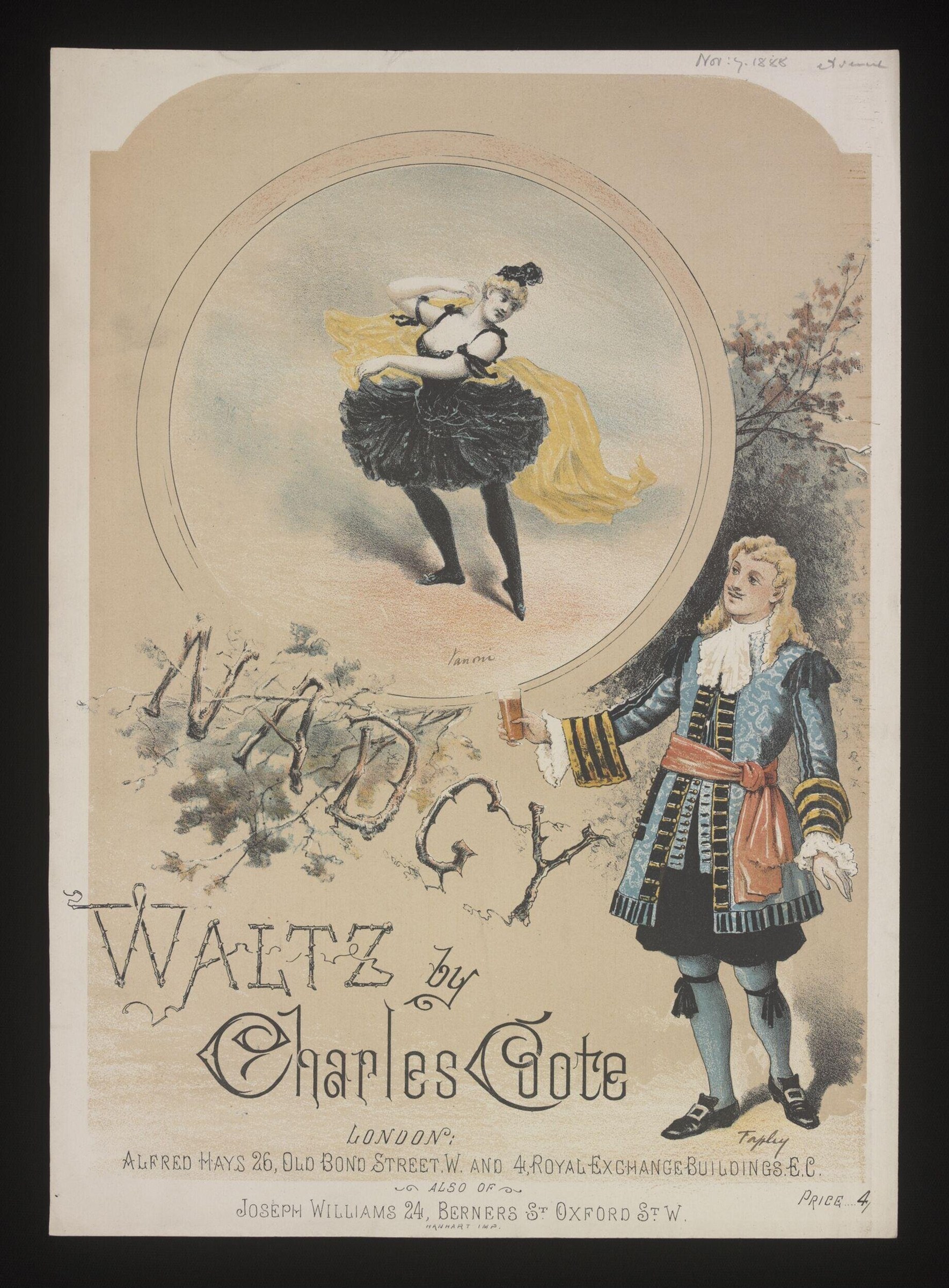
This is the cover of a piece of sheet music, printed in color with decorative composition. A fashionable young woman in a black tutu, yellow shawl, and dark hair adorned with plumes or feathers stands at the lower right, gazing upward. She wears a lavishly decorated costume with gold trim and ornamental details characteristic of theatrical dress. To her left, within a circular frame decorated with a double-line border, a female dancer in mid-leap is shown in silhouette or simplified form, wearing the same tutu and shawl, captured in a moment of aerial suspension. The composition frames this inner image like a vision or memory the standing woman is conjuring. Below the circular frame, a carefully drawn tree branch with sparse foliage and buds extends leftward, anchoring the lower portion of the page. The background is a soft cream or pale tan, creating an intimate, nostalgic mood suitable for the romantic era of dance that produced such music.
The dancing
The standing figure is posed in contemplation, weight settled on one leg, gazing upward toward the circular frame. The figure within the circle is captured at the apex of a jump or leap, legs extended in a vertical line or in a balletic jump position, arms held in a lifted frame. The dancer's body demonstrates the weightless suspension valued in Romantic-era ballet technique. The two figures appear to be the same person—the memory of the leap and the moment of reflection upon it. The pose suggests trained balletic technique rather than social dancing.
The dance depicted
This is a Waltz by Charles Coote, titled 'Nadgy Waltz' and published in London in 1888. The waltz was the dominant ballroom and theatrical dance form of the late nineteenth century, performed by professionals and amateurs alike. However, the Romantic ballet iconography—the tutu, the pointe-work suggested by the silhouette, the theatrical costume—indicates this may be a concert or theatrical waltz rather than a social ballroom piece. The image captures the theatrical waltz as a vehicle for female virtuosity and aerial grace, a performance form that elevated the waltz from the ballroom to the stage.
How it was made
This is a color lithograph, a reproductive print technique that allowed for mass production of sheet music covers with sophisticated color effects. The medium enabled the publisher to reach a broad market of amateur musicians, music teachers, and concert-goers in late Victorian London. Lithography's capacity for fine detail and subtle gradation of tone is evident in the shading of the figures and the delicate rendering of the tree. The print was created by a commercial publisher (Alfred Hays, 26 Old Bond Street, and Joseph Williams, 24 Berners Street, Oxford Street) and sold at a modest price of 4 shillings, indicating a middle-class audience.
About this work
This is the cover of a concert waltz published in London in 1888, featuring theatrical imagery that captures the late Romantic fascination with the female dancer as an ethereal, weightless creature. The unnamed dancer (or the dancer persona 'Nadgy') is depicted both in contemplative repose and in the memory or vision of her own leap—a doubled image that suggests the interior life of performance. The work belongs to a rich visual tradition of theatrical dance imagery in the late nineteenth century, when lithographed sheet music covers became a primary medium for circulating images of dancing bodies to a mass audience. Sheet music covers of this period are among the most accessible and widely distributed dance imagery of their time, reaching parlors and music rooms across the Victorian world.
How to look at it
Observe how the artist has created a doubled image of the dancer: the contained, reflective pose and the soaring leap in memory or imagination. The tutu and shawl are rendered with attention to fabric and movement, suggesting the material reality of stage costume. The tree branch in the lower left, while decorative, may evoke the natural settings of Romantic ballet narratives. Notice how the circular frame isolates and elevates the leap into a vision or ideal, separate from the everyday reality of the standing figure.
The artist
Charles Coote was a London-based composer of light theatrical and dance music in the late nineteenth century. The publication details identify him as the composer of this waltz, which was published by two London music houses—Hays and Williams—suggesting he was an established enough figure to command professional publication and distribution. Beyond this attribution, little is documented about Coote's life or broader practice.
The period
The 1880s were a period of intense interest in theatrical dance in Britain, with the international success of imported European ballet companies and the rise of new performance venues in London's West End. The waltz had evolved from a social ballroom dance into a sophisticated concert form performed by professional dancers and celebrated in large orchestral arrangements. Lithography had become the dominant print technology for sheet music covers, allowing composers and publishers to market their work through vivid, theatrically evocative imagery. The aesthetic of this cover—the Romantic tutu, the pointe work, the ethereal female form—reflects the continued dominance of the Romantic ballet vocabulary even as newer forms of theatrical dance were emerging.
Where it lives
This is a color lithograph sheet music cover for a concert waltz, published in London by two music publishers in 1888. It survives as a cultural artifact of the music publishing industry and reveals the visual culture surrounding theatrical dance in the late Victorian period.
Dance in this work
Questions about this work
Was this a piece for professional dancers or for amateur musicians at home?
Both. The waltz was composed and published as sheet music, indicating it was intended for amateur pianists and musicians to perform in home settings. However, the theatrical imagery and the title suggest it may also have been performed as a concert piece by professional dancers and musicians. The sheet music cover itself—with its glamorous theatrical imagery—was marketed to appeal to both audiences, allowing amateurs to imagine themselves as the ethereal dancer depicted.
Why does the dancer appear twice?
The doubled image—the standing figure gazing upward at the circular frame containing the leaping figure—suggests a moment of memory, aspiration, or inner vision. This compositional strategy was common in late Romantic imagery, representing the interior consciousness or desire of the figure. The standing woman may be remembering her own leap, or imagining the ideal of the perfect performance.
What kind of waltz was this?
The theatrical costume and the aerial imagery suggest this was a concert or stage waltz rather than a ballroom waltz for social dancing. By the 1880s, the waltz had become a standard vehicle for professional dancers in concert halls and theaters, performed in elaborate costumes and often choreographed to tell a story or express a mood. The music would have been orchestral or for piano, suitable for professional performance or ambitious amateur musicians.
More dance artwork





