49 works in this view — arrow keys or swipe to move between them.
Dance in Art
Choristers' Waltz
Phelps, Bernard
- Collection:
- Sheet Music
- Source:
- Victoria and Albert Museum
- Rights:
- Rights vary by item — check the source record before reusing this image. Source record ↗
- Recorded as:
- V&A — check rights per item
This work is a rare visual record of theatrical waltz performance in the 1890s, showing how the ballroom waltz was adapted and staged for male chorus work in theatrical contexts. The image also documents the commercial machinery of Victorian popular entertainment—sheet music as a mass medium that brought dance imagery into working-class homes and circulating libraries.
What you are looking at
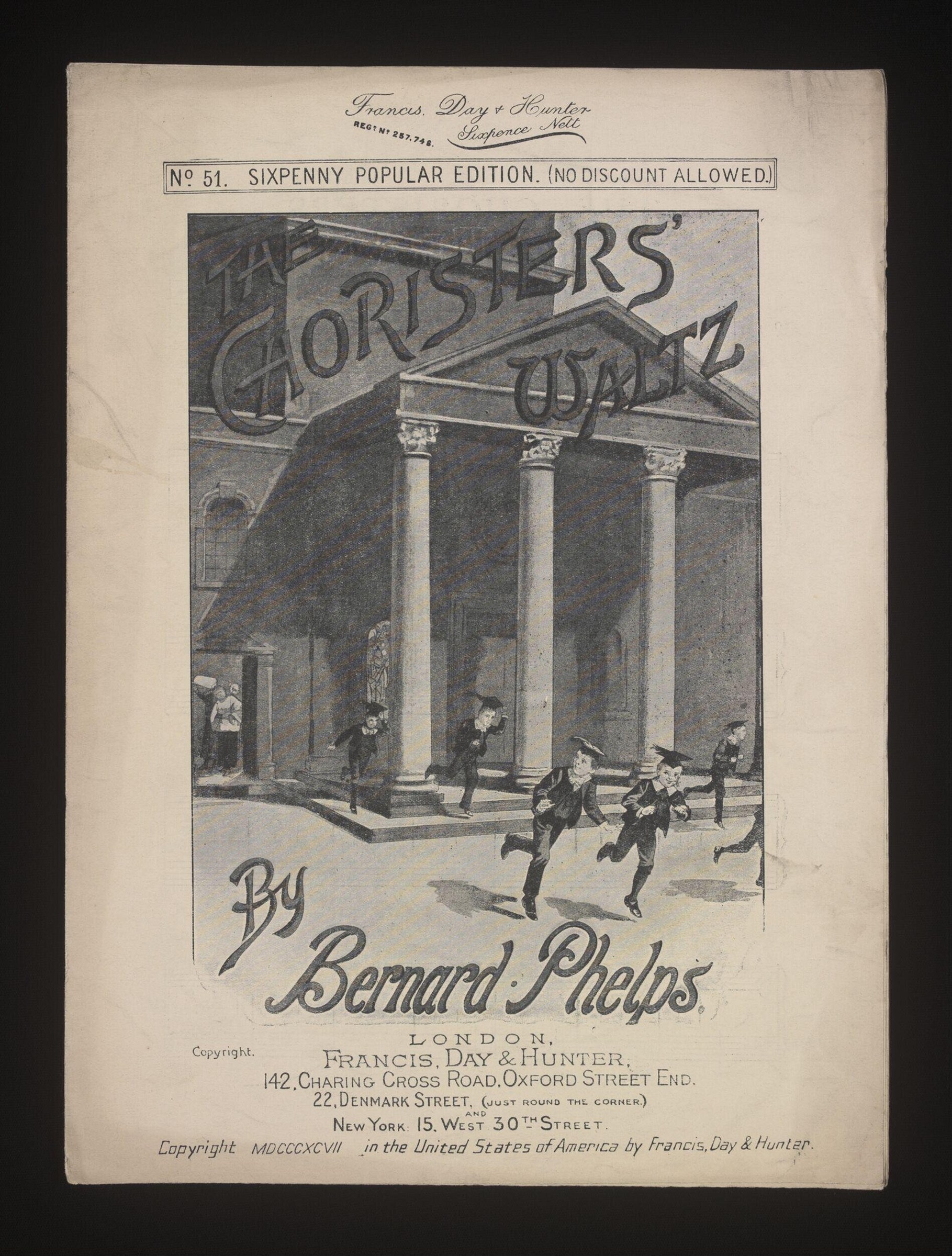
A lively scene outside a grand neoclassical building with tall columns and a signboard reading "CHORISTERS' WALTZ." Eight figures in dark formal dress—suits and bowler hats—are captured mid-movement on the colonnade. The nearest figures stride forward with energy, their bodies leaning into the motion, while others in the background cluster under or near the columns. The composition uses strong diagonal lines created by the figures' forward momentum and the geometric regularity of the architecture, creating a sense of playful urgency. The lithographic technique renders the scene in grayscale with subtle gradation, emphasizing the drama of light and shadow across the classical facade.
The dancing
The dancers move in a loose group rather than in closed couples or formal lines. Their posture is upright but animated—knees bent, bodies inclined forward as though caught mid-stride or mid-skip. Arms are generally at the sides or slightly raised. The figures are all male and uniformly dressed in dark suits and hats, which reads as a chorus or group of performers rather than a mixed social gathering. The closest figure on the right leads the movement with an emphatic forward step, setting the energy for the group.
The dance depicted
The title identifies this as a waltz danced by choristers—a male chorus, likely theatrical or church-based given the formal setting. The waltz in 1897 would have been a standard ballroom and theatrical form, but this image shows it executed as a group number rather than in couples, suggesting a theatrical or performance context rather than social dancing. The forward-striding, upright posture is consistent with theatrical movement training of the period. The architectural setting—a formal columned hall—suggests either a theatrical set or a place of public gathering, reinforcing the staged nature of the performance.
How it was made
This is a lithographic print, identifiable by the characteristic grainy texture and tonal range. Lithography allowed rapid, affordable reproduction suitable for mass-market sheet music publication. The print was produced by Francis, Day & Hunter, a major London music publisher, for their Sixpenny Popular Edition—a series designed for working- and middle-class consumers. This medium and edition indicate the work circulated widely and was intended as affordable popular entertainment rather than a fine-art object.
About this work
This is a cover illustration for a waltz composition by Bernard Phelps, published as sheet music by Francis, Day & Hunter in 1897. It depicts a group of formally dressed male performers—a theatrical chorus—executing a waltz in a grand neoclassical interior, capturing the energy and formality of late Victorian theatrical dance. The image records both a musical composition and a performance practice: the waltz adapted for group theatrical presentation rather than ballroom couples. As sheet music cover art, it served as advertisement, cultural commodity, and visual document of how Victorian audiences encountered dance and music together.
How to look at it
Attend to the moment the artist chose: not a waltz turn or rise-and-fall, but a group of performers striding forward in unison, suggesting the theatrical rather than ballroom context. Notice how the neoclassical setting—the tall columns and formal architecture—lends dignity to the scene while the energetic diagonal lines of the figures' movement inject playfulness. The uniform dark suits and hats, repeated across all eight figures, emphasize unity of ensemble rather than romance or courtship, the traditional social associations of the waltz.
The artist
Bernard Phelps was a composer of light theatrical and popular music active in the late 19th century. This waltz, published by Francis, Day & Hunter, was part of the vast output of theatrical and ballroom music that defined Victorian commercial entertainment. Phelps's work fits within the tradition of accessible, tuneful composition designed for performance and home use rather than concert prestige.
The period
The 1890s saw the waltz at the height of its theatrical and social currency. It remained the dominant ballroom form and was regularly featured in musical comedy, pantomime, and revue. The development of cheap lithographic sheet music in the mid-19th century democratized access to dance music; by the 1890s, illustrated covers like this were a standard marketing tool. The Sixpenny Popular Edition series speaks to the emergence of a mass market for music, parallel to the rise of music halls and theatrical entertainment as primary leisure activities for urban working and middle classes.
Where it lives
This is a sheet music cover from the Francis, Day & Hunter Sixpenny Popular Edition series, a low-cost publication line designed to bring musical content to mass audiences. The notation and publisher information at foot indicate British publication, with American distribution through their New York office. This was a consumable object, sold for sixpence, and would have been discarded once worn or superseded by newer releases.
Dance in this work
Questions about this work
What is a 'Sixpenny Popular Edition'?
A line of inexpensive sheet music publications by Francis, Day & Hunter, a major Victorian music publisher. At sixpence (about 2.5p), it was affordable to working- and middle-class households. The low price and illustrated covers made music and dance imagery available to a mass market rather than an elite one.
Why a male chorus dancing a waltz?
Theatrical waltzes were common in Victorian musical comedy, pantomime, and revue. A male chorus provided spectacle, movement, and unison precision. This image likely documents either a professional theater production or an amateur performance by a church or civic choir—'choristers' suggests the latter.
Is this a real dance performance or imagined?
It is almost certainly based on actual theatrical practice. The anatomically plausible postures, the specific architectural setting, and the mass production of the sheet music all suggest this depicts a real performance style that audiences would have recognized. The lithograph served as advertisement and souvenir simultaneously.
More dance artwork





