49 works in this view — arrow keys or swipe to move between them.
Dance in Art
Magic Waltz
Montgomery, W.H.
- Collection:
- Sheet Music
- Source:
- Victoria and Albert Museum
- Rights:
- Rights vary by item — check the source record before reusing this image. Source record ↗
- Recorded as:
- V&A — check rights per item
The image captures the Victorian fascination with ballet and theatrical spectacle at a moment when romantic ballet was being revived and repackaged for middle-class entertainment through published scores and illustrated sheet music. It is a rare visual document of how late 19th-century audiences understood and imagined the aesthetic of romantic ballet—ethereal, supernatural, visually elaborate—and of how music publishing and theater were integrated commercial enterprises. For historians of dance, costume, and theatrical marketing, it offers concrete evidence of what a ballet scene was understood to look like in this period, and how it was sold.
What you are looking at
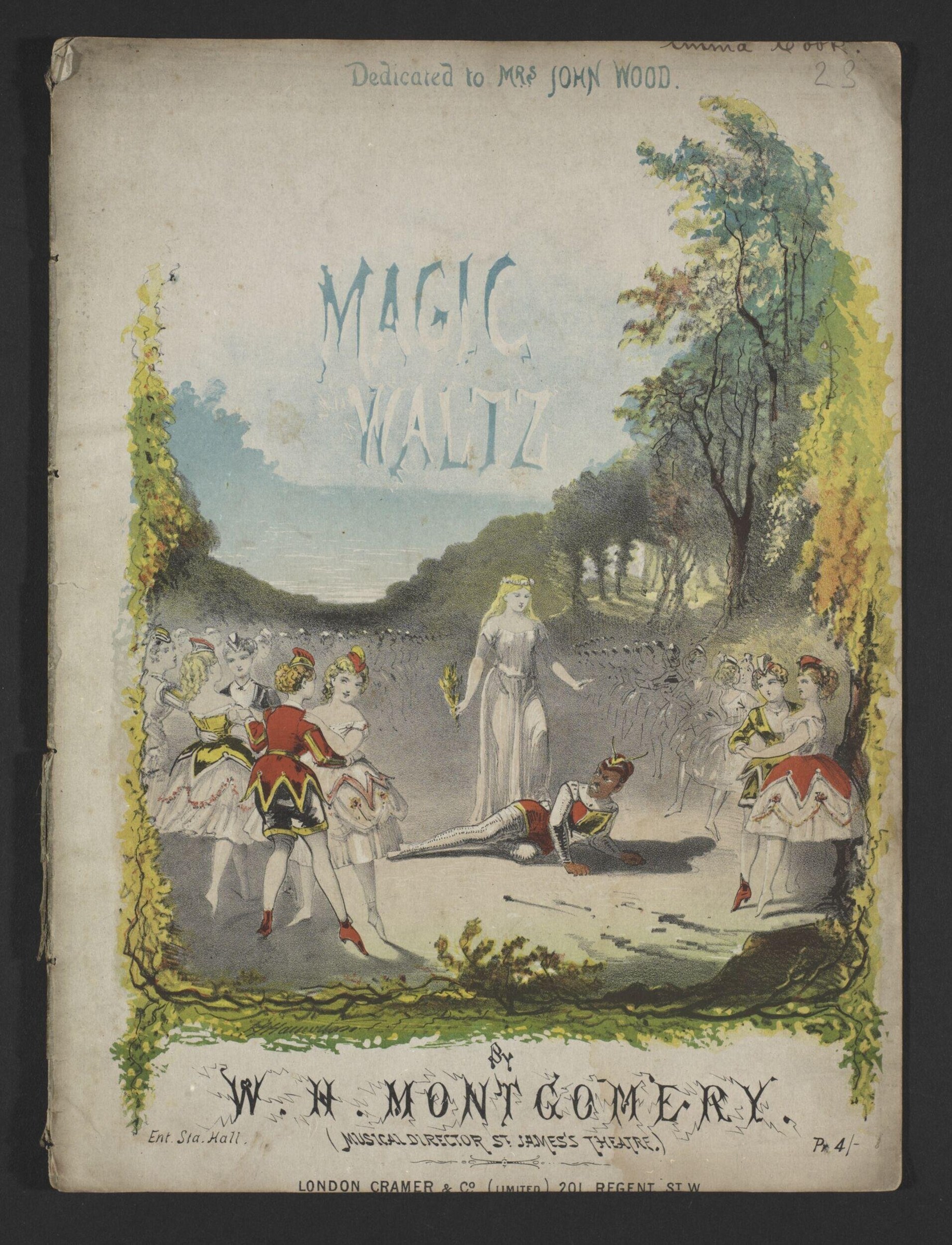
This is the cover or title page of a theatrical musical score, framed by decorative ivy-leaf borders in yellow-green. The central image depicts an outdoor garden or arcadian scene: a woman in flowing white robes stands centrally, elevated on a mound, her arms outstretched in a gesture of benediction or command. She faces a gathering of ethereal figures—a mix of female dancers in pale tulle skirts trimmed with red, and male figures in tights and red-trimmed costume. The dancers are arranged in loose groups to left and right, some in conversational poses, others in attitudes of attention toward the central figure. In the immediate foreground, one male dancer lies prostrate on the ground in an attitude of devotion or collapse. The setting is a moonlit glade bordered by tall trees; water and distant hills are visible in the background, evoking a romantic, supernatural realm. The overall composition is one of theatrical fantasy—a vision of fairies, sylphs, or magical beings gathered in a timeless nocturnal landscape.
The dancing
The central female figure, evidently a supernatural being or queen, stands in a commanding contrapposto with arms raised and open, her white dress falling in classical folds. The surrounding dancers are arranged informally rather than in ballroom hold or formation; several face inward toward the center, their posture suggesting receptiveness or enchantment. The male figure in the foreground is in a full recumbent position—either collapsed, kneeling, or in an extreme attitude of homage. The costumes suggest the late 19th-century theatrical tradition: the women wear romantic tutus with fitted bodices and the red-trimmed detail typical of stage dress of the 1880s–1890s, while the men wear tights and short military-style jackets. There is no closed-position ballroom hold anywhere in the scene; the arrangement is tableaux-like and ceremonial rather than partnered social dance.
The dance depicted
This is a theatrical ballet scene, most likely from a romantic or fantasy ballet of the late 19th century. The presence of the ethereal female ensemble in tutus, the supernatural setting, the central figure of apparent magical authority, and the attitudes of the male dancers all point to a work in the tradition of romantic ballet—possibly depicting a scene of fairy magic, transformation, or supernatural intervention such as those found in *La Sylphide*, *Giselle*, *The Nutcracker*, or similar ballets. The title *Magic Waltz* suggests a waltz-based choreography integrated into this magical scene, though the visual evidence here shows more of a ceremonial or processional tableau than active waltz dancing. The image captures a dramatic moment of revelation or enchantment rather than the movement itself.
How it was made
This is a chromolithograph, identifiable by the layered color printing, decorative borders, and quality of line work characteristic of late 19th-century theatrical printing. It is a cover or interior illustration for the published sheet music of the composition by W. H. Montgomery. The use of color lithography allowed for the vibrant reproduction of costume and atmospheric detail, making this both a commercial advertisement for the musical work and a souvenir of the staged production. The printer is Cramer & Co. of London, a leading music publisher of the period. This medium and distribution indicate an audience of amateur musicians, theater-goers, and middle-class households purchasing parlor music to recreate fashionable theatrical dances in their own settings.
About this work
This is the illustrated cover of a theatrical musical composition, *Magic Waltz*, by W. H. Montgomery, likely dating to the 1880s–1890s and printed in London. It depicts a scene from a romantic ballet—a moment of supernatural intervention in which a magical or fairy figure commands the attention of an ensemble of male and female dancers in a moonlit glade. The composition follows the conventions of Victorian theatrical fantasy, with elaborate costume detail and an arcadian setting rendered in the chromolithographic technique that made such images widely reproducible and affordable. As both a work of visual art and an artifact of theatrical and musical publishing, it documents how dance and music were promoted, circulated, and consumed in the late 19th-century market. The dedication to Mrs. John Wood, a known theatrical figure of the period, anchors it to a specific production or performance context.
How to look at it
Attend first to the composition of the scene: the central authority figure (the "magic" of the title) is positioned at the apex of the composition, her arms open and raised, commanding the visual and narrative space. All other figures are subordinate to her, arranged in loose symmetrical groups. The artist has chosen to depict not a moment of active dancing but a moment of stasis—a revelation, a spell, a tableau of enchantment. The chromolithography technique here emphasizes the luminosity of the white dress against the darker landscape and the delicate detail of the tutus, creating an effect of otherworldliness appropriate to the romantic ballet aesthetic. The frame of ivy leaves reinforces the theatrical artifice of the image—it is a picture of a stage scene, not nature itself.
The artist
W. H. Montgomery is listed as the composer of *Magic Waltz*. Little is presently known of Montgomery's broader output or biographical details beyond this publication. The work is described as music for a director at the James Theatre, suggesting it may have been written for or associated with a specific theatrical production. The dedication to Mrs. John Wood (a prominent actress and theater manager of the 1870s–1880s) suggests either a professional connection or a gesture of respect to a prominent theatrical figure. The chromolithography and publication by Cramer & Co. places the work within the mainstream of Victorian sheet music publishing.
The period
The 1880s–1890s were a period of intense romantic ballet revival in Europe and America. Works like *Swan Lake* and *The Sleeping Beauty* were being created in Russia, while in England and America, romantic and fairy-tale ballets remained popular in both professional and amateur contexts. The Victorian era saw an explosion of published sheet music for piano and domestic performance, often illustrated with scenes from the theatrical productions that inspired them. Chromolithography had become the standard and affordable technology for color reproduction, making illustrated scores a viable commercial product for the growing middle-class market of amateur musicians. The aesthetic of the image—the ethereal tutus, the moonlit setting, the supernatural central figure—belongs entirely to the romantic ballet tradition, even as it was being refreshed and commercialized for a new era.
Where it lives
This work is held as sheet music in an archival collection (source: va). The catalogue record indicates it is the illustrated cover or interior page of a published musical score, printed by Cramer & Co. of London, presumably in the 1880s or early 1890s based on costume and printing conventions. The dedication to Mrs. John Wood handwritten at the top suggests this may be a presentation copy or an inscribed edition given to the dedicatee.
Dance in this work
Questions about this work
Is this a painting or a print?
This is a chromolithograph—a color print made by layering inks on stone, a standard and affordable technique for reproducing theatrical images in the late 19th century. It was produced as the cover or interior illustration of published sheet music. The technique allowed for the vivid color and fine detail you see here to be reproduced in many copies.
Who were the dancers in this ballet?
We do not know from the image alone, though the dedication to Mrs. John Wood (a prominent actress and theater manager) suggests the work may have been created for or associated with a specific production. The illustration shows the scene as it would appear on stage, with typical costume and ensemble arrangement of the period, but does not identify individual performers.
Is this a waltz or a ballet?
It is both: a theatrical ballet that incorporates waltz music and choreography. The title *Magic Waltz* indicates that the composition is a waltz, but the visual scene is from a romantic ballet—a theatrical work in which waltz-based music and movement were integrated into a dramatic narrative. This was a common practice in 19th-century ballet and theatrical music.
What does the central figure represent?
The title *Magic Waltz* and the figure's commanding pose and supernatural setting suggest she represents a magical or fairy being—a sylph, fairy queen, or enchantress. Her raised arms and centrality in the composition indicate she is the source or focus of the "magic" of the title, commanding the attention and devotion of the other dancers.
More dance artwork





