49 works in this view — arrow keys or swipe to move between them.
Dance in Art
A Waltz Dream
Martin, Rita
- Collection:
- Photograph
- Source:
- Victoria and Albert Museum
- Rights:
- Rights vary by item — check the source record before reusing this image. Source record ↗
- Recorded as:
- V&A — check rights per item
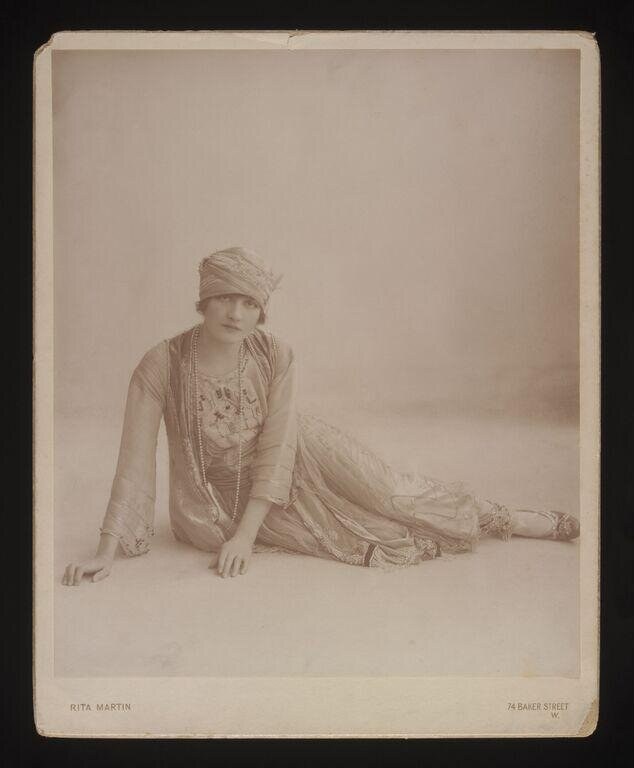
This photograph documents both a vanished dancer and a vanished choreography from a period when theatrical dance was a major form of popular entertainment. It shows us what a dancer's training and professional presence could communicate through stillness and pose alone—the photograph tells us that this was a skilled, trained performer whose body and costume were carefully composed for public view. The specific dance, the choreographer, and the dramatic context are now irrecoverable, making this image a poignant record of the ephemerality of live performance.
What you are looking at
A single female dancer kneels on a bare stage floor in a pose of languorous reverie. She wears an ornate costume of draped pale fabric with embroidered details, a decorative headwrap, and long strands of beads that fall across her torso. Her weight is balanced on her knees, one arm extended forward in a gentle reach while her body leans slightly back, creating a sinuous curve from hip to shoulder. The fabric of her skirt pools around her in soft folds, suggesting recent movement—perhaps a spin or collapse into this moment of stillness. The plain, light background isolates the figure entirely, focusing all attention on her posture and the quality of her repose. The photograph captures not an instant of vigorous action but rather a moment of dramatic pause, the kind a performer might hold at the climax of a romantic narrative.
The dancing
One dancer, female, is shown in a kneeling position with her body weight distributed across her knees. Her left arm extends forward from the shoulder at roughly chest height; her right arm is less visible but appears to rest near her torso. Her head is held upright, gazing slightly upward and to the side in a dreamy, abstracted manner. The spine shows a gentle backward curve, creating an elongated line from knee to crown. Her costume—the beads, the embroidered gown, the wrapped headdress—suggests a trained professional dancer rather than a novice, and the controlled nature of her balance indicates practiced bodily control even in repose.
The dance depicted
The title 'A Waltz Dream' suggests a romantic or fantastical moment extracted from waltz performance or its narrative context. However, the actual pose bears no direct relationship to waltz technique—the kneeling, the backbend, the arms—suggesting instead that this photograph captures a theatrical or interpretive moment, perhaps the denouement of a romantic scene or a dream sequence within a larger work. The costume is too elaborate and the pose too stylized for social ballroom dancing; this is theatrical dance, and the 'dream' likely signals a narrative frame common to early 20th-century theatrical and classical-derived performance. Without identifying marks or additional context, the precise choreography cannot be determined, but the image suggests a hybrid of classical theatrical vocabulary with decorative, possibly Orientalist or fantasy elements popular in Edwardian stage spectacle.
How it was made
This is a gelatin silver or albumen photograph, mounted on card stock and printed by a professional London photography studio (the mark '74 BAKER STREET W.' at lower right identifies the location). The photographer Rita Martin operated from this address and worked primarily with performers and theatrical subjects. The even, diffuse lighting typical of studio work eliminates shadow and emphasizes form; the pale, plain backdrop was standard theatrical portrait practice. The small size and mounted format suggest this was distributed as a promotional or cabinet photograph, the kind that performers sold to admirers or that circulated through theatrical networks.
About this work
This is a professional theatrical photograph of a female dancer in costume, posed in a moment of romantic reverie—a kneeling, slightly arched pose that conveys dream or introspection rather than active movement. The photograph is identified only by its title and the photographer's imprint; the dancer's name does not survive. The costume—draped gown, beaded ornament, wrapped headdress—and the pose suggest early 20th-century theatrical dance of a kind that blended classical training with contemporary taste for exotic or fantastical spectacle. The image belongs to a large category of promotional photographs of theatrical dancers that circulated widely in Edwardian London and beyond, each one a record of a performer and a moment of choreography now lost to time.
How to look at it
Attend to the pose as a moment of narrative—the upward gaze, the reach of the arm, the backward arc of the spine all communicate emotion and reverie rather than technical virtuosity. Note how the photograph suspends the dancer between stillness and implied motion; her costume suggests she has just finished moving, and the pose itself is held with muscular control. The ornament—beads, embroidery, headdress—was probably integral to the choreography or at least central to the performer's persona; early 20th-century stage dance often made costume and movement inseparable. The photograph is theatrical portraiture, not a documentation of movement as it happens, so read it as a performance of stillness rather than a frozen instant of action.
The artist
Rita Martin was a London-based theatrical and portrait photographer active in the early 20th century, working from a studio at 74 Baker Street in the West End. She specialized in photographs of performers—dancers, actors, and other theatrical professionals—and her work circulated primarily through the entertainment world as promotional material. Martin's photographs are characterized by careful studio lighting, attention to costume and ornament, and an ability to capture performers in posed moments that conveyed character and narrative. Her archive survives primarily through such promotional photographs held in institutional collections.
The period
The photograph dates to 1911, a moment when theatrical dance in London was flourishing and diversifying. The era of Diaghilev's Ballets Russes (founded 1909) was beginning to reshape European theatrical dance aesthetics, but the London musical theatre and variety stage sustained an older tradition of spectacular, narrative-driven dance with a taste for Oriental and fantasy subjects. Waltz remained a dominant romantic narrative framework in theatrical dance and opera, even as new styles emerged. The Edwardian stage welcomed elaborate costumes and exotic settings as markers of theatrical sophistication and world-class entertainment.
Where it lives
The photograph is held by the Victoria and Albert Museum (collection reference VA). The mounted print and photographer's mark indicate it was a commercial studio product, likely sold or distributed by Martin herself; such images were standard promotional material for theatrical performers of the period.
Dance in this work
Questions about this work
Can you identify the dancer?
No. The photograph is credited only to the photographer Rita Martin; the dancer's name is not recorded. The title 'A Waltz Dream' appears to be supplied by the museum or photographer, not a title given by the dancer or choreographer.
What dance is being performed?
The pose itself does not correspond to standard waltz technique or any recognizable ballroom pattern. The title suggests a theatrical work with a waltz theme or a dream-sequence moment within a larger narrative. The actual choreography cannot be determined from this single posed photograph.
Why is the costume so elaborate?
The ornament—the beaded strands, the embroidered gown, the wrapped headdress—indicates this is theatrical dance performed on a professional stage, not social ballroom dancing. The style suggests early Edwardian taste for exotic or fantastical subjects in musical theatre and variety performance.
Why is she kneeling if this is a waltz?
Waltz is ballroom dancing done upright and in motion. The kneeling pose suggests either a moment outside the waltz itself (a dream, a narrative frame, a moment of emotion) or that the title 'A Waltz Dream' refers to the theatrical context rather than the movement vocabulary of the pose.
More dance artwork





