49 works in this view — arrow keys or swipe to move between them.
Dance in Art
A Waltz Dream
Martin, Rita
- Collection:
- Photograph
- Source:
- Victoria and Albert Museum
- Rights:
- Rights vary by item — check the source record before reusing this image. Source record ↗
- Recorded as:
- V&A — check rights per item
The photograph documents how early 20th-century theatrical dance was understood through the visual language of romantic yearning and dreaming—coded through costume, pose, and photographic convention rather than through movement vocabulary. It also preserves the practice of dancer portraiture as a form of promotion and artistic record in the Edwardian era, revealing what studios, photographers, and performers considered important to capture and circulate about their work.
What you are looking at
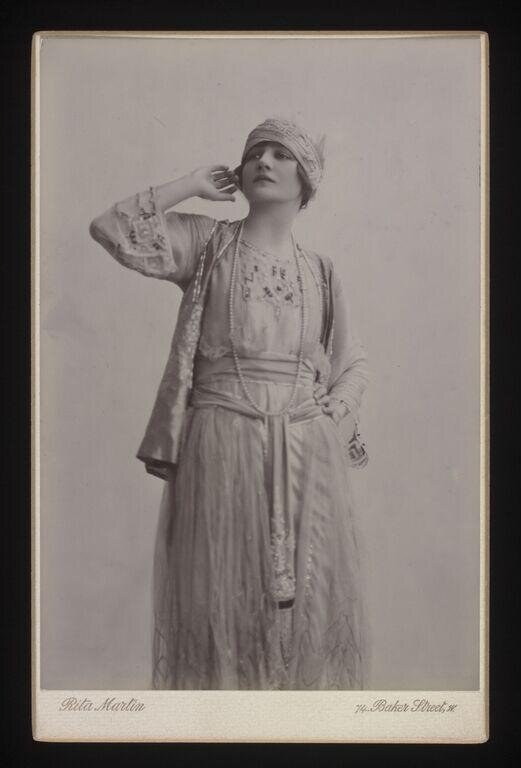
A studio portrait photograph of a woman in an elegant early 1910s gown, posed in a contemplative attitude against a plain backdrop. She wears a long, flowing dress of pale fabric with delicate embroidered or printed detail across the bodice and a decorative sash or panel draping from the waist. A matching shawl or stole is draped over one shoulder. Her head is covered with a close-fitting embroidered cap or head covering typical of the period. She gazes upward and to the side, her left arm raised to touch her head in a graceful, dreaming pose. The lighting is soft and even, characteristic of studio portraiture, creating minimal shadow and emphasizing the texture of the fabrics. The composition is a three-quarter length study, with the figure centered and the lower portion of her skirt fading toward the frame edge.
The dancing
The woman stands with her weight settled on one leg, creating a gentle asymmetry in her silhouette. Her raised left arm follows a line from shoulder through elbow to fingertips touching her cap, creating a sinuous vertical accent. Her right arm hangs at her side, the hand partially visible near her skirt. The pose is lyrical and introspective rather than dynamic—the body is not in motion but in an attitude of reverie or yearning. Her torso is erect; there is no weight transfer or partnering.
The dance depicted
The title "A Waltz Dream" and the dress, bearing strong resemblance to Edwardian ball gowns and theatrical costume of the period, suggest this is a theatrical or posed interpretation of waltz aesthetics rather than a captured moment of actual dance. The pose itself—the lifted arm, the upward gaze, the stationary stance—recalls the romantic vocabulary of early 20th-century theatrical dance and the idealized female dancer of the Romantic era. This is a portrait of a dancer in character or attitude, not a demonstration of waltz technique or partnering. The image belongs to the theatrical and promotional portraiture tradition of the Edwardian stage.
How it was made
This is a silver gelatin photograph, likely produced in a professional studio. The mounting card bears the photographer's mark "Rita Martin" and the studio address "ca Baker Street w" (presumably London's Baker Street). The print is well-executed with careful lighting and composed studio technique, suggesting a commercial portrait practice. The photograph's formal presentation and professional finish indicate it was made for circulation, likely promotional material for a dancer or theatrical performer of the period.
About this work
This is a studio portrait photograph of a performer identified as Rita Martin, dated 1911. The image captures a woman in theatrical costume posed in an attitude of romantic dreaming, titled "A Waltz Dream." It belongs to a rich tradition of Edwardian-era theatrical portraiture in which dancers were photographed in character and in costume, often posed to evoke the emotional and narrative content of the dances they performed rather than to document technique. The work sits at the intersection of theatrical dance, portrait photography, and the commercial promotion of performers at the turn of the 20th century. It is an artifact not of waltz technique but of how waltz and Romantic ballet were understood and marketed to audiences of the Edwardian stage.
How to look at it
Attend to the pose as an expression of narrative and emotion rather than of technical skill: the upward gaze and the hand raised to the head are gestures of longing or reverie, not positions demonstrating waltz technique. The costume—the embroidered cap, the flowing gown, the draped shawl—reads as Romantic-era theatrical dress, evoking a world of fantasy and dream that the title makes explicit. The stillness of the figure and the contemplative attitude convey the period's understanding of waltz as a vehicle for romantic feeling rather than as a social or technical practice.
The artist
Rita Martin was a professional dancer and performer of the Edwardian era. Beyond the attribution on this photograph and the studio address, little context is available in the current record. The professional quality of the portrait and the theatrical costume suggest she performed in London's West End or equivalent theatrical venues. The photograph's format and finish are consistent with the work of London society and theatrical photographers of the period.
The period
In the 1910s, theatrical dance in Britain was dominated by Romantic ballet, the legacy of 19th-century Romanticism, and the rising influence of Russian Imperial Ballet following Diaghilev's 1909 London seasons. The waltz, once a ballroom dance, had been absorbed into theatrical and ballet contexts as a vehicle for romantic expression. Studio portraiture of dancers was a major commercial practice, with photographs serving as publicity materials, mementos for audiences, and records of performers' roles and repertoire. The convention of posing dancers in costume and character, rather than in technical positions, was standard for commercial theatrical portraiture of this era.
Where it lives
The photograph is held in a collection marked "va" (likely the Victoria & Albert Museum or a related archive). It is a mounted studio print bearing the photographer's mark, indicating it was produced as a commercial theatrical portrait.
Dance in this work
Questions about this work
Is this a document of actual waltz dancing?
No. This is a posed studio portrait in which a performer is photographed in theatrical costume and attitude. The pose evokes the emotional content associated with the waltz in Romantic ballet—dreaming, longing, reverie—but does not capture or demonstrate waltz technique or partnering. It belongs to the tradition of theatrical portraiture rather than dance documentation.
What does the costume tell us?
The embroidered cap, flowing gown, and draped shawl are theatrical costume in the Romantic ballet idiom, evoking the aesthetic world of early 19th-century Romantic ballet rather than contemporary Edwardian ballroom dress. The costume codes the figure as a Romantic heroine—dreaming, yearning, inhabiting a fantasy world—which the title reinforces.
Who was Rita Martin?
The record identifies her only by name and the photograph's studio address on Baker Street, London. She was a professional performer in the Edwardian era, but beyond these details and the evidence of this portrait, little is known from the current record.
Why photograph dancers this way?
Theatrical portraiture served multiple purposes: promotion of performers to audiences, documentation of roles and costume, artistic record, and commercial sale of photographs as keepsakes. The pose and costume conveyed the emotional and narrative character of the dance or role, which was considered more important to capture than technical detail.
More dance artwork





