49 works in this view — arrow keys or swipe to move between them.
Dance in Art
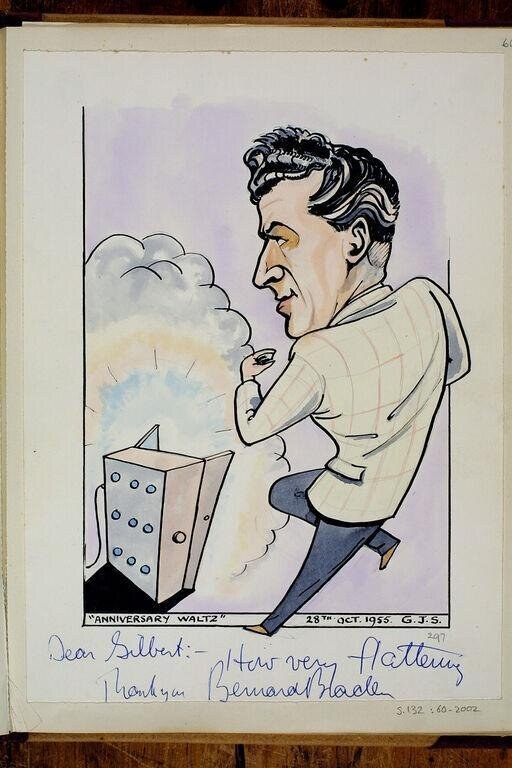
Bernard Braden in <i>Anniversary Waltz</i>
Sommerlad, Gilbert
- Collection:
- Caricature
- Source:
- Victoria and Albert Museum
- Rights:
- Rights vary by item — check the source record before reusing this image. Source record ↗
- Recorded as:
- V&A — check rights per item
It documents the crossing of ballroom dance and theatrical comedy in mid-century Broadway and British theatre, showing how waltz could be adapted for entertainment and character rather than competition. The caricaturist's eye captures something essential about performance: that the frozen moment of maximum comic effect is often not the moment of maximum technical precision.
What you are looking at
A caricature in ink and watercolour shows a man in profile, energetically mid-dance, leaning back with exaggerated posture. He wears a light jacket over a collared shirt and dark trousers. His face is drawn with sharp, comic features—a prominent nose and jutting chin—and his dark hair is swept back. To his left stands a large, boxy modernist structure with a grid of circular apertures, rendered in pale geometric planes. A cloud of white and blue smoke or mist billows from the top of this structure. The composition is intimate and comedic: the dancer's body curves away from the box as if propelled by it, his right hand raised expressively, his left arm bent. The drawing is signed and dated 23 October 1955, and inscribed at the foot in handwriting: 'Dear Gilbert: How very Matthewi [?] looking. Bernard Haeda' or similar. The work is a theatrical sketch, likely made to commemorate a performance or broadcast.
The dancing
A single male dancer shown in a dynamic, open frame with an exaggerated backward lean and raised arms. His posture is unstable and comic—weight appears to be thrown backward, the body arched, one arm extended expressively. The position suggests momentum, surprise, or comic collapse rather than technical ballroom form. The gesture is theatrical and caricatural, emphasizing personality and narrative over precision.
The dance depicted
The work documents Bernard Braden in a performance of *Anniversary Waltz*, a Broadway comedy that opened in 1954. The waltz is implicit in the title rather than explicit in the frozen moment; the exaggerated lean and comic collapse shown here may represent a comedic variation or theatrical interpretation of waltz choreography, rather than a classical closed-position waltz frame. The image captures ballroom dance as entertainment and comedy, where the form serves the narrative and humour of the stage production.
How it was made
A caricature executed in ink line with watercolour wash in blue, purple, and pale flesh tones. The technique is rapid and gestural, with bold outline work typical of theatrical caricature of the 1950s. The loose handling of the watercolour and the economy of the ink line suggest this was drawn quickly, likely from life or memory of a performance, for immediate circulation in press or theatre documentation. The style is characteristic of mid-century British theatrical illustration.
About this work
This is a theatrical caricature of actor and dancer Bernard Braden during a performance of the Broadway comedy *Anniversary Waltz* in 1955. Braden, known for his comic timing and physical comedy, is shown mid-dance in a moment of exaggerated, unstable posture that emphasises the humour of the scene rather than the formal beauty of ballroom technique. The modernist box beside him—possibly a theatrical prop or abstract set element—adds to the sense of staged comedic chaos.
The work belongs to a tradition of theatrical caricature and performance documentation that was central to how dance and theatre were reviewed and circulated in mid-century Britain. It captures not the technique of the waltz but the persona of the performer and the comedic use of ballroom dance within dramatic narrative.
How to look at it
Notice the moment chosen: not the peak of the movement, but the moment of comic collapse or surprise, where the body is most unstable and most expressive of character. The caricaturist has exaggerated the backward lean and the facial expression to emphasise personality over formal posture. The boxy prop or set element is rendered in stark geometric abstraction, creating visual contrast with the loose, gestural drawing of the dancer's body. This is the opposite of a dance manual image—it captures the performer, not the technique.
The artist
Gilbert Sommerlad was a British caricaturist and illustrator active in the mid-twentieth century, known for theatrical and entertainment subjects. His work appeared in theatrical documentation and periodicals. This sketch exemplifies the rapid, observant style of theatrical caricature—drawing that aimed to capture personality and the essential energy of a performance in a few quick lines.
The period
In 1955, ballroom dance was a staple of Broadway entertainment and British theatre, distinct from the ballroom competition world that would later dominate public perception of the form. *Anniversary Waltz*, which premiered in 1954 and ran for two years, was a domestic comedy that used dance as a vehicle for character and humour. The same period saw ballroom dance in film and theatre treated as a form accessible to comedians and actors, not only to trained dancers. The modernist visual language of the set element in the background is typical of 1950s theatrical design.
Where it lives
The work is part of a caricature collection (source: va, likely the Victoria and Albert Museum). The inscription suggests it was a gift from or inscribed by Bernard Braden himself, indicating it circulated as a memento of the production.
Dance in this work
Questions about this work
Who was Bernard Braden?
Bernard Braden (1917–1992) was a Canadian-born actor and comedian who worked extensively in British and American theatre and television. He was known for comedy and physical performance. *Anniversary Waltz* was one of his Broadway successes in the early 1950s.
What is Anniversary Waltz?
*Anniversary Waltz* was a Broadway comedy that premiered in 1954, running for two years. It centred on a married couple and used dance, including waltz sequences, as part of its comic and romantic narrative. The play was adapted for film and television.
Is this a ballroom dance image?
It documents ballroom dance—specifically the waltz—but as a theatrical entertainment rather than competition or social dancing. The caricature captures the comedic and performative use of the form, not its technical content.
What is the box beside the dancer?
The geometric box is likely a theatrical prop or abstract set element, part of the *Anniversary Waltz* staging. It may be architectural, decorative, or abstract—the caricature does not provide enough context to determine its exact function in the production.
More dance artwork





