49 works in this view — arrow keys or swipe to move between them.
Dance in Art
Le Perichole Waltz
Charles Coote
- Collection:
- Source:
- Victoria and Albert Museum
- Rights:
- Rights vary by item — check the source record before reusing this image. Source record ↗
- Recorded as:
- V&A — check rights per item
This work documents the vital but often invisible link between theatrical music and ballroom practice in the 19th century: how opera melodies became dance music, and how the published image of exotic operatic costume and spectacle shaped the aesthetic aspirations of amateur dancers and musicians. It also shows how waltz music and imagery were commercialised and distributed to a mass market.
What you are looking at
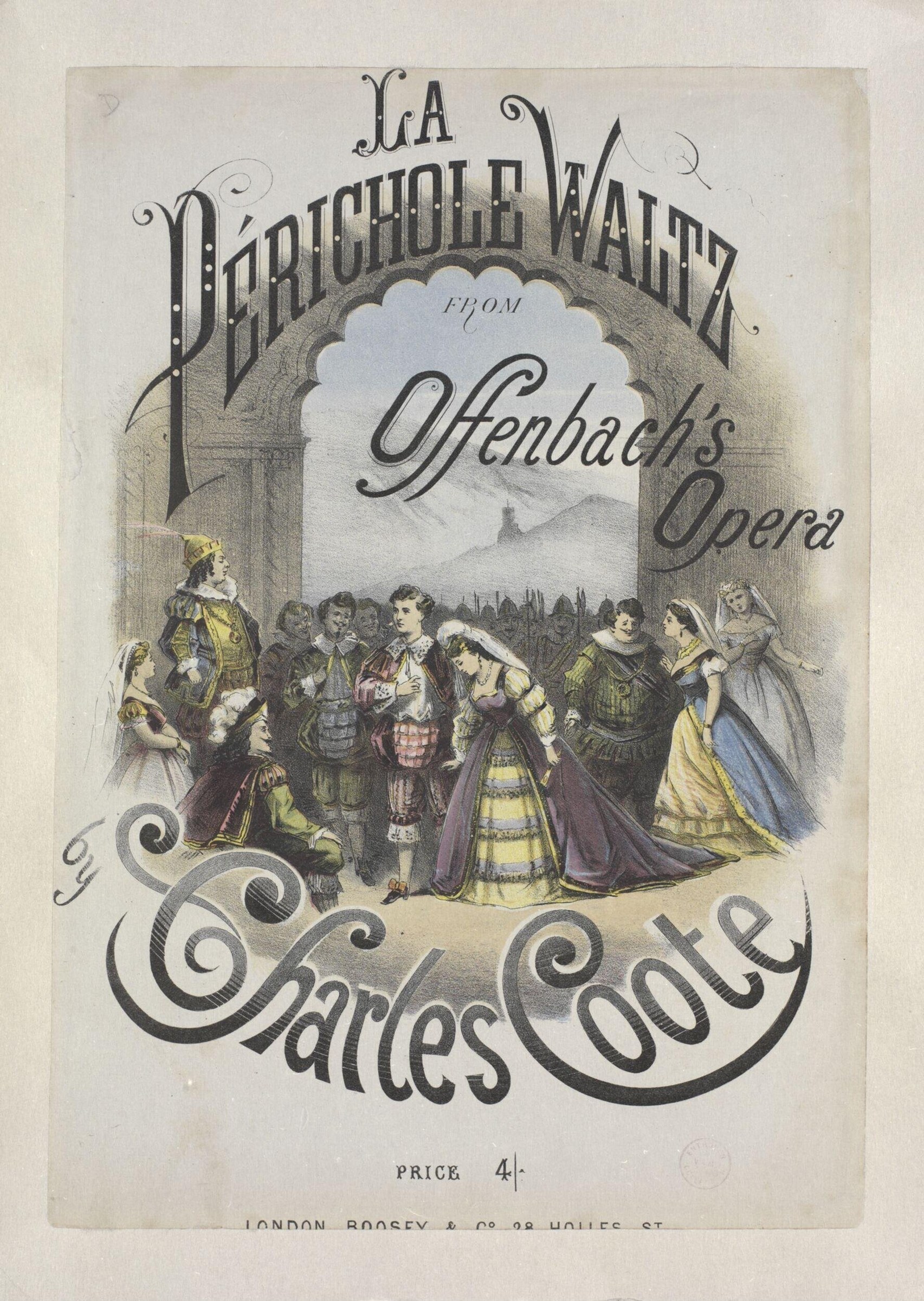
This is a title page for a musical waltz based on Offenbach's opera *La Périchole*, published by Boosey & Co. in London. The composition shows a theatrical archway framing a distant cityscape (likely Lima, Peru, the opera's setting) with a group of opera characters posed in period costume on the stage before it. The figures are arranged in a loose semi-circle: men in military uniforms with plumed hats and ornate jackets in yellows and reds; women in elaborate ball gowns with full skirts in jewel tones—purples, blues, and yellows with gold trim. The lighting is atmospheric, with the sky beyond the arch rendered in soft grey wash. The overall tone is festive and theatrical, capturing the exotic glamour the opera promised to European audiences. The price marked on the cover—4 shillings—indicates this was a commercial publication aimed at middle-class domestic musicians.
The dancing
The figures are posed rather than captured mid-movement, standing upright in formal stances typical of staged presentation. Several of the women hold their arms at their sides or slightly raised; the men stand at attention in military posture. No couple appears to be in a closed dance hold. The spacing between figures suggests a processional or ensemble grouping rather than paired dance partners. The dress is ballroom formal—these are not folk dancers or acrobats but operatic principals and chorus members portraying aristocratic society.
The dance depicted
The work depicts a waltz derived from Offenbach's 1868 opera *La Périchole*. The waltz was a standard ballroom dance and concert form by the 1870s–80s, popular both in the ballroom and as a concert piece for piano or small ensemble. The opera itself is set in 18th-century Peru; Offenbach's music was exotic and comic in intent, a parody of high Spanish and South American culture. This arrangement for piano would have been played in parlours and at dances by both amateur musicians and professionals. The image shows the theatrical rather than ballroom context—these are opera singers in costume, not dancers executing the waltz, but the waltz as dance and musical form is the subject of the publication.
How it was made
This is a colour-printed title page, likely chromolithograph or hand-coloured engraving, a standard format for commercial sheet music covers of the 1870s–1880s. The engraved and printed title and lettering are integrated with a tinted illustration. The technique allowed for mass production and wide distribution; music publishing houses such as Boosey & Co. used such covers to advertise both the music and the theatrical spectacle it referenced. The aesthetic—decorative lettering, romantic illustration, affordable price—speaks to a market of middle-class amateur musicians for whom opera arrangements and dance music were staple purchases.
About this work
This is a commercial music cover for a piano waltz arrangement of themes from Offenbach's *La Périchole*, published in London in the late 19th century. It sits at the intersection of theatrical entertainment and domestic music-making: the image advertises an opera through dance music meant to be played at home. The waltz was the dominant ballroom dance of the century, and arrangements of famous operatic melodies were a primary vehicle for bringing theatrical glamour into the drawing room. As an artifact, it records not a moment of actual dance but the cultural appetite for exotic theatricality and the centrality of the waltz to that appetite.
How to look at it
This is not a depiction of dance in action but a theatrical advertisement rendered through the visual language of waltz-era popular culture. Notice the decorative lettering and theatrical framing—the archway is a picture-within-a-picture, suggesting the proscenium arch of the opera stage. The costumes and formal poses signal 'society' and 'spectacle' rather than movement. The composition is heraldic and promotional: the point is not to show how the waltz is danced but to attach the fashionable allure of Offenbach and operetta to the waltz form, thereby selling the music to amateur musicians.
The artist
Charles Coote is recorded as the artist. The name is otherwise obscure in dance or art history; he appears to have been a commercial illustrator for London music publishers, producing theatrical title pages and illustrations for sheet music in the 1870s–1880s. Such artists were rarely celebrated as fine artists but were crucial to the visual culture of music consumption.
The period
The waltz had become the dominant ballroom dance of the 19th century after the Napoleonic Wars, spreading from Vienna across Europe and the Americas. By the 1870s, it was ubiquitous in both ballrooms and concert halls. Offenbach's operettas, comic and musically sophisticated, were immensely popular from the 1850s onward; *La Périchole* premiered in 1868 and was frequently performed and adapted. The exoticism of the Peru setting reflects the era's fascination with non-European cultures, often presented through an Orientalist or Romantic lens. Sheet music covers of this period were themselves a significant art form, using colour printing technology to create miniature theatrical scenes that would attract buyers.
Where it lives
This is a printed sheet music cover from a London publisher, Boosey & Co., 28 Holles Street. It represents the commercial production and distribution of dance-derived music to the Victorian middle class.
Dance in this work
Questions about this work
Was this music actually used for dancing?
Yes. Waltzes arranged from opera were standard ballroom and social dance music throughout the 19th and early 20th centuries. Such arrangements would have been played by orchestras at balls and by pianists at private parties. The cover advertised the music's theatrical pedigree, but the waltz itself was a social dance form.
What is Offenbach's *La Périchole*?
*La Périchole* is an operetta (comic opera) by Jacques Offenbach, first performed in 1868. It is set in 18th-century Peru and tells a satirical story of a street singer. Offenbach was the dominant composer of French operetta, and his works were enormously popular across Europe and in the Americas.
Who would have bought this music?
Middle-class amateur musicians, primarily women, who played piano in the parlour. The 4-shilling price (a modest sum for the era) indicates this was affordable popular music, not a luxury item. Such pieces were a staple of domestic entertainment.
Is this waltz still danced?
The specific arrangement has likely fallen out of use, but the waltz itself remains a foundational ballroom dance in both competitive and social contexts. Waltz music from this era continues to be played and danced.
More dance artwork





