49 works in this view — arrow keys or swipe to move between them.
Dance in Art
Doris
Nicholas Hanhart
- Collection:
- Music score
- Source:
- Victoria and Albert Museum
- Rights:
- Rights vary by item — check the source record before reusing this image. Source record ↗
- Recorded as:
- V&A — check rights per item
This image documents the theatrical waltz as a multimedia form in which music, narrative, and spectacle were integrated—a context in which 'dance' was not distinct from dramatic performance or scene painting. For scholars and dancers interested in how dance functioned in popular theatre and music-hall culture, this reproduction reveals the visual conventions and commercial apparatus surrounding theatrical musical works.
What you are looking at
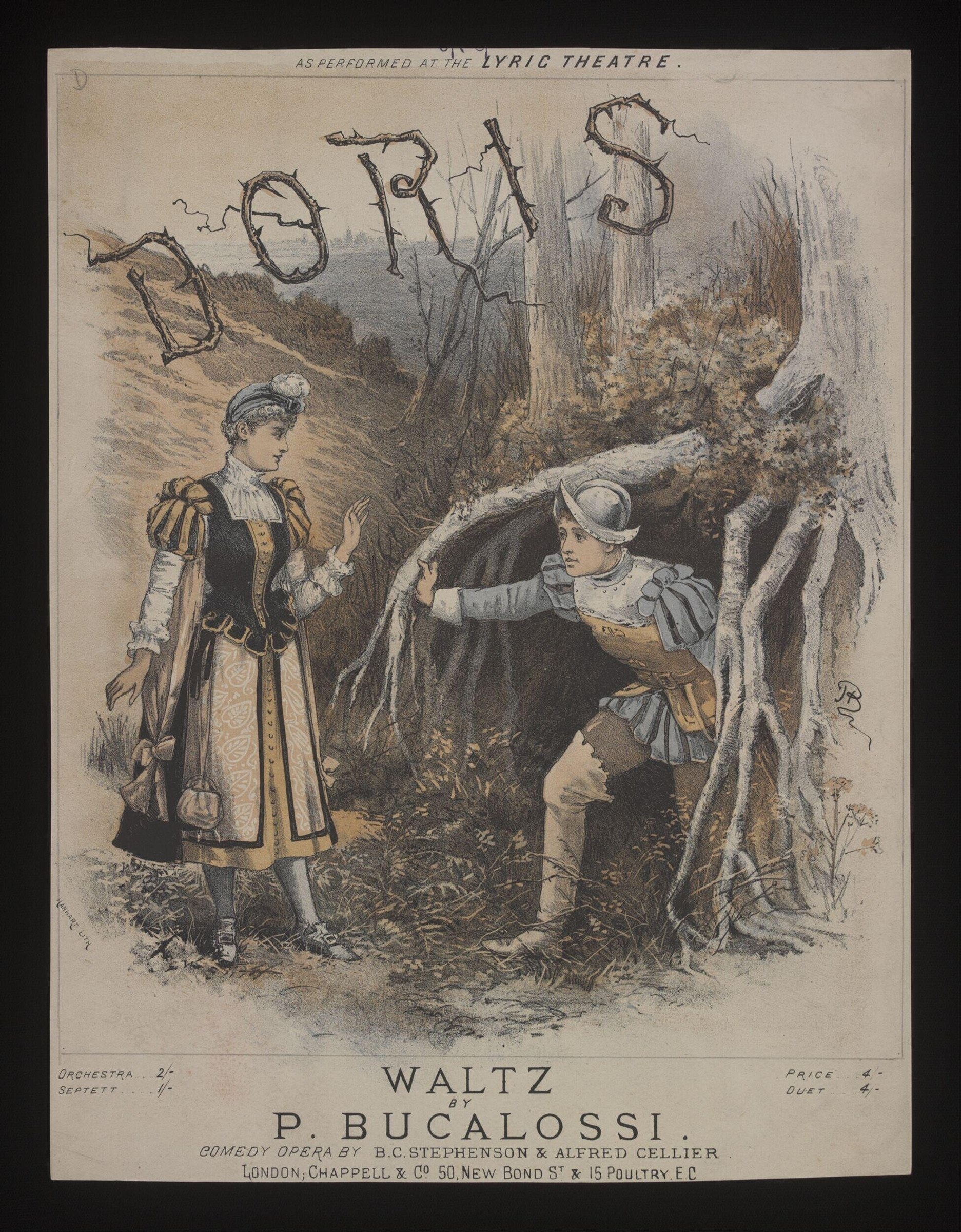
Two young women encounter each other in a wooded glade. The woman on the left wears a richly decorated jacket with puffed sleeves and a long skirt, her posture upright and formal; the woman on the right, positioned lower in the composition as if seated or crouching, wears a similar period costume with a hat and gestures expressively toward her companion. Bare tree trunks frame the scene—some with visible striations suggesting they have been stripped or marked—and the background dissolves into a misty woodland rendered in soft brown and grey tones. The title "DORIS" is lettered in large serif capitals at the top of the composition, with "WALTZ BY P. BUCCALOSSI" and production credits below. The overall mood is romantic and theatrical: the encounter is staged as a crucial moment between two characters, and the careful attention to period costume and natural setting suggests this is a scene from a theatrical production rather than a spontaneous meeting.
The dancing
Neither figure is actively dancing; both are arrested in conversational gestures. The standing woman on the left holds one arm extended with an open palm, as if speaking or gesturing in emphasis, while maintaining an erect, dignified carriage. The seated woman below and to the right looks upward, one arm raised in response. Their relationship appears intimate and dramatic—this is not a dance frame or position but a moment of social interaction frozen as if between musical phrases or narrative beats. The composition emphasizes their faces and upper bodies; their lower bodies are less clearly defined, suggesting the artist prioritized legibility of expression and costume detail.
The dance depicted
This is a scene from a theatrical musical work—specifically a waltz composition by P. Buccalossi—as performed at the Lyric Theatre. The work is titled "Doris," and this particular image may represent a scene from the narrative drama accompanying or framing the waltz rather than a depiction of the waltz itself. The waltz as a theatrical form in the late 19th and early 20th centuries often combined choreographed dance with pantomime and spoken drama, especially in operatic and music-hall contexts. The image captures not the dance proper but a charged dramatic moment between two characters, suggesting the waltz was part of a larger theatrical vehicle rather than a concert piece. Without access to the full score or production history, the specific narrative context cannot be determined.
How it was made
This is a color-printed engraving or chromolithograph, a mass-market reproductive process that allowed color theatrical illustrations to be disseminated widely and affordably. The technique is evident in the layered application of color—browns, greys, and ochres for the landscape and tree trunks; careful hand-coloring or tint stone application for the figures' clothing; and the characteristic fine linework of engraving defining facial features and decorative details. The paper is cream-colored and shows age. This was a standard format for advertising theatrical productions and music scores in London publishing; the credit line identifies the publisher as Chappell & Co., a major London music house. Such prints would have been displayed in theatre lobbies, music shops, and distributed with sheet music sales.
About this work
This is a theatrical illustration promoting a waltz composition by P. Buccalossi, performed at the Lyric Theatre in London. Rather than showing dancers executing a waltz, it depicts a dramatic moment between two female characters dressed in late Victorian or Edwardian period costume, meeting in a wooded setting. The image is part of the material apparatus of theatrical commerce—a color-printed engraving designed to advertise both the musical work and the theatrical production that featured it. It belongs in a dance collection because the waltz as a theatrical and social form was central to the musical and choreographic culture of the period, and because theatrical illustrations such as this shaped how audiences understood the relationship between music, narrative, and movement on stage. The work shows how 'dance' in popular theatrical contexts of this era was inseparable from drama, spectacle, and the marketing machinery that surrounded theatrical performance.
How to look at it
Attend to the moment chosen: not the waltz itself but the narrative encounter that either precedes or frames it. The artist has frozen a moment of social drama—two women meeting, communicating something through gesture—to convey that this musical work has a story. Note how the engraver has emphasized facial expression, costume detail, and pose rather than the bodies' spatial relationship or positioning; this reflects the priority of theatrical narrative and character over pure dance visualization. The bare trees and soft, romantic landscape are generic conventions of the theatrical picturesque, not a naturalistic setting—they signal 'forest scene' to the viewer.
The artist
Nicholas Hanhart was a London-based engraver and illustrator active in the late 19th and early 20th centuries, working primarily on theatrical and musical subjects for the sheet-music and performing-arts industries. He was one of many reproductive printmakers producing chromolithographed theatrical illustrations for publishers like Chappell & Co., working in a tradition that valued clear, decorative, accessible imagery suited to commercial distribution.
The period
The late Victorian and Edwardian era saw the theatrical waltz thrive as a hybrid form—part concert music, part staged spectacle, part social dance. Composers like Waldteufel, Strauss, and Buccalossi created waltzes that were performed both in ballrooms and on concert and theatrical stages. The period also saw the rise of the illustrated sheet-music cover as a major form of theatrical publicity and a vehicle for chromolithographic printing. Music publishers competed for market share by commissioning attractive, genre-specific illustrations. The figure types and costume here—young women in fashionable dress, a woodland setting evoking romance and Nature—were stock conventions of theatrical and popular-music imagery of the period.
Where it lives
This is a color-printed engraving published by Chappell & Co., the London music publisher and retailer, and distributed with or as advertisement for the sheet music of Buccalossi's waltz. It belongs to the category of theatrical and musical illustration used to promote performances and score sales in the late 19th and early 20th centuries.
Dance in this work
Questions about this work
Is this a depiction of actual dancers performing a waltz?
No. This is a dramatic or narrative scene featuring two characters in period costume in a woodland setting. It illustrates the theatrical context or story surrounding the waltz composition rather than the dance itself. The figures are posed in conversational gestures, not dance positions or holds.
Who was P. Buccalossi?
Buccalossi was a composer of theatrical music and waltzes active in the late 19th or early 20th century, whose works were published and performed in London. 'Doris' appears to have been a theatrical waltz—a musical composition designed for theatrical performance with narrative or dramatic content.
What is the Lyric Theatre?
The Lyric Theatre was a London theatre active in this era (there were several theatres with this name at different periods). The credit line indicates this scene was 'as performed at the Lyric Theatre,' meaning this illustration promoted a production staged there.
How were illustrated sheet-music covers used?
Such chromolithographed covers and promotional prints served multiple purposes: they were bound with or wrapped around published sheet music, displayed in music shops and theatre lobbies, and distributed as advertisements for theatrical performances and composers' works. They were an important form of visual marketing for the music and theatre industries.
More dance artwork





