49 works in this view — arrow keys or swipe to move between them.
Dance in Art
Print Collection
Brandard, John
- Collection:
- Source:
- Victoria and Albert Museum
- Rights:
- Rights vary by item — check the source record before reusing this image. Source record ↗
- Recorded as:
- V&A — check rights per item
This image is a primary-source record of how Romantic ballet was packaged and consumed by the London public in the 1840s. It shows not only the costume and aesthetic ideals of the period but also how commercial printmaking made ballet celebrity and technique accessible to a broad audience, establishing visual conventions that shaped public understanding of what ballet was and should be.
What you are looking at
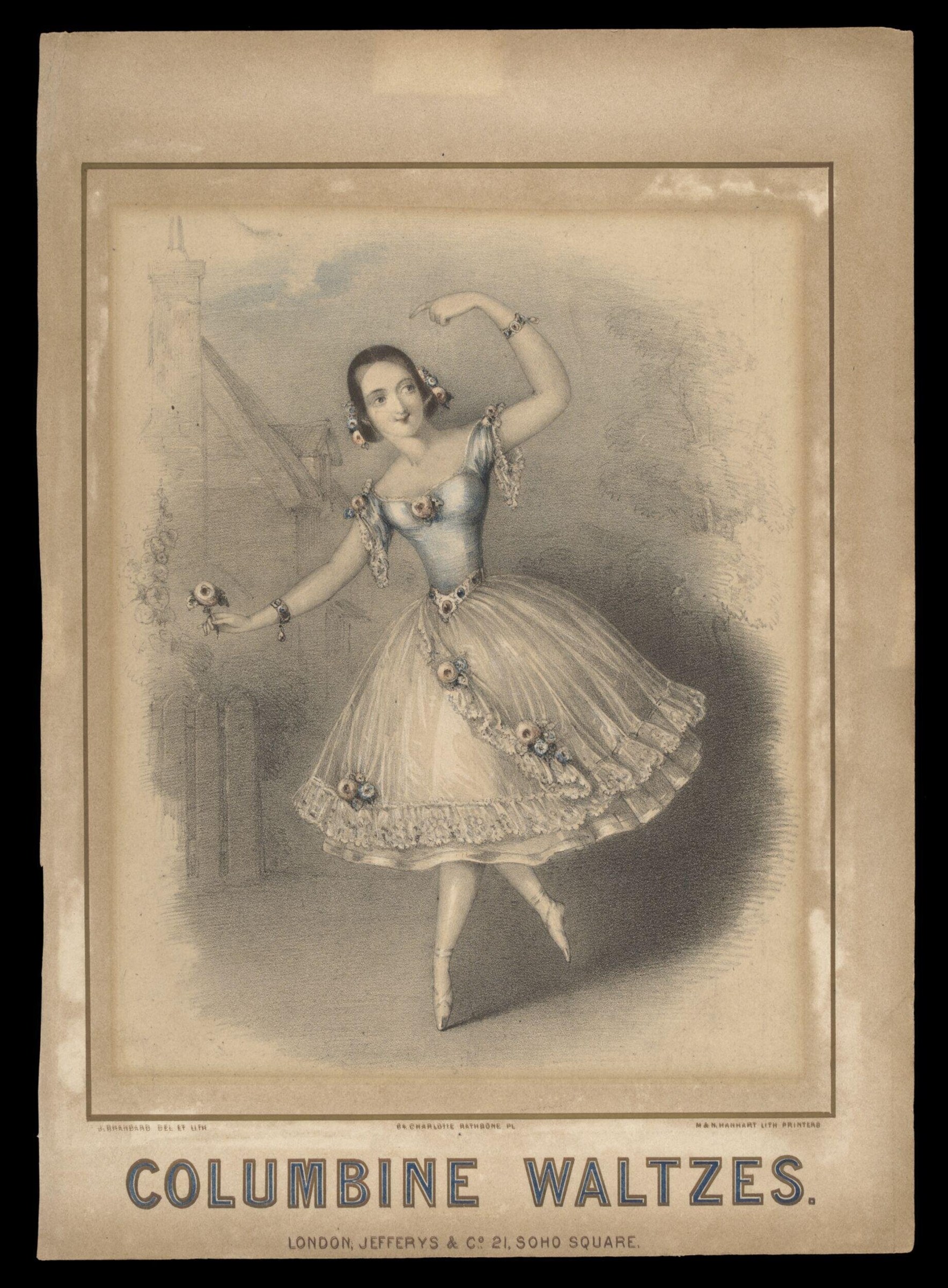
A young woman in Romantic-era ballet costume dances alone against a hazy architectural background. She wears a fitted bodice with short draped sleeves and a voluminous tulle skirt reaching to mid-calf, decorated with floral garland swags. Her dark hair is styled close to her head with ringlets and adorned with flowers. She stands in a graceful contrapposto pose, one leg supporting her weight while the other extends behind, her arms raised—one extended to the side at shoulder height, the other lifted near her head in a characteristic pose of 1840s ballet. The background suggests an interior or stage setting with architectural elements rendered in soft focus. The overall effect is ethereal and weightless, emphasizing the dancer's delicate frame and the buoyancy of her costume.
The dancing
A single female figure dominates the composition. She balances on one leg in what appears to be a penché or attitude-like position, with elegant upward reach through her torso and arms. The supported leg is extended and turned outward; the working leg appears lightly placed. Her arms frame the body asymmetrically—one soft and raised, one extended—creating an open, lyrical silhouette. The pose emphasizes verticality and weightlessness characteristic of Romantic ballet, with careful attention to the line from hip through fingertip.
The dance depicted
This is a Romantic ballet image from the 1840s, depicting the style of ethereal, otherworldly femininity that dominated the period. The costume, pose, and presentation are consistent with the celebrated Romantic ballets of the era—particularly the vocabulary visible in works like *La Sylphide* (1832) and *Giselle* (1841). The pose, costume vocabulary, and single female figure against an abstracted setting are all hallmarks of the Romantic ballet aesthetic. The dancer appears to be captured mid-phrase in a moment of suspended grace, typical of the choreographic ideals of Adolphe Adam, Jules Perrot, and other leading choreographers of the period.
How it was made
This is a hand-coloured lithographic print, as indicated by the inscription at the bottom crediting 'M. & N. Hanhart Lith Printers' and publishers Jefferys & Co. The soft, atmospheric quality and the precise rendering of the tulle skirt and facial features are characteristic of mid-19th-century dance prints. The lithographic process allowed for subtle gradations of tone and fine detail while remaining reproducible and affordable, making such prints standard publicity and souvenir items for dancers. Hand-colouring was applied after printing, which accounts for the delicate watercolour-like tones in the skin, flowers, and architectural background.
About this work
This is a lithographic print celebrating a Romantic ballet dancer, likely a souvenir or promotional image from a London performance in the 1840s. The title *Columbine Waltzes* indicates that the work is associated with comic-theatrical dance, yet the image itself depicts a thoroughly Romantic ballerina in classical dress. The print exemplifies how dance imagery functioned in Victorian popular culture—as both documentation of performance style and as idealized, marketable imagery of the ethereal feminine form. The work sits at the intersection of theatrical promotion, fine printmaking, and the Romantic movement's fascination with otherworldly beauty.
How to look at it
Observe the pose carefully: the dancer is not in a static symmetrical position but captured mid-movement, with the weight shifted and the limbs arranged to suggest continuous motion. The tulle skirt is rendered with great precision, showing how the lightweight fabric would have moved and caught light on stage. The soft focus of the background and the precise detail of the figure create the illusion of a spotlight isolating the dancer against the theatre interior—a visual convention of the period that mimics stage lighting.
The artist
John Brandard was a London-based printmaker and lithographer active in the mid-19th century, specializing in theatrical and dance imagery. He worked with publishers Jefferys & Co. in Soho Square to produce hand-coloured lithographs of celebrated performers, particularly dancers. His prints were common souvenirs and promotional materials for London theatres, capturing the likenesses and costumes of leading artists of the day.
The period
The 1840s were the height of the Romantic ballet era in Europe. *Giselle* premiered in 1841, *La Sylphide* had transformed ballet a decade earlier, and the sylph—a supernatural, weightless, ethereal female figure—had become the dominant ideal in choreography and visual culture. London was a major centre for ballet performance, with the King's Theatre and Theatre Royal competing to present celebrated dancers from the Continent. Lithographic prints like this one were standard merchandise sold in theatre lobbies and print shops, creating a parallel visual culture of dance celebrity and technique.
Where it lives
This print is held in the Virginia Museum (accession code VA). It is a commercial lithographic print published by Jefferys & Co., London, with hand colouring applied. The inscription credits M. & N. Hanhart as printers and identifies the work as one of a series of theatrical prints.
Dance in this work
Questions about this work
Is this a portrait of a real dancer?
The title *Columbine Waltzes* and the idealized, stylized rendering suggest this is not a portrait of a specific named performer but rather a type—the Romantic ballerina as a stock character in popular theatre. The image represents an ideal rather than an individual. However, the skill and specificity of the costume rendering indicates the artist had access to performance or costume documentation.
Why is this called a waltz if it's ballet?
Columbine is a comic-theatrical character from the commedia dell'arte tradition, often appearing in pantomimes and lighter theatrical works. The *Columbine Waltzes* may have been a performance piece combining elements of comic theatre, dance, and music, or the title may simply have been a theatrical label used in the 1840s London programme. The image itself shows a Romantic ballet aesthetic regardless of the performance context.
How was this made?
A lithographic stone was drawn and processed, then printed in black ink. After printing, each copy was hand-coloured with watercolours or watercolour-based paints, applied by a colourist. This made each print slightly unique while remaining affordable and reproducible—key to the commercial success of theatrical prints in Victorian London.
What does her pose tell us about the ballet technique of the period?
The emphasis on verticality, turned-out legs, raised arms, and the apparent balance on a single leg all reflect the classical vocabulary developing in the 1840s. The pose shows the influence of the ascending, ethereal aesthetic Romantic choreographers valued. However, the artist's interpretation is more idealized than documentary—a real ballerina would likely adopt slightly different weight distribution in such a position.
More dance artwork





