49 works in this view — arrow keys or swipe to move between them.
Dance in Art
Été 1931
Madeleine Wallis
- Collection:
- Fashion design
- Source:
- Victoria and Albert Museum
- Rights:
- Rights vary by item — check the source record before reusing this image. Source record ↗
- Recorded as:
- V&A — check rights per item
This work documents the material culture of 1930s social dance—specifically, how fashion designers engineered dresses to enable and enhance ballroom movement. The tiered skirt construction is not decorative ornament but functional engineering, allowing the wearer to rotate, sway, and execute the rise-and-fall and sway of the Waltz and Foxtrot without restriction. For historians of both fashion and dance, this sketch reveals how closely couturiers worked within the kinetic constraints and possibilities of contemporary ballroom practice.
What you are looking at
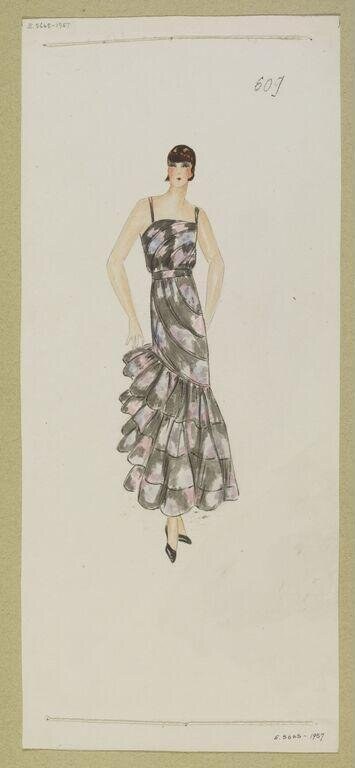
A single female figure stands against a plain cream background, posed in elegant contrapposto. She wears a sleeveless, fitted evening dress with a sweetheart neckline and a dramatically tiered skirt that cascades downward in a series of ruffled, spiral-layered panels. The skirt construction creates a sculptural, fountain-like silhouette that extends to mid-calf; the multiple tiers are shaded in charcoal and graphite to suggest dimensional volume and movement. The dress appears to be rendered in a swirling pattern—possibly geometric or abstract—across the bodice and upper skirt. The figure has dark, waved hair in a 1930s style, minimal facial features, and wears dark pointed-toe shoes. Her posture is upright and formal, with arms relaxed at her sides, suggesting either a presentation pose or the moment before or after a figure in motion.
The dancing
The single figure stands in a neutral, elongated pose with weight evenly distributed. The silhouette is columnar above the waist, with narrow shoulders and a fitted bodice, then expands dramatically below into the tiered skirt. The arms hang naturally, and the small feet are angled slightly inward. The pose suggests either a modeling stance or a moment captured during a turn or waltz—the spiral tiers of the skirt create the visual impression of arrested rotation, though the body itself is still.
The dance depicted
This is a fashion design sketch rather than a documentation of an actual dance, but it captures the silhouette and movement potential of 1930s evening wear designed for ballroom dancing. The construction and proportions—particularly the expansive, layered skirt—are consistent with designs intended for women's ballroom and social dance wear, likely for Waltz or Foxtrot. The tiered skirt design would create dramatic movement and visual interest during the rotation and sway of ballroom dancing. Whether this sketch represents a specific garment made or worn is unclear from the image alone.
How it was made
This is a fashion design sketch in graphite and charcoal on paper, rendered in a characteristic 1930s couture illustration style. The artist has used shading and cross-hatching to suggest volume, fabric drape, and pattern, while the figure itself remains relatively spare—a thin outline filled with carefully controlled tone. This technique was standard for haute couture and ready-to-wear design houses, allowing designers to communicate fabric behavior and silhouette to dressmakers and clients without photographic reproduction. The sketch's economy of line combined with precise shading suggests it was a working design or a presentation drawing.
About this work
This is a fashion design drawing titled Été 1931 (Summer 1931) by Madeleine Wallis, likely created for a couture house or commercial pattern design. The work sits at the intersection of fashion design and dance costuming—the tiered evening dress depicted here is explicitly designed for movement, and its proportions and construction suggest ballroom wear of the period. The sketch preserves a moment in design history when evening wear for social dance was undergoing refinement: the bias cut and spiral tiers visible here allow for the fluid, swaying movement essential to 1930s ballroom styles, while maintaining the formal elegance the period demanded. As a design drawing, it represents the blueprint between designer intention and the worn object.
How to look at it
Attend to the construction of the skirt: each tier is individually shaded and slightly offset from the others, creating the visual illusion that the skirt is mid-rotation or has just caught the air. The sketch captures not a static garment but the potential for movement inherent in its design. Notice how the artist has used charcoal to shade the interior of each tier, suggesting both shadow and fabric weight, and how the outline remains fluid and unbroken, suggesting the way such a skirt would flow in motion. The pose of the figure—formal and still—is a conventional fashion illustration stance, but it is the dress itself that implies dance and movement.
The artist
Madeleine Wallis was a fashion designer working in Paris or the European couture market during the 1930s. Little is currently documented about her independent practice, though her surviving sketches suggest she worked either as a freelance designer, for a fashion house, or created designs for commercial pattern publication. The style and execution of her work are consistent with commercial fashion illustration of the period, and the notation 'Été 1931' suggests seasonal collections or regular design output.
The period
In 1931, ballroom dancing was undergoing a technical refinement in both dance and dress. The 1920s had seen the rise of the Foxtrot and the refinement of Waltz technique; by the 1930s, ballroom dancing was moving toward standardization, particularly in competitive contexts. Parallel to this, fashion was shifting from the drop-waist, straight silhouette of the 1920s toward the fitted, bias-cut designs that celebrated the body's curves and movement. Designers like Madeleine Vionnet pioneered the bias cut specifically to allow fluid motion, and Wallis's spiral-tiered skirt is a variation on this principle—using layers rather than continuous bias to create controlled volume and movement. The 1930s evening dress was engineered for dancing in a way that earlier decades' designs were not.
Where it lives
This work is held in the Fashion Design collection of the V&A (Victoria and Albert Museum) in London, catalogued as a fashion design drawing. It is one of many such sketches preserved from the 1930s European couture industry.
Dance in this work
Questions about this work
Is this a sketch for a real dress, or an imaginary design?
The sketch presents itself as a working or presentation design, but the archive record does not indicate whether it was produced as a garment. Many such sketches were created for seasonal collections or pattern companies and may or may not have been manufactured. The precision and finish of this sketch suggest it was meant for presentation to a client or production team, but confirmation would require additional archival research.
Why is the skirt constructed in tiers rather than as a single bias-cut piece?
Tiered skirts offered several advantages: they were easier to construct than a full bias cut, allowed for pattern repeats in printed or patterned fabrics, and created a more structured silhouette while still allowing the freedom of movement required for ballroom dancing. The tiers also create a more visually dramatic effect of movement and rotation.
What dances would this dress have been worn for?
The design and proportions suggest this was intended for Waltz and Foxtrot—the primary social ballroom dances of the 1930s. The fit and skirt length are appropriate for these dances, and the tiered construction would enhance the visual impression of the rise, fall, and sway that characterizes them. It could also have been worn for general evening social dancing and formal occasions.
Who was Madeleine Wallis?
Very little is currently documented about Wallis's independent practice or biography. She appears in the archive as a fashion designer working in or around the 1930s, but her training, professional affiliations, and output remain largely unrecorded. She may have worked for a couture house, as a freelance designer, or for a pattern company; her surviving sketches suggest a professional practice, but further research would be needed to establish her career and influence.
More dance artwork





