49 works in this view — arrow keys or swipe to move between them.
Dance in Art
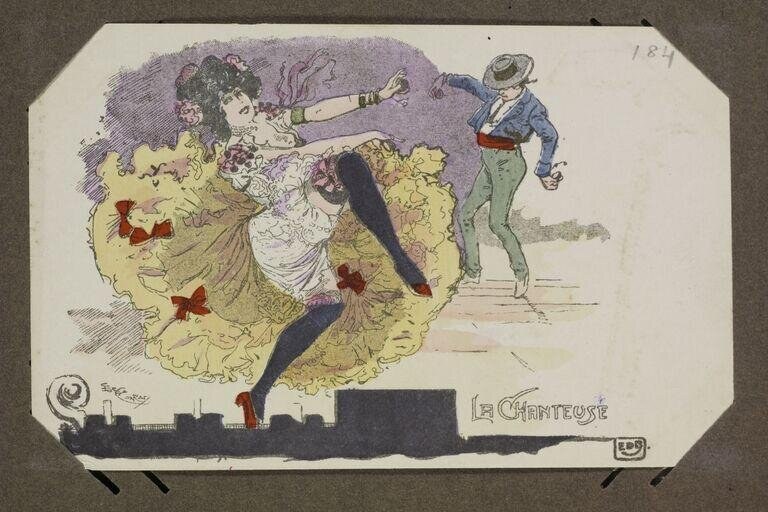
La Chanteuse
Unknown
- Collection:
- Postcard
- Source:
- Victoria and Albert Museum
- Rights:
- Rights vary by item — check the source record before reusing this image. Source record ↗
- Recorded as:
- V&A — check rights per item
Cabarets and music halls were where modern theatrical dance emerged outside ballet; their conventions of movement, costume, and spectacle influenced Modernist dance and visual art throughout the 20th century. Understanding how the *chanteuse* was depicted—her body, her pose, her relationship to the male gaze—reveals how dance and performance were gendered and consumed in the commercial culture of the period, and offers visual evidence of what contemporary audiences saw and desired.
What you are looking at
A cabaré scene depicting a female entertainer in a dramatic pose, caught mid-performance against a purple background suggesting stage lighting or atmosphere. The singer wears a voluminous yellow gown with red bows at the waist and décolletage, her body arched backward in an exaggerated contrapposto with one leg extended forward and her arm raised holding a cigarette holder or similar prop. Her dark hair is elaborately coiffed. To the right, a male figure in a blue jacket and straw hat watches from the side, his posture casual and detached, creating a dynamic tension between performer and observer. The composition is energetic and theatrical, with a silhouetted cityscape or building outline at the bottom suggesting a modern urban setting. The whole scene conveys the energy and sensuality of early 20th-century cabaret culture.
The dancing
The central female figure dominates through her exaggerated S-curve posture—an arched back, extended leg, and raised arm that reads as performance rather than natural standing. Her body is fully extended vertically and horizontally, creating maximum visual drama. The male observer on the right stands with weight on one leg, shoulders relaxed, creating a sharp contrast of active performer versus passive viewer. There is no partnering or closed hold; the woman performs for an audience, including the man shown.
The dance depicted
This depicts cabaret or music-hall entertainment of the Belle Époque or Edwardian era, the theatrical genre of European urban nightlife rather than ballroom or concert dance. The woman is a *chanteuse*—a singing entertainer—rather than a classical dancer, though her pose is highly choreographed for visual impact. The exaggerated arching and leg extension were conventions of cabaret performance designed to display the body provocatively and command attention. The gesture belongs to theatrical entertainment rather than any codified dance form; it is the language of spectacle and seduction that defined early 20th-century cabaré culture.
How it was made
This is a color lithograph or colored print, identifiable by the layered flat color, the crisp line work, and the decorative economy typical of commercial poster art or postcard production. The cataloguing notes it as a postcard, which determined its medium and intended circulation: these were mass-produced, affordable images distributed through the mail, allowing middle-class audiences to collect and display imagery of contemporary entertainment and urban life. The style is consistent with French Art Nouveau and Symbolist illustration of the 1900s, with its emphasis on sinuous line, dramatic gesture, and synthetic color. The signature and design of the card confirm it was a commercial product intended for the popular market.
About this work
This is a color lithographic postcard documenting the cabaret culture of early 20th-century Paris or a major European city, capturing the theatrical pose and costume conventions of the *chanteuse*—a female entertainer-singer who was central to Belle Époque nightlife. The exaggerated arched back, extended leg, and cigarette holder signal a performance designed to be watched, to provoke, and to display the female body as spectacle. The work sits at the intersection of dance history, theater history, and the visual culture of urban entertainment; while not ballet or concert dance, cabaret was a site where movement, costume, music, and sexuality converged into a recognizable performance genre that shaped popular culture and visual art.
How to look at it
The artist has frozen the performer at a moment of maximum visual and physical extension: the body is not in a natural stance but in a pose designed for effect. The arching and the extended leg are conventions of theatrical display, not functional movement. Note how the male figure's stillness and small scale emphasize the woman's dominance of the frame and her role as spectacle. The color and line work—the bright yellow against purple, the red accents, the sinuous curves—are part of the performance language, not naturalistic representation. The viewer is positioned as an audience member watching the cabaret show.
The artist
The artist is unknown, but the postcard was produced within a commercial printing and illustration industry that flourished in France and Central Europe in the 1900s. Cabaret postcards were a major product category, and the style here—Art Nouveau line, synthetic color, theatrical subject—was typical of this market. Many such cards were unsigned or credited only to a printer or publisher.
The period
The early 1900s saw the rise of cabaret as a distinct form of urban entertainment in Paris, Berlin, and Vienna, distinct from both classical theater and ballet. The *chanteuse*, often sensual or satirical in performance, became an icon of modernity and transgression, especially after the Moulin Rouge opened in 1889. Simultaneously, Symbolist and Art Nouveau artists were drawn to theatrical subjects and the human figure in exaggerated, expressive poses. The postcard medium itself was new and booming, allowing rapid circulation of images of contemporary entertainments to a mass audience. The visual conventions of the cabaret—the cigarette, the arched body, the elaborate costume—were being standardized and reproduced through images like this one.
Where it lives
Catalogued as a postcard held in an archive (source: va). The work is a commercial color print, mass-produced and distributed through postal and retail channels in the early 1900s. Postcards were intended as affordable collectibles and souvenirs of contemporary entertainment, making them a primary historical record of how audiences consumed and understood popular performance.
Dance in this work
Questions about this work
Is this a dance performance?
Not in the classical sense. This is a cabaret or music-hall entertainer, a *chanteuse* or singing performer. However, her movement—the arched back, extended leg, and overall theatrical pose—is highly choreographed for visual and erotic effect. Cabaret blurred the line between singing, dancing, and acting, and was a major site where modern theatrical movement developed outside ballet.
What is the cigarette holder for?
It is a prop and a status symbol. The cigarette was a modern, sophisticated accessory associated with urban nightlife and female independence in the early 1900s. It signals the entertainer's modernity and is part of her visual character as a worldly, knowing figure rather than a naive performer.
Who made this and when?
The artist is unknown, though the style and subject matter place it in the early 1900s, likely 1906 as noted in the catalogue. It was produced as a commercial lithographic postcard, a mass-market product. Many postcards of this era were unsigned or credited only to a publisher, making attribution difficult.
Why does the man look so uninterested?
His detachment is part of the composition's drama. He is positioned as a witness to the woman's performance, but his relaxed, almost bored posture contrasts with her theatrical energy. This tension between her active display and his passive spectatorship reflects the dynamics of cabaret as entertainment, where the performer works for the gaze of an indifferent or controlling audience.
More dance artwork





