49 works in this view — arrow keys or swipe to move between them.
Dance in Art
Kinney, Troy
- Collection:
- Source:
- Victoria and Albert Museum
- Rights:
- Rights vary by item — check the source record before reusing this image. Source record ↗
- Recorded as:
- V&A — check rights per item
The image records the visual grammar of late 19th-century concert dance at a moment when new aesthetics of the dancing body were emerging. For historians of Romantic ballet, early modern dance, and the figure of the dancer in visual culture, this print offers evidence of how artists understood and celebrated movement, emotion, and the female dancer's agency during a pivotal transition in dance history.
What you are looking at
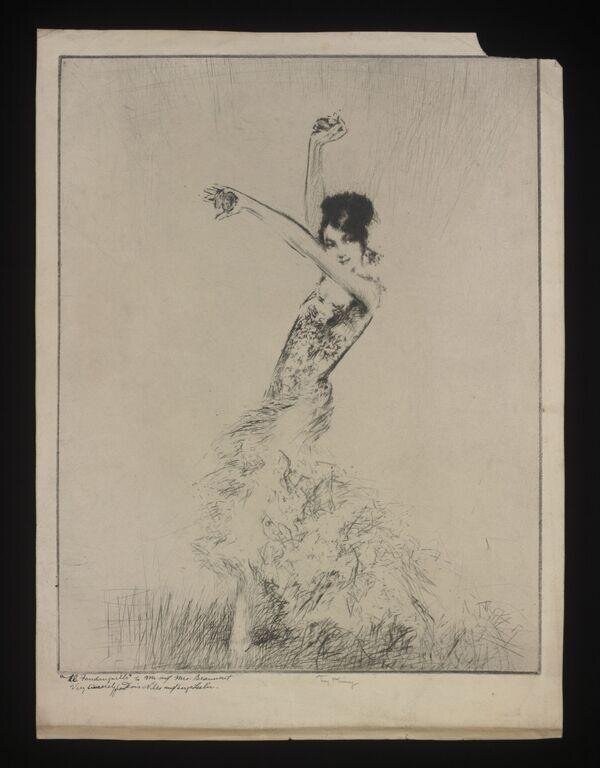
This is an etching or engraving depicting a single female figure in an attitude of joyous elevation or ecstasy. She rises from a ground densely sketched with vegetation and foliage, her body arching backward in an extended, airborne pose. Her upper body twists slightly, with both arms extended—one reaching upward and back, the other stretching forward—in a gesture of unfettered freedom. She wears a fitted, ornate costume with decorative patterning across the bodice and torso, suggesting either embroidery or jeweled detail. Her dark hair is styled up and away from her face. The figure's legs are lightly indicated beneath the costume, with the skirt or lower garment rendered in loose, energetic lines that follow the movement upward. The background is minimal: soft vertical hatching suggesting fabric or atmosphere. The composition isolates the dancer against this neutral ground, drawing all attention to her lifted, buoyant form and the emotional intensity of the gesture.
The dancing
A single female dancer occupies the composition, captured mid-movement in a strongly arched, backward-leaning pose that suggests both weightlessness and abandon. Her frame is extended and elongated—the torso curves dramatically, the arms frame an open upper body, and her weight appears suspended rather than grounded. There is no visible supporting partner or corps; this is a soloist's moment. The body position—extended arms, lifted chest, arched spine—reads as a pose that emphasizes verticality and aspiration rather than footwork or traveling movement. The costume is form-fitting and decorative, allowing the line of the body to be read clearly.
The dance depicted
The image likely depicts theatrical or concert dance from the late 19th or early 20th century, most probably Romantic or early modern ballet or interpretive dance. The pose—an extended, ecstatic backward arch with lifted arms—is characteristic of Romantic ballet's vocabulary of escape and transcendence, or of the emerging modern expressionist dance of the 1890s–1920s. The joyous upward reach and the solitude of the figure suggest a moment of emotional or spiritual awakening rather than a narrative pantomime scene. The ornate costume and the figure's apparent lightness point toward concert or theatrical rather than social dance. Without an inscription or further context, the specific work cannot be identified, but the aesthetic is consistent with Isadora Duncan-influenced interpretive dance or late Romantic ballet imagery.
How it was made
This is an etching or engraving—a fine-line intaglio print executed with a needle or burin on a metal plate (most likely copper). The evidence is the delicate parallel hatching that models form and tone, the precise control of line weight, and the way detail (such as the costume pattern and hair) is achieved through accumulated parallel strokes. The technique allows for subtle gradations of light and shadow while maintaining a strong linear sensibility. This mode of reproduction suggests a work intended for circulation among educated or affluent audiences through portfolios or exhibition prints, rather than mass reproduction.
About this work
This print captures an idealized moment of dance in a mode that was contemporary to its making: a solitary female figure in an attitude of transcendent joy, rendered through the delicate and precise language of line characteristic of late 19th-century etching. The work sits at the intersection of theatrical practice and fine art printmaking, documenting the aesthetic of uplift and escape that defined Romantic ballet and the early modern dance movement. It is a document both of what was performed and of how artists understood and celebrated the dancer's body during a period of profound change in concert dance—a moment when ballet was being challenged and reimagined by figures like Isadora Duncan, and when the figure of the dancer in art carried associations of liberation and transcendence.
How to look at it
Attend to the arch and reach of the body—this is not a balanced or grounded position, but one that emphasizes lift and aspiration. The artist has frozen the moment of greatest extension and emotional intensity, not a moment of repose or weight-bearing. Notice how the costume, though ornate, does not dominate the composition; instead, the line of the body is paramount. The sparse background and the figure's isolation against it make this a portrait of an ideal or an emotion rather than a narrative or a social scene. The etching technique itself—fine, precise, and labor-intensive—lends the image a quality of reverence and permanence appropriate to its subject.
The artist
Troy Kinney (1871–1938) was an American painter, illustrator, printmaker, and dance historian based in New York. He was prolific in etching and produced numerous prints of theatrical subjects, dancers, and society scenes during the early 20th century. Kinney was also the author of *The Dance: Its Place in Art and Life* (1914), an influential study of dance across cultures and history, demonstrating that his interest in dance was both visual and intellectual. His prints circulated widely and are held in major collections; he was a respected contributor to the illustrated press and produced work for exhibitions and private collectors.
The period
This print was made in 1952, but Kinney's practice as a printmaker and dance chronicler was established decades earlier, in the early 1900s. The image's aesthetic—the Romantic ballet vocabulary, the celebration of the solitary female dancer, the emphasis on spiritual and emotional transcendence—reflects the artistic currents of the 1890s–1920s, when Romantic ballet was being both preserved and reimagined, and when modern dance was challenging academic ballet. The late date of cataloguing may reflect the print's reissue or the collection's acquisition date rather than the work's original creation or first circulation.
Where it lives
The work is held in a print collection (the record notes 'Print' as both medium category and holding). The source annotation 'va' suggests a Virginia holding, though the specific institution is not recorded. Kinney's prints were widely distributed through exhibition and sale; many are now in major American museum collections.
Dance in this work
Questions about this work
What is the dancer doing?
She is arching her body upward in an attitude of ecstasy or transcendence, with both arms extended outward and upward. The pose suggests a moment of emotional or spiritual climax rather than a technical display of steps or footwork. This kind of elevated, opened, aspiring pose is characteristic of Romantic ballet and early modern dance, where the body is used to express inner feeling.
Who was Troy Kinney?
Kinney (1871–1938) was an American painter, printmaker, illustrator, and dance historian. He was prolific in etching and produced numerous prints of theatrical and dance subjects during the early 20th century. He also wrote *The Dance: Its Place in Art and Life* (1914), an influential historical and philosophical study that demonstrated his deep engagement with dance as both an art form and a cultural phenomenon.
Why was this print made?
Kinney's dance prints circulated among educated audiences as fine art and as documentation of theatrical practice. This image likely commemorated or idealized a type of solo dance performance that was fashionable during the early 20th century—the interpretive or expressive solo recital. Such prints served both as artworks in their own right and as a record of performance for audiences who could not attend live theater.
Is this a specific dancer or character?
The print does not contain an inscription identifying a named dancer or role. It is most likely an idealized or generic representation of the Romantic ballet or early modern dance aesthetic—a study of the dancing body in a state of transcendence rather than a portrait of a particular performance.
More dance artwork





