49 works in this view — arrow keys or swipe to move between them.
Dance in Art
Spellbound
Locke, Hew
- Collection:
- Drawing
- Source:
- Victoria and Albert Museum
- Rights:
- Rights vary by item — check the source record before reusing this image. Source record ↗
- Recorded as:
- V&A — check rights per item
The work exemplifies a moment in twentieth-century visual culture when artists turned to dance as a subject capable of expressing interiority, emotion, and the sublime—categories less legible in visual art. The technical achievement of rendering the moving body through accumulated ink marks rather than outline or gesture alone demonstrates how modernist formal experiment could be applied to dance imagery.
What you are looking at
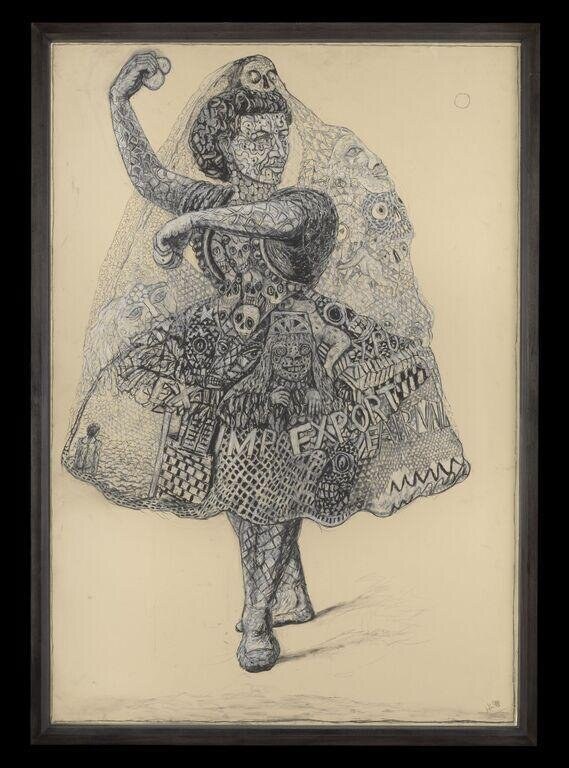
A single figure stands in three-quarter view against a blank ground, rendered in pen and ink with dense, intricate patterning. The dancer wears a voluminous, heavily decorated dress or robe that extends to mid-calf, its surface covered entirely in geometric patterns, organic motifs, and ornamental marks. The garment billows outward, creating a dramatic silhouette. One arm is raised and bent, the other held across the torso in a gesture suggestive of classical theatrical posture. The figure's head is tilted slightly back, the face rendered with careful attention to planes and shadow. The single visible leg extends forward and downward, planted firmly on a thin ground line. The overall effect is of a dancer captured mid-movement, arrested in a moment of expressive gesture.
The dancing
One figure in a contrapposto or near-contrapposto stance, with the weight shifted to one leg. The raised arm is bent at the elbow in an attitude that suggests either a classical port de bras or a moment of recoil or enchantment. The torso is upright and dignified, the head tilted back with an expression that reads as either rapture, shock, or surrender. The posture communicates theatricality and emotional intensity rather than technical virtuosity or social dance mechanics.
The dance depicted
The image likely depicts a figure from theatrical or concert dance, though the specific style is difficult to determine with certainty. The classical balletic port de bras and the moment of apparent emotional transport suggest Romantic or early-twentieth-century theatrical idiom. The title 'Spellbound' reinforces the reading of a figure under some supernatural or emotional influence—possibly a fairy-tale subject or a moment of trance or possession. The patterned costume is the work's dominant visual element and resists easy categorisation; it may be fanciful, ornamental dress rather than historically or ethnographically specific garment.
How it was made
The work is executed in pen and ink on paper, likely with fine-tip pen or nib. The entire surface is covered in controlled, repetitive mark-making—cross-hatching, stippling, linear patterns, and decorative motifs—that builds form and texture through accumulation rather than through line or wash. This technique allowed the artist to create optical texture and a sense of richness and complexity without relying on colour. The method is labour-intensive and suggests a work intended for circulation as a print, or as a finished drawing for its own sake.
About this work
This drawing presents a solitary theatrical figure arrested in a moment of apparent enchantment or emotion. The composition is frontal and iconic, treating the dancer less as a naturalistic body moving through space and more as a symbol or emblem of a state of mind. The overwhelming visual interest lies in the patterned costume and the careful rendering of the figure's emotional expression and posture. The work demonstrates a sophisticated interest in ornament, pattern, and the theatricality of the body—concerns that place it in twentieth-century modernist practice, yet the classical balletic vocabulary and the romantic title suggest engagement with earlier theatrical traditions.
How to look at it
Attend to the dense, obsessive surface patterning: the work is as much about the rhythm and variety of mark-making as about the figure itself. Notice the contrast between the carefully articulated gesture and expression of the face and body, and the abstraction and decorative excess of the costume. The title 'Spellbound' should prompt you to ask what state the figure is in—is this rapture, trance, fear, ecstasy, or possession? The back-tilted head and the arrested gesture suggest a moment outside normal bodily control.
The artist
Hew Locke (born 1959) is a British-Guyanese visual artist known for densely patterned, ornamental works that layer symbol, text, and decorative motif to explore questions of identity, colonialism, and cultural memory. His practice spans drawing, sculpture, and installation. Locke often employs obsessive mark-making and accumulative technique, filling surfaces with intricate pattern and detail. This drawing is consistent with his interest in figuration, ornament, and the decorative as a carrier of cultural and political meaning.
The period
The work dates to 1998, a moment when contemporary visual art was increasingly engaging with dance as both subject and formal model. In the 1990s, artists were mining dance history—particularly twentieth-century modernist and avant-garde dance—as a source for figuration and movement. Simultaneously, dance itself was becoming more integrated into contemporary art institutions. In British and international visual culture, there was renewed interest in ornament, pattern, and decorative excess as vehicles for artistic and political meaning, partly in response to the dematerialisation and austere formalism of earlier conceptual art.
Where it lives
The work is held in a drawing collection, catalogued as from the VA (likely the Victoria and Albert Museum, London, or another collection designated by that abbreviation). It is catalogued as a 'Drawing' without further medium specification, though the image confirms it is ink on paper.
Dance in this work
Questions about this work
Is this a figure from a specific ballet or dance?
The image does not correspond to any well-known, identifiable narrative ballet or character. The title 'Spellbound' and the figure's apparent emotional state suggest a fairy-tale or magical subject, but the work appears to be a studio or imaginative figure rather than a representation of a performed role. The patterned costume is ornamental and fantastical rather than historically or ethnographically specific.
What is the significance of the patterning covering the entire figure?
The dense patterning is central to the work's meaning and technique. It transforms the figure into a surface, suggesting that the body is not naturalistic or anatomically studied, but rather a canvas for ornament, symbol, and decorative meaning. This aligns with Locke's broader practice of using pattern and ornament to explore identity and cultural layering.
Why would a visual artist depict a dancer?
Dance offered twentieth- and twenty-first-century visual artists a way to explore movement, emotion, transformation, and the human body beyond naturalism. A dancer's pose, gesture, and the notion of the body in transition allowed artists to compress narrative, emotion, and formal concerns into a single figure.
More dance artwork





