49 works in this view — arrow keys or swipe to move between them.
Dance in Art
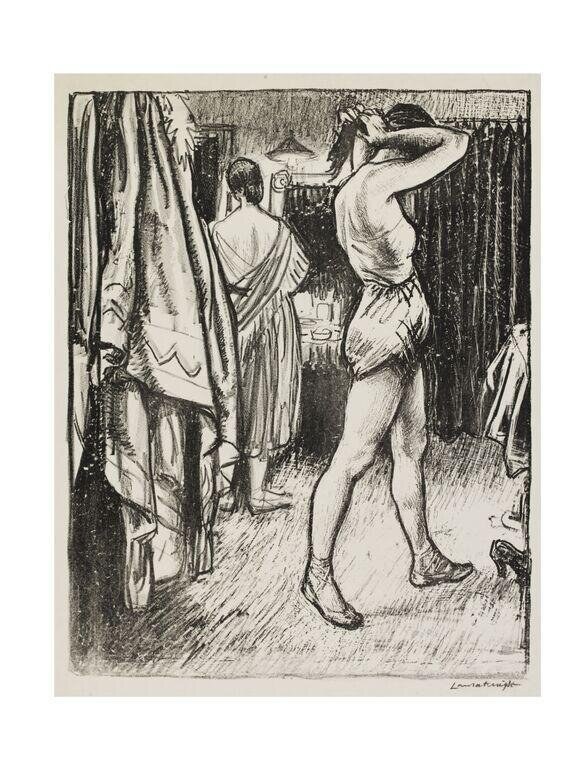
Two dancers in a dressing room
Knight, Laura
- Collection:
- Source:
- Victoria and Albert Museum
- Rights:
- Rights vary by item — check the source record before reusing this image. Source record ↗
- Recorded as:
- V&A — check rights per item
This work documents the everyday physical reality of a dancer's body and labour in a period when most dance imagery celebrated the polished product of performance rather than its preparation. It is a rare backstage view that treats the dressing room as a legitimate subject for serious artistic attention, and it shows how dancers of the 1920s understood their own bodies—not always as instruments of beauty, but as matter requiring constant grooming, adjustment, and management. For historians of dance, theatre, and the female body in early modernism, it is evidence of how artists were beginning to look at performers with a new kind of unflinching attention.
What you are looking at
Two female dancers occupy a narrow dressing room or backstage space lined with heavy theatrical curtains. The figure on the left, seen from behind, adjusts a hat or headdress while wearing a draped garment that falls from her shoulders. The figure on the right stands in profile, bare-shouldered and wearing what appears to be a short skirt or costume bottom, one arm raised to her head in a gesture of preparation or adjustment. Both women are unshod. The space is cramped and intimate, the walls formed by hanging fabric that creates deep shadows and a sense of enclosure. A third figure appears dimly in the background right. The composition captures a moment of private preparation rather than performance—the dancers are attending to costume and grooming, not executing choreography. The linear hatching and bold contrasts of the medium create a sense of urgency and physicality in what is ostensibly a quiet moment.
The dancing
Both primary figures are posed in the act of dressing or grooming rather than dancing. The left figure bends forward slightly, hands raised to her head, her body draped in soft fabric. The right figure stands nearly frontal, one arm lifted to adjust her hair or hat, her torso upright and shoulders back. Neither is in a dance frame or hold. The near-nudity of both figures emphasises the private, backstage nature of the scene—they are captured in a state of undress and self-attention rather than in the formal presentation demanded by performance.
The dance depicted
This is not a depiction of dance itself but of dancers preparing for performance. The work captures the labour and intimacy of theatrical dressing-room life rather than the finished product of choreography. The casual undress and the focus on grooming suggest these may be performers in revue, music hall, or theatrical contexts popular in the 1920s. The composition privileges the bodies and gestures of preparation over any visible dance technique.
How it was made
This is a black-and-white engraving or etching, likely from the early 20th century. The linear hatching creates strong contrasts between light and shadow, giving the forms solidity and volume while maintaining the crisp legibility of the print medium. The technique allows for sharp detail in the faces and hands while the background curtains dissolve into dense shadow. The precision and control suggest a hand-worked engraving or etching rather than a photograph, and the medium's capacity for expressive line-work is fully deployed to convey both the physical immediacy of the bodies and the theatrical textures of fabric.
About this work
This is a backstage study of two dancers in a moment of preparation, made as a print in the 1920s. Rather than depicting performance or formal choreography, it captures the private labour of dressing and grooming that precedes it. The work belongs in a dance gallery because it documents the material reality of a performer's life—the near-nudity, the focus on the body outside the frame of choreography, the intimacy of the dressing room—and because it reveals what audiences do not see. The engraving technique gives the scene both immediacy and a sense of documented observation, as if the artist has gained access to a world normally hidden from view.
The work is characteristic of early modernist interest in theatre and performance as subjects worthy of serious artistic attention. By choosing the dressing room rather than the stage, the artist privileges authenticity and the body's reality over theatrical illusion. This represents a broader shift in how artists represented dance and dancers in the early 20th century—not as idealised performers in completed movement, but as working people engaged in the mechanics of their profession.
How to look at it
Attend to what the artist chose not to show: there is no choreography, no audience, no completion. Instead, notice the careful attention to the textures and folds of fabric, the exact position of hands and heads as they attend to costume, and the physical confidence of both figures. The engraving technique creates very sharp shadows that divide the composition into zones of light and darkness; the effect is to make the dressing room feel more claustrophobic and more intimate than it might appear in a photograph. The near-nudity is presented matter-of-factly, without coyness or idealisation—these are working bodies, not aesthetic objects. The composition treats the dressing room as a legitimate theatre in its own right, worthy of the same serious artistic attention usually reserved for the stage.
The artist
Laura Knight (1877–1970) was a major British painter and printmaker known for her paintings and prints of theatre, circus, and dance. She was among the first women elected to full membership in the Royal Academy of Arts (1936). Her practice was characterised by a fascination with the physical life of performers—dancers, acrobats, circus artists—and she frequently depicted both performance and the labour behind it. She worked extensively in oils, watercolours, and prints, and her subjects often captured informal moments and backstage scenes that revealed the body's reality behind theatrical convention. Her interest in theatre extended to detailed observation of costume, movement, and the relationships between performers.
The period
The 1920s were a period of major change in theatrical dance and in how it was represented in visual culture. The Russian Ballet's influence on European theatre was at its height, and there was growing fascination with the body of the dancer as a subject for serious artistic study. At the same time, theatrical revue and music-hall performance remained enormously popular in Britain, and both elite and popular dance forms were major attractions. Modernist artists and writers were intensely interested in theatre and performance as subjects that revealed truth about contemporary life. The decade also saw increasing acceptance of the female body in art and the increasing visibility of women artists working in serious media like printmaking. Knight's work sits at the intersection of these interests—documentary attention to performance, modernist interest in the authentic body, and artistic seriousness about theatrical subjects that had previously been considered secondary.
Where it lives
This is a print held in the collection of the Victoria and Albert Museum, which holds extensive records of British theatrical visual culture. The catalogue record identifies it as a work by Laura Knight from 1924 but does not record the specific print medium.
Dance in this work
Questions about this work
Why is this a dance artwork if there is no dancing in it?
Because it depicts dancers and is concerned with the life and labour of dance as a profession. Dance does not only happen on stage; it also happens in rehearsal, in training, and in the everyday work of preparing the body for performance. This work documents that reality. Moreover, the subject—the physicality and presence of the female dancer's body—was central to how dance was understood and represented in early modernist visual culture.
Who were these dancers supposed to be?
The catalogue record does not identify them. They may have been real performers Knight observed backstage, or they may be generative figures representing the type of theatrical dancer working in revue or music-hall performance in 1920s Britain. The work is not a portrait of specific individuals, but an observation of a kind of performer and a kind of labour.
Is Knight documenting a real moment she witnessed, or is this a composed or imagined scene?
That cannot be established from the image alone. Knight was known for observing performers closely and working from life, but artists of her period often combined observation with imagination and studio composition. The work has the immediacy and particularity of a documented scene, but the engraving medium necessarily involves significant artistic decision-making and reworking that goes beyond simple recording.
What does the near-nudity mean in the context of 1920s art?
It represents both the actual reality of theatrical undressing and changing, and a modernist artistic interest in the unidealized body. The 1920s saw growing acceptance of the female body in art, but this work avoids both Victorian modesty and the decorative idealisation common in earlier theatrical imagery. Instead, it presents the body as a working instrument, matter-of-fact and unglamorous.
More dance artwork





