49 works in this view — arrow keys or swipe to move between them.
Dance in Art
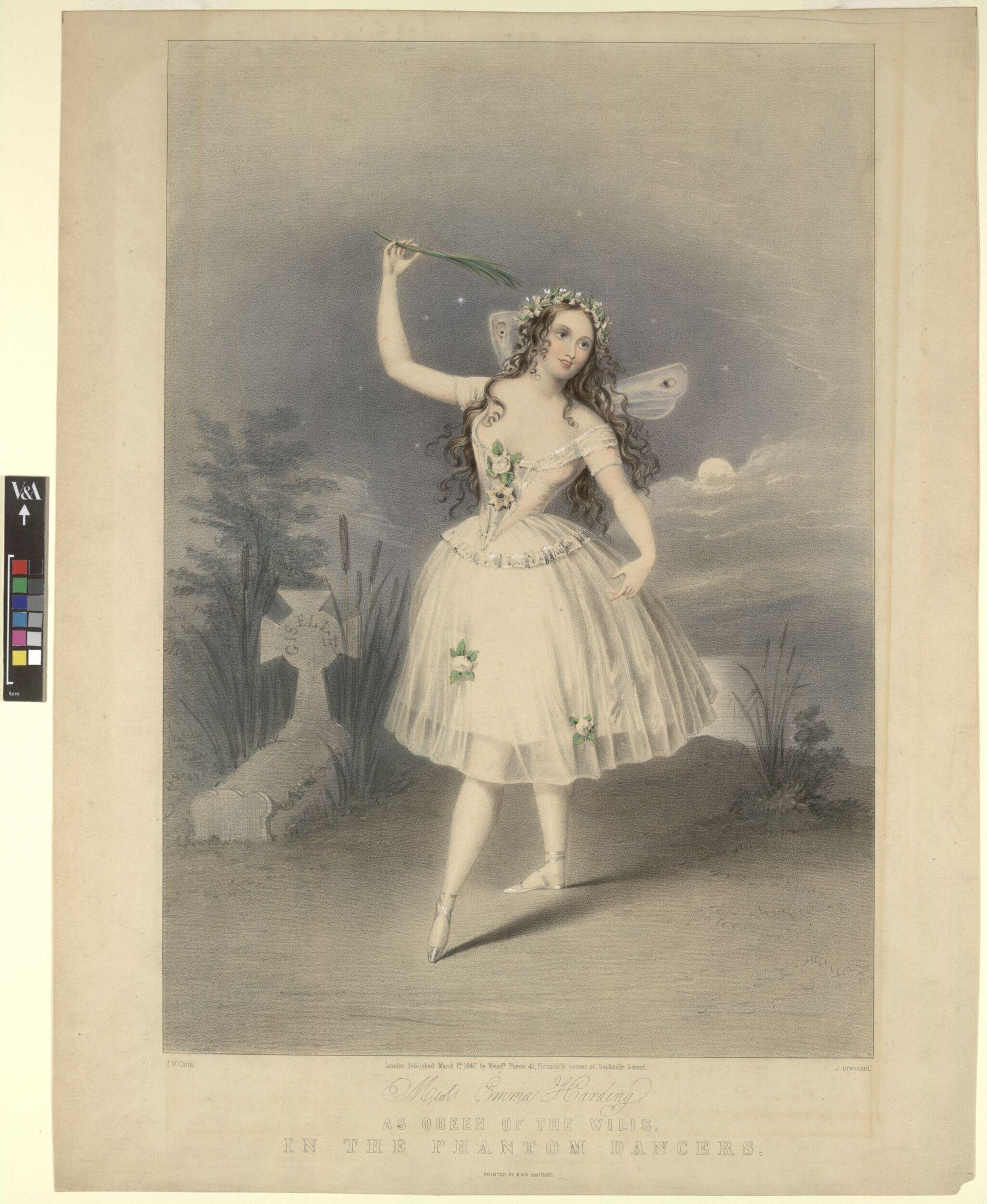
Emma Harding as Queen of the Wilis in The Phantom Dancers
Brandard, John
- Collection:
- Source:
- Victoria and Albert Museum
- Rights:
- Rights vary by item — check the source record before reusing this image. Source record ↗
- Recorded as:
- V&A — check rights per item
This is primary visual evidence of how Romantic ballet was staged and understood by contemporary audiences in the 1840s. It shows the technical and aesthetic vocabulary of pointe work, costuming, and scenic design that defined the era, and it documents the celebrity of individual dancers—Emma Harding—whose performances shaped the development of ballet as a theatrical art form. For historians and dancers, it is a rare surviving record of actual practice rather than idealised representation.
What you are looking at
A young female dancer stands alone in an atmospheric landscape, posed mid-performance on pointe. She wears a white Romantic-era tutu with floral decoration at the bodice and waist, and her long dark hair is crowned with a wreath of white flowers. Her right arm is raised gracefully, holding what appears to be a palm frond or green branch, while her left arm extends outward in a characteristic ballet port de bras. The setting is dreamlike and ethereal: a misty gray background with hints of foliage, a stone monument or gravestone to the left, and marsh grasses at ground level. The lighting is soft and diffuse, creating an otherworldly atmosphere consistent with supernatural or fantastical narrative ballet. The dancer's posture and the setting together evoke a scene from the spirit world or the domain of the supernatural—appropriate to a character identified as the Queen of the Wilis, the vengeful spirits of maidens who died before their wedding day in the Romantic ballet tradition.
The dancing
The dancer stands in an extended penché or attitude position on her right pointe foot, with the left leg raised behind and the body tilted forward slightly, creating an elegant elongated line. Her upper body demonstrates classical ballet port de bras, with the raised right arm positioned above shoulder height and the left arm extended sideways and slightly forward. The head is tilted upward and back in a contemplative or ethereal expression. The positioning shows sophisticated command of balletic alignment and the ethereal, weightless quality prized in Romantic ballet.
The dance depicted
This is a scene from *La Sylphide* or *Giselle*, most likely representing a character from the supernatural realm in Romantic ballet—specifically Emma Harding as the Queen of the Wilis. The Wilis are the spirits of jilted brides in European folklore, depicted in ballet as ethereal, malevolent beings who dance men to death. The imagery—the pale tutu, the pointe work, the floral crown, the palm branch, and the sepulchral setting—all encode the aesthetic of Romantic ballet's engagement with death, desire, and the supernatural. The artist has captured the visual language of this genre: ethereal, slightly menacing beauty in a landscape that blurs the boundary between the earthly and the spectral.
How it was made
This is a hand-coloured engraving or lithograph, rendered in soft tones of gray, sepia, and pale color wash. The technique allows fine detail in the dancer's pose and costume while using atmospheric effects—particularly the hazy background and mist effects—to create the dreamlike, supernatural mood essential to the subject. The medium's capacity for precise reproduction and circulation suggests this was a popular theatrical print, likely published to commemorate a celebrated performance or dancer and distributed to audiences and collectors of theatrical imagery.
About this work
This is a theatrical print commemorating Emma Harding's performance as the Queen of the Wilis in a 1847 production of *The Phantom Dancers*, a work engaging with the Romantic ballet tradition's fascination with the supernatural and the femme fatale. It is a document of mid-nineteenth-century ballet stagecraft and stardom, capturing both the technical achievement of pointe work and the aesthetic of Romantic ballet's engagement with death, otherworldliness, and female power. The work belongs in a dance gallery as evidence of how ballet was visualized, marketed, and remembered in the nineteenth century, and as a record of the specific performance tradition surrounding Romantic ballet's supernatural narratives.
How to look at it
Attend to the moment chosen: the dancer is captured in an extended, almost floating posture, with the weight concentrated on a single pointe foot and the limbs arranged to suggest weightlessness and otherworldliness rather than effort. The artist has chosen a moment of stillness and contemplation rather than explosive movement, consistent with Romantic ballet's aesthetic of languid, supernatural beauty. The palm branch in her hand and the floral crown are narrative details that anchor her character and story, while the sepulchral setting—the gravestone, the mist—supplies context for her role as a spirit. The soft, atmospheric engraving technique reinforces the ethereal mood.
The artist
John Brandard was a London-based engraver and lithographer active in the early-to-mid nineteenth century, specializing in theatrical and portrait prints. His prints documented celebrated performances and performers of the day, making him a visual chronicler of the theatrical world. His work circulated widely among theatre-goers and collectors, establishing him as one of the primary commercial recorders of Victorian and Romantic-era dance and theatre.
The period
1847 falls in the heart of the Romantic ballet era (c. 1830–1850), when ballet had become enchanted with the supernatural, the exotic, and the unattainable female body. *La Sylphide* (1832) and *Giselle* (1841) had established the Wilis as a central motif in ballet's vocabulary, representing a dark underbelly of desire, transgression, and death. The development of pointe technique had accelerated in the 1830s–40s, enabling the ethereal effects Romantic choreographers sought. Theatrical prints like this one were a major medium for disseminating images of dancers and performances to audiences who could not attend live performances, and for cementing the celebrity of star performers.
Where it lives
This is a theatrical print held in the Victoria and Albert Museum's collection, a major archive of theatrical ephemera and visual documentation of stage performance. Such prints were commercial objects, sold to audiences and collectors and used to promote performances and dancers.
Dance in this work
Questions about this work
What is a Wili and why are they important in ballet?
Wilis are the spirits of maidens who died before marriage, appearing in European folklore and immortalized in Romantic ballets like *Giselle*. They represent the era's fascination with death, female agency, and supernatural power. In ballet, they are portrayed as ethereal and dangerous, dancing men to their doom—a dark fantasy embodying anxieties about female desire and transgression.
Who was Emma Harding?
Emma Harding was a celebrated English ballet dancer of the 1840s, known for her performances in Romantic ballet roles. This print commemorates her performance as the Queen of the Wilis, indicating she was a star performer of the day, though detailed biographical records are sparse.
How does this image show the technique of pointe work?
The dancer stands on the tip of one foot with the body extended and balanced, a technique that became increasingly refined during the Romantic era. The artist has rendered the foot in a precise penché position, showing the technical achievement required. Pointe work enabled the ethereal, weightless effects audiences associated with Romantic ballet and supernatural characters.
What does the floral crown and palm branch signify?
These are narrative and symbolic props. The floral crown identifies her as a supernatural or allegorical figure, while the palm branch may reference victory, martyrdom, or otherworldly blessing. Together, they situate her as a spirit or fairy rather than a mortal dancer, part of the visual language of Romantic ballet.
More dance artwork





