49 works in this view — arrow keys or swipe to move between them.
Dance in Art
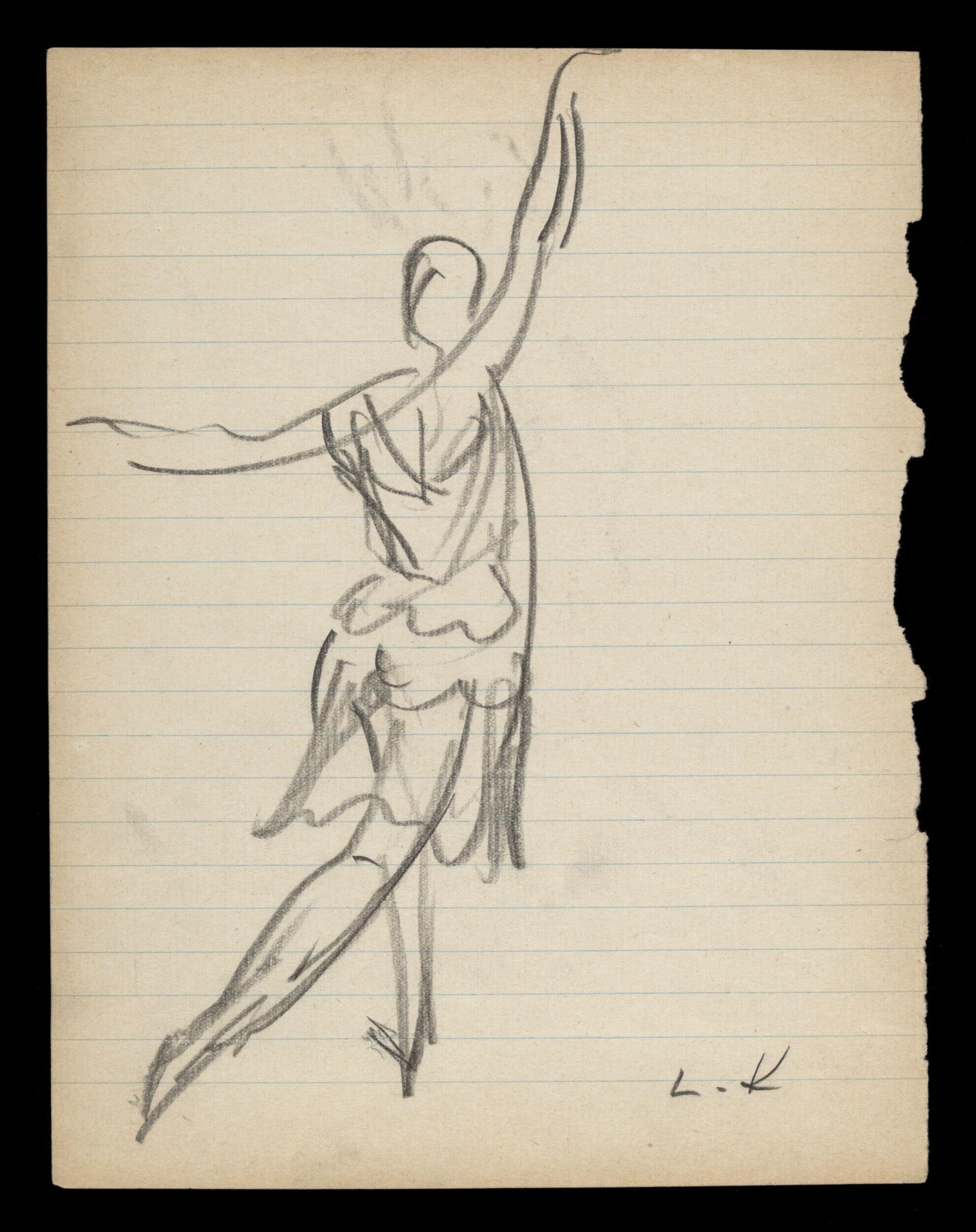
Sketch by Laura Knight of a female dancer
Knight, Laura (Dame)
- Collection:
- Drawing
- Source:
- Victoria and Albert Museum
- Rights:
- Rights vary by item — check the source record before reusing this image. Source record ↗
- Recorded as:
- V&A — check rights per item
This sketch documents how ballet was seen and remembered by trained visual artists during the period when ballet was undergoing significant transformation in both technique and theatrical idiom. It preserves a dancer's pose with the directness of studio practice, offering insight into which moments choreographers and artists chose as worth capturing. The informal medium and apparent spontaneity make it valuable evidence of how dance was embedded in artistic practice beyond finished theatrical paintings.
What you are looking at
A single female dancer, drawn in graphite pencil on lined notepaper, occupies the center of the composition. She stands in a high, elongated pose with her body arched vertically, her left arm raised and extended upward in a flowing line that curves gently at the wrist, while her right arm gestures outward at shoulder height. Her torso is draped in what appears to be classical theatrical costume—a short, layered skirt or tunic with soft folds—and her legs are extended in a balletic line, with her weight seemingly on one leg while the other stretches behind or beside her. The figure is rendered with economy of line; the artist has suggested form through minimal shading and the placement of contour strokes rather than through heavy modeling. The drawing sits on ordinary ruled paper, suggesting this is a working sketch or study, captured in a moment of apparent elevation or sustained extension.
The dancing
The dancer's frame displays classical ballet vocabulary: a pronounced vertical alignment, raised turnout in the hip, and an extended leg line that suggests either arabesque or attitude position. The upper body shows a lifted, open carriage with the shoulders relaxed and the head positioned to follow the raised arm, creating an unbroken line from fingertip through torso. The gestural quality is one of sustained grace and control rather than dynamic motion; this is a posed or held moment rather than a snapshot of traveling movement. The single figure dominates the composition with no other dancers or spatial context.
The dance depicted
This is almost certainly a ballet dancer, rendered in a pose consistent with classical academic ballet training of the early 20th century. The extended leg line, the upward extension of the arms, the shallow theatrical costume, and the overall verticality of the composition all point to formal ballet of the Romantic or early Classical tradition. The drawing style—economical, anatomically assured, and concerned with line rather than mass—suggests the work was made by someone with direct knowledge of dancers' bodies and professional understanding of ballet movement. Without additional context, the specific ballet cannot be identified, but the image records a moment of elevation or sustained balance in a balletic pose.
How it was made
Graphite pencil on lined paper. The medium itself is informal—ordinary school or writing paper ruled with blue lines—which indicates this is a working sketch, not a finished gallery work. The technique is spare and gestural: the artist builds form through economy of line, using minimal shading and relying on the placement and weight of contour strokes to suggest the body's three-dimensional form. This approach is typical of life-drawing studies or choreographic notation sketches made in a studio setting, where speed and clarity of observation matter more than finish. The choice of lined paper suggests the sketch was made opportunistically, perhaps during rehearsal or as a record for future reference.
About this work
This is a rapid graphite study of a classical ballet dancer in a lifted, extended pose, drawn on ordinary lined notepaper by an artist with trained understanding of ballet form and anatomy. The sketch exemplifies early 20th-century practice in studio drawing—informal, economical, and observational—where dancers' bodies were recorded in characteristic poses for reference, memory, or choreographic planning. The work belongs in a gallery of dance art as evidence of how dance artists themselves documented movement in real time, before photography of dance became routine, and as a record of a specific moment in the dancer's vocabulary.
How to look at it
Attend to the specific pose the artist chose to record: the lifted verticality, the precise articulation of the limbs, the balance of the extended leg. These details tell us which moment in the classical vocabulary Knight found worth capturing. The economy of the line—how much the artist leaves unsaid—is itself a form of knowledge: it shows confidence in the essential forms of the body and suggests the sketch was made from direct observation rather than memory. The choice to work in pencil on paper, rather than more permanent or formal materials, signals this as a working record, perhaps made during or immediately after a rehearsal or performance.
The artist
Laura Knight (1877–1970) was one of Britain's most accomplished and prolific painters of the 20th century, with particular renown for her depictions of theatre, circus, and dance. She was elected Dame of the British Empire in 1929 for her services to art. Knight had long-standing connections to the ballet world and painted numerous studies of dancers and theatrical performers, both as finished exhibition works and as working sketches. Her engagement with dance was sustained and professional; she attended rehearsals and performances and drew dancers with the eye of someone who understood movement and the performer's craft. This sketch sits within her larger practice of documenting theatrical and performance life.
The period
This drawing was made in the early 20th century, a period of extraordinary ferment in ballet. The Ballets Russes had arrived in Europe in 1909, challenging the academic conservatism of established ballet traditions with new choreography, experimental movement, and cross-cultural artistic collaboration. Simultaneously, classical ballet technique was itself evolving and becoming more technically demanding. Visual artists including painters, sculptors, and graphic artists were intensely engaged with documenting and reimagining dance during this period, drawn to the energy of modern theatre and the geometric possibilities of the dancing body. Knight's sketches were part of this widespread artistic fascination with ballet as a subject worthy of serious observational study.
Where it lives
The work is held by the Victoria & Albert Museum, London (source code 'va'), where it resides within the museum's extensive collection of theatrical and performance documentation. It is catalogued as a drawing, consistent with its medium and scale.
Dance in this work
Questions about this work
Is this a finished artwork or a sketch?
It is a working sketch, made in graphite pencil on ruled notepaper. The medium and informal presentation indicate it was drawn in a studio or rehearsal context, likely for reference or choreographic notation rather than exhibition. Such sketches were an important part of how dancers, choreographers, and artists documented movement before photography of dance became standard practice.
What ballet or pose is being shown?
The specific ballet cannot be identified from the image alone, but the pose is consistent with classical academic ballet vocabulary—likely an arabesque, attitude, or sustained extended position. The costume and pose suggest the work was made during the early 20th century, when such classical positions remained central to ballet technique and theatrical presentation.
Why would Laura Knight draw dancers?
Knight was deeply engaged with the theatre throughout her career and made extensive studies of performers, including dancers, musicians, and actors. Drawing dancers allowed her to understand the mechanics of movement, to study the figure in action, and to create a visual record of the performance world. These sketches often fed into her finished exhibition paintings and contributed to her reputation as a painter of theatrical life.
What can we learn from a sketch like this?
The sketch reveals how ballet dancers were understood and valued by visual artists of the period: as figures whose bodies possessed inherent grace and formal beauty. The specific pose chosen—lifted, extended, balanced—shows which qualities of classical ballet the artist considered worth preserving in permanent form. The drawing is also evidence of the intensity with which artists attended to live performance before film and photography could capture it.
More dance artwork





