49 works in this view — arrow keys or swipe to move between them.
Dance in Art
Dancer
Dubreuil, Jean
- Collection:
- Source:
- Victoria and Albert Museum
- Rights:
- Rights vary by item — check the source record before reusing this image. Source record ↗
- Recorded as:
- V&A — check rights per item
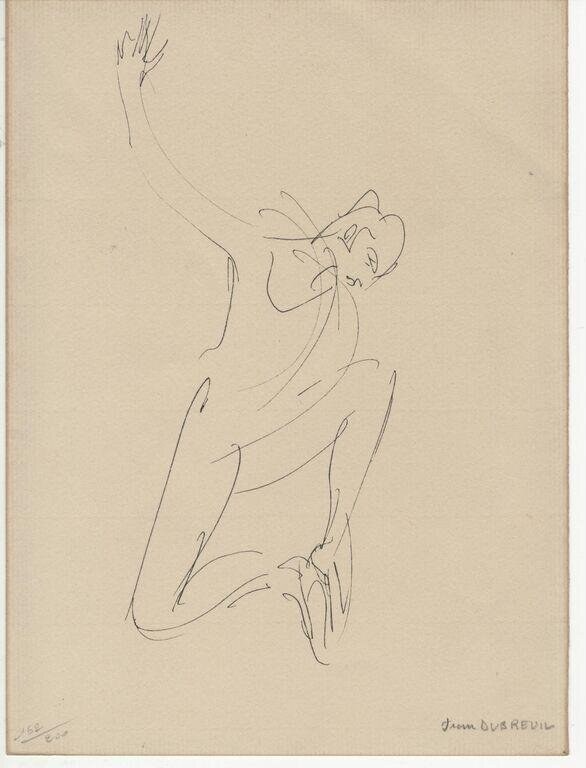
The drawing demonstrates how early modern artists used the dancer's body as a pure linear form, abstracted from narrative or character. Dubreuil's spare technique captures a single suspended moment—the peak of effort and extension—and treats it as sufficient subject matter, showing how dance had become central to modernist visual practice.
What you are looking at
A single figure drawn in elegant continuous line occupies most of the composition. The dancer is captured mid-leap or in a suspended moment, head tilted back with chin raised, body arched in an extended line. The right arm sweeps upward in a graceful arc while the left arm extends downward, creating a diagonal opposition. The torso is bare or draped in a minimal garment; the lower body shows the legs in a long, stretched line. The drawing style is economical—spare, flowing lines with no background setting, allowing the figure to float on the page. The pose suggests a moment of full extension and elevation, a classical lift or jump moment frozen in time.
The dancing
A single dancer shown from approximately a three-quarter view. The body is elongated and extremely extended, with the head thrown back in an attitude of abandon or transcendence. The arms create an asymmetrical frame—one raised, one lowered—suggesting either a controlled classical position or a more ecstatic, less formal pose. The legs appear fully pointed and stretched, with no visible bend at the knee. The overall line is fluid and unbroken, suggesting either great strength or a moment of weightlessness.
The dance depicted
The pose most closely resembles academic ballet vocabulary, particularly a sustained jump such as a grand jeté or the apex of a développé held in the air. The extreme back-arch and the upward tilt of the head suggest either Romantic ballet aesthetics (in which the body could express yearning or transcendence) or an early modernist reimagining of classical form. The figure could also represent acro-dance or partner acrobatics if this is the top figure of a lift, though the image shows no partner. The spare, linear style emphasizes the pure geometry of the extended body rather than narrative or character.
How it was made
A pen-and-ink line drawing on paper, likely created with a single flowing stroke or minimal linework. The artist's signature 'Jean DUBREUIL' appears in the lower right. The technique is economical and assured—no shading, no modeling, pure contour. This approach suggests a sketch or study rather than a finished work, and allows for rapid circulation as a print or reproduction. The lack of detail and setting focuses attention entirely on the body's linear form.
About this work
This is a linear pen drawing of a single dancer in an extended, airborne pose, signed by Jean Dubreuil. The figure appears to be caught at the peak of a classical jump or lift, with the body arched and the arms in an asymmetrical frame. The drawing style is minimalist and economical, using continuous line to convey the geometry of the extended form. The work belongs to an early-to-mid twentieth-century tradition of artist-drawn dance studies, in which the dancer's body became an abstract line capable of expressing both classical discipline and modernist simplification.
How to look at it
Attend to the moment the artist chose: the apex of the jump, when the body is fully extended and weightless. Notice how the single flowing line conveys both classical precision (the pointed foot, the extended line) and a more expressive quality (the arched back, the raised head). The asymmetry of the arms breaks classical symmetry, suggesting either a specific choreographic moment or an artistic preference for dynamic imbalance. The complete absence of background or context forces the viewer to read the body as pure form.
The artist
Jean Dubreuil was a French artist active in the early twentieth century. The signature on the drawing is consistent with art deco and modernist practice of the period. Little is documented about his practice in widely available sources, though his hand appears trained in classical drawing. The style and subject suggest he was part of the circles of artists who drew from live dance performance in Paris during the 1920s–1930s.
The period
In the early twentieth century, dance became a primary subject for visual artists seeking to capture movement, energy, and the human body in abstraction. The Russian Ballets Russes and the rise of modern dance created new audiences for dance imagery. Artists including Degas, Picasso, and many others made dance studies. The linear, reductive style of Dubreuil's drawing aligns with art deco principles and with the modernist interest in essential form. The pose itself—an extreme back-arch—was achievable in both academic ballet and in the more experimental modern dance that was emerging in Europe during this period.
Where it lives
Held in the Virginia Museum of Art (indicated by the source code 'va' in the catalogue record). The work is recorded as a print, though this particular object appears to be a drawing or a print of a drawing.
Dance in this work
Questions about this work
What dance style is this?
The pose most closely resembles classical ballet at the apex of a jump or lift—likely a grand jeté or similar extended jump. The extreme back-arch could also suggest Romantic ballet or early modern dance. The drawing style does not provide enough detail to identify a specific choreography.
Is this a finished artwork or a sketch?
The economical, single-line technique suggests a study or finished small work rather than a detailed composition. It is the kind of drawing that could be made quickly from a live performance or from memory. The signature and apparent intentionality of the style suggest it is a finished work, not preliminary notes.
Who was the dancer?
The drawing is not titled with the dancer's name, and the record does not identify them. Dubreuil may have drawn from a live performance or from a known dancer of his circle, but without further documentation, the identity remains unknown.
More dance artwork





