49 works in this view — arrow keys or swipe to move between them.
Dance in Art
Dancers of the Ballets Russes
Sasha
- Collection:
- Photograph
- Source:
- Victoria and Albert Museum
- Rights:
- Rights vary by item — check the source record before reusing this image. Source record ↗
- Recorded as:
- V&A — check rights per item
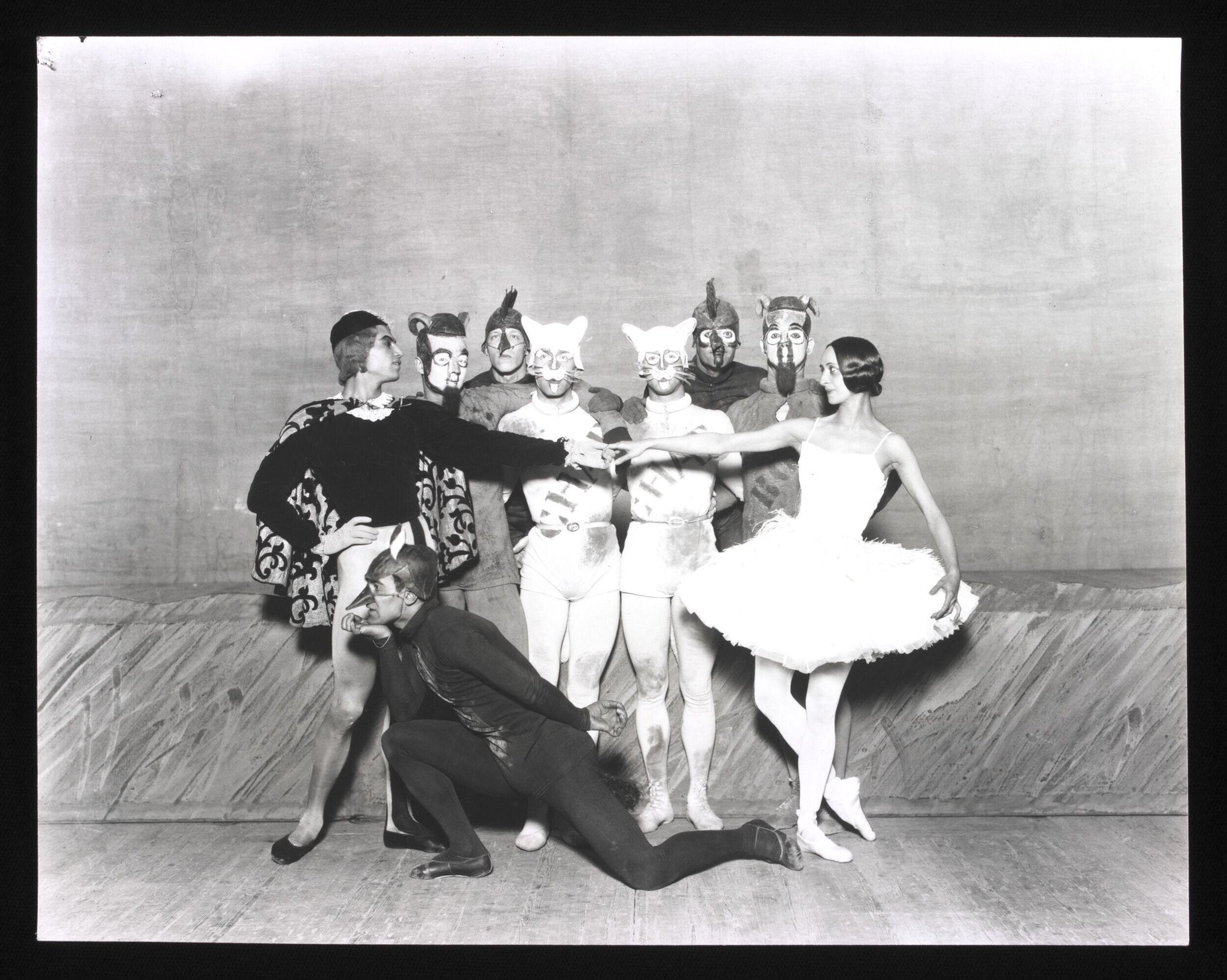
The Ballets Russes redefined what could count as dance theater by absorbing visual and narrative innovations from contemporary art. This photograph shows dancers in masks and animal heads—a direct challenge to the idea that dance meant bodily virtuosity displayed in light, classical dress. For scholars tracking the aesthetic genealogy of non-Western and non-academic dance within European modernism, and for practitioners interested in how costume and ensemble narrative reshape movement, this image is concrete evidence of a pivotal historical shift.
What you are looking at
Eight figures in theatrical costume occupy a wooden stage against a plain backdrop. Seven wear animal-head masks—cats, devils, and other creatures—in a variety of styles. Most are bare-chested or lightly dressed; two wear tutus or skirts. One unmasked male figure in dark clothing with ornate embroidery kneels at center-left, reaching toward the group. The masked dancers form a loose semicircle, their bodies angled toward one another in attitudes of play or narrative interaction. The composition suggests a moment of dramatic or comic confrontation, with the kneeling figure at a disadvantage to the masked ensemble. The lighting is even and frontal, typical of stage photography.
The dancing
The bodies show relaxed, naturalistic postures rather than classical turnout or balletic alignment. The masked figures stand with weight distributed casually, some with arms linked or raised in theatrical gesture. The kneeling man's arm extends in supplication or pleading. No dancer displays the rigid épaulement or vertical spine of academic ballet; instead, the grouping suggests commedia dell'arte or carnival play, where character and narrative take precedence over technique. The diversity of body types and the informal arrangement emphasize ensemble dramaturgy over individual virtuosity.
The dance depicted
This appears to document a scene from a Ballets Russes production, likely from the 1920s avant-garde wing of the company. The animal masks, the theatrical asymmetry, and the narrative staging suggest Sergei Diaghilev's experimental aesthetic—possibly a work by a modernist choreographer such as Léonide Massine or Michel Fokine responding to contemporary art movements. The kneeling posture and the surrounding masked figures suggest either a scene of humiliation, enchantment, or comic ritual. Without identifying inscriptions or additional documentation, the specific ballet cannot be named, but the visual language points to Surrealism, Constructivism, or primitivism—aesthetic directions Diaghilev actively pursued. The Ballets Russes frequently employed animal imagery and mask-work to destabilize classical ballet conventions.
How it was made
This is a gelatin silver print photograph, a standard format for theatrical documentation from 1929. The sharp focus, bright tonality, and frontal composition are consistent with press or archival stage photography of the era. The evenness of the lighting and the posed nature of the grouping suggest this was taken during rehearsal or a formal photo call rather than captured during a live performance. The photograph's clarity and preservation indicate it was meant for circulation—to press, to the company, or to historical record. Stage photography of this period was instrumental in documenting avant-garde dance before reliable film documentation became routine.
About this work
This 1929 photograph documents a Ballets Russes ensemble scene in which narrative, mask-work, and unconventional body language displace classical ballet virtuosity. The image records a pivotal moment in twentieth-century dance history: the company's systematic dismantling of academic ballet codes in favor of modernist theater. The photograph preserves not only the visual fact of a performance but also evidence of how Diaghilev and his collaborators used costume, mask, and sculptural grouping to embed narrative and avant-garde aesthetics into dance spectacle. For historians and dancers interested in the non-academic lineages of twentieth-century performance, this image is primary documentation of how theatrical dance absorbed ideas from painting, sculpture, and experimental drama.
How to look at it
Look first at the contrast between the unmasked man's formal, supplicating posture and the playful, masked ensemble surrounding him—this compositional relationship tells a narrative without words. Notice how few of these bodies display the turned-out legs or lifted spine that would signal classical ballet training; instead, the relaxed weight and casual arm positions belong to theater and mime. Observe how the masks themselves—cats, demons—reference carnival, commedia dell'arte, and non-European theatrical traditions, signaling Diaghilev's deliberate mixing of high art and popular, 'primitive' sources. The photographer has chosen a frontal, documentary moment rather than a climactic leap or arabesque; this choice reflects a modernist interest in ensemble, narrative, and sculptural grouping over individual virtuosity.
The artist
Sasha was a photographer active in European theatrical documentation in the 1920s and 1930s, working during the period of the Ballets Russes' greatest experimental intensity. The photographer's name and archive appear in sources relating to Diaghilev's company and avant-garde performance documentation, though detailed biographical information remains sparse. Photographers of stage work during this period were often credited by single names and their work was valued for its documentary clarity and formal composition rather than for auteurial signature.
The period
In 1929, the Ballets Russes was in its second decade and at a creative crossroads. Fokine's narrative ballets and Nijinsky's avant-garde works of the 1910s had already tested classical ballet's limits. By the late 1920s, Diaghilev was increasingly aligned with Surrealism and Constructivism—movements that celebrated the irrational, the grotesque, and the mechanistic. Simultaneously, artists like Picasso, Matisse, and sculptors were designing for ballet, embedding visual modernism directly into dance spectacle. The use of masks, animal imagery, and broken classical line reflected broader artistic interests in primitivism, the unconscious, and the liberation of form from naturalism. Stage photography itself had become a crucial medium for circulating images of avant-garde dance to an international audience.
Where it lives
The photograph is held in a collection identified as 'va' (notation from the catalogue record, likely indicating a Virginia archive or collection). The photograph survives as a theatrical documentation object—one of many such prints produced by touring companies and press photographers to record performances for posterity and publicity.
Dance in this work
Questions about this work
Can you name the specific ballet?
Not from the image alone. The photograph is identified only as 'Dancers of the Ballets Russes' and is attributed to a photographer named Sasha, dated 1929. The visual evidence—the masks, the narrative grouping, the modernist aesthetic—points to Diaghilev's experimental repertory of the late 1920s, possibly a Massine or Fokine work influenced by Surrealism or Constructivism. The specific title would require additional documentation or archival research.
Why would ballet dancers wear masks and animal heads?
The Ballets Russes, especially under Diaghilev's direction, deliberately moved away from classical ballet as a display of virtuosity toward ballet as total theater. Masks, animal imagery, and non-naturalistic costume referenced modernist painting, primitivism, commedia dell'arte, and experimental theater. These elements transformed the dancer's body from an instrument of technical perfection into a sculptural, narrative, or symbolic element. The effect was to make the performance about character, ensemble, and visual composition rather than individual skill.
Is this a rehearsal or a performance?
Most likely a formal photo call or rehearsal documentation. The posed quality, the frontal lighting, and the clarity of composition suggest this was arranged for photography rather than captured during a live performance. Stage photographers of this era typically worked from predetermined moments or posed scenes, since film speed and stage lighting made candid live photography unreliable.
What does this tell us about how dance was documented in 1929?
Stage photography was the primary medium for recording and circulating images of avant-garde dance before cinema became routine. Photographs were cheaper and faster to produce and distribute than film, and they preserved a single, legible moment of design and composition. For a touring company like the Ballets Russes, photographs were essential publicity tools and historical documentation. This image shows how photographers worked in collaboration with choreographers and designers to create images that conveyed the visual and narrative essence of a work.
More dance artwork





