49 works in this view — arrow keys or swipe to move between them.
Dance in Art
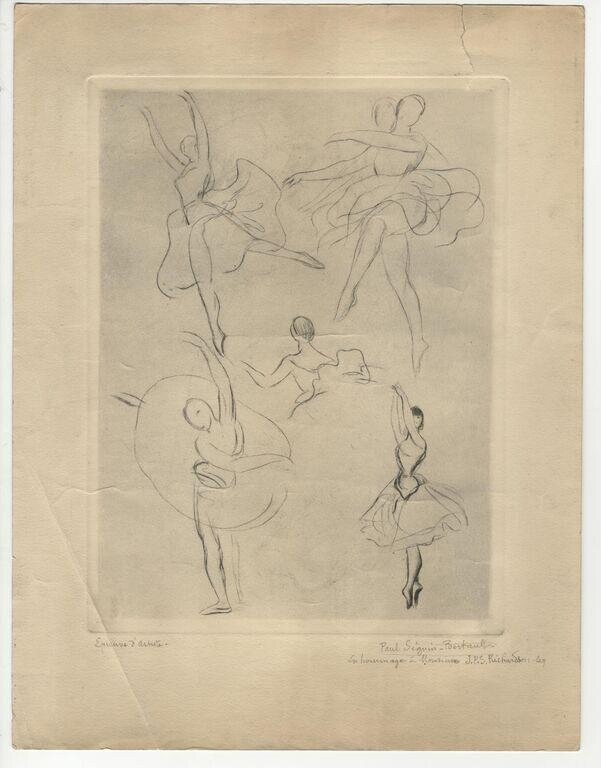
Five ballet dancers
Seguin-Bertault, Paul
- Collection:
- Source:
- Victoria and Albert Museum
- Rights:
- Rights vary by item — check the source record before reusing this image. Source record ↗
- Recorded as:
- V&A — check rights per item
The work is a rare example of an artist studying ballet as pure form rather than as narrative spectacle. It shows how dancers and choreographers in the nineteenth century understood their own bodies—as instruments of line, balance, and extension rather than as characters in a tale. For historians of ballet pedagogy, the image documents the poses and proportions that were considered ideal in the classical tradition.
What you are looking at
Five female ballet dancers are arranged in a vertical composition, each caught in a different moment of movement. At the top, two dancers in mid-leap occupy the upper third—one arched dramatically backward with limbs extended, the other in a sharper contrapposto with one leg raised. Below them, a single dancer is depicted in profile, seated or reclining on what appears to be a spherical object, her torso twisted with arm extended. At lower left, another figure balances on one leg, arms raised in a classical port de bras. The final dancer at bottom right stands in a graceful, extended pose. All figures are rendered in delicate line, with minimal shading, against a plain background. The drawing emphasizes the elongated proportions and fluid curves of classical ballet vocabulary, with particular attention to the architecture of the spine and the placement of the limbs in space.
The dancing
Each dancer demonstrates command of the ballet line: high extensions, arched backs, and controlled weight placement. The upper figures show the balletic leap (grand jeté or similar) with the body fully extended and lifted. The reclining figure maintains turnout and reaches the leg away from the body even in this unusual seated position. The standing figures demonstrate the classical closed positions and épaulement (shoulder articulation) central to academic ballet technique. The artist has captured multiple variations of the basic ballet silhouette, suggesting study of a single vocabulary applied across different poses.
The dance depicted
This is unquestionably a study of classical ballet, most likely from the nineteenth century based on the emphasis on the romantic line and the ethereal, weightless quality of the poses. The composition suggests a practice or teaching document—a study of positions and movements rather than a narrative scene. The reclining figure is unusual in classical ballet vocabulary; it may depict a transition, a dramatic moment from a specific ballet, or an imaginative extension of the classical line. The work demonstrates intimate knowledge of how the ballet body moves and how to convey that movement in line alone.
How it was made
This is a pen or pencil drawing on paper, likely rendered with fine line work and minimal tonal variation—the artist has relied almost entirely on the contour and the subtly modulated line to convey form and movement. The technique suggests a studio drawing: economical, focused, without the detail of a presentation work. The delicate, exploratory quality of the line—visible particularly in the limbs and the curves of the torso—indicates this was made directly from observation or memory, not copied from another print. The medium allowed the artist to work quickly and capture the ephemeral nature of dance.
About this work
This drawing is a study of five ballet dancers in classical poses, executed in fine line to capture the essential geometry and flow of academic ballet technique. The work appears to be a practice or teaching document, possibly used to understand how the ballet body moves through space. It belongs in a history of dance imagery because it represents the artist's sustained attention to ballet as a system of proportion and line—the visual language through which dancers embody the classical tradition. The drawing is not illustrative of a story or a performance, but rather a technical and aesthetic meditation on the ballet figure itself.
How to look at it
Follow the line of each figure carefully: notice how the artist has used the placement of a single limb—a raised leg or an extended arm—to create the impression of balance and lift, even in the reclining figure. The drawing works because it captures the specific relationship between the spine, the placement of weight, and the direction of the gaze that makes a figure look "like a dancer." Observe how little the artist needed to say—no faces, minimal anatomical detail, no setting—to convey the classical ballet vocabulary completely. The economy of line is itself a reflection of the training the dancers underwent.
The artist
Paul Seguin-Bertault is not widely documented in available sources. The signature on the drawing confirms the attribution. His practice appears to have centered on the study of the human figure in motion, with particular emphasis on ballet. The delicate, unadorned technique of this work suggests an artist trained in academic drawing who brought that discipline to the specific challenge of capturing dance.
The period
This drawing was made at a moment when ballet was becoming a subject of sustained artistic attention in France and across Europe. The nineteenth century saw the rise of the Romantic ballet and the cult of the ballerina; artists began to study dancers both in performance and in the studio. The emphasis on the ethereal, extended line in this drawing reflects the Romantic ideal of the dancing body—weightless, elongated, and dematerialized. At the same time, the work documents the classical vocabulary that underpinned all ballet training, regardless of era.
Where it lives
The work is held as a print in a visual arts collection (source: va). The object itself is a drawing on paper, not a print in the reproductive sense, though it may have been circulated or reproduced in facsimile.
Dance in this work
Questions about this work
Why is one dancer sitting on a ball?
The seated figure may depict a specific moment from a ballet narrative, a transition or landing between movements, or an imaginative study extending the ballet vocabulary into an unusual position. The artist may also have been exploring how the classical line persists even in unconventional poses. Without a title or date, the context is ambiguous, but the pose maintains the essential turning-out and extension that defines ballet.
Is this a preparation for a larger work?
The style and technique suggest a study or sketch rather than a finished exhibition work. The artist may have been using these drawings to understand the ballet figure before composing a larger scene, or the drawings may have been kept as a record of poses and positions. The careful execution indicates they held value in themselves.
When was this made?
The catalogue record does not provide a date. The style, costume, and emphasis on the Romantic ballet line suggest the nineteenth century, most likely the mid-1800s when ballet had become a major subject for visual artists. A more precise date would require additional research into the artist's biography and the history of the holding collection.
More dance artwork





