49 works in this view — arrow keys or swipe to move between them.
Dance in Art
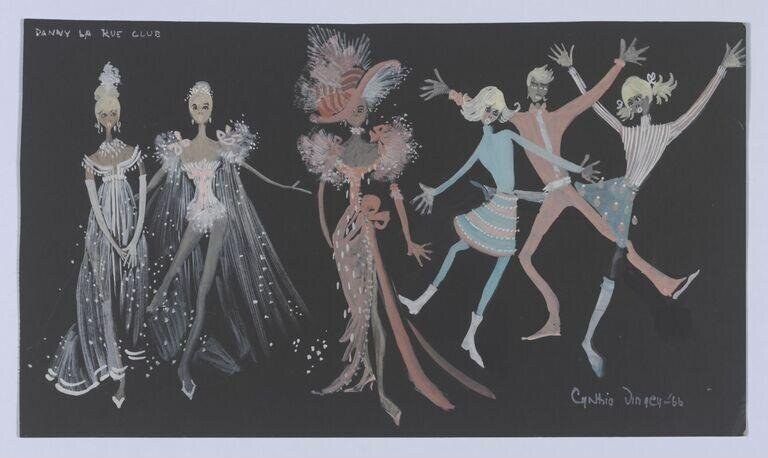
Showgirls and dancers at the Danny La Rue Club
Tingey, Cynthia
- Collection:
- Costume design
- Source:
- Victoria and Albert Museum
- Rights:
- Rights vary by item — check the source record before reusing this image. Source record ↗
- Recorded as:
- V&A — check rights per item
This sketch preserves a moment in the history of London nightlife and queer performance space during a period when such venues were culturally significant and legally precarious. It shows the labour of costume design—the careful thinking about how bodies move in fabric, how light plays across sequins and feathers, how glamour and joy can coexist in a single garment. For dance historians, it documents the idiom of mid-century cabaret performance and the kinetic vocabulary available to performers in that context.
What you are looking at
This is a costume design sketch for five showgirls or dancers at the Danny La Rue Club, a famous London nightclub of the mid-twentieth century. The artist has arranged the figures in a frieze across the dark ground, moving from formal to exuberant. On the left stand two figures in elaborate evening wear: one in a strapless gown with a dramatic high collar and cascading fabric embellished with sparkles or beading, the other in similar opulent dress. These give way to a central figure in a bronze or copper-toned gown with feathered or fringed detailing at the bodice and hem, posed with one arm raised. To the right, two figures in lighter clothing—one in pale blue, one in white with blue accents—strike dynamic, celebratory poses with raised arms and extended legs, their bodies in mid-leap or mid-twist. The sketch shows the artist's interest in contrasting registers of glamour: the formal grandeur of the seated or standing figures beside the uninhibited exuberance of the jumping dancers. The medium appears to be gouache or watercolour with ink outline on dark paper, allowing the whites and pastels to read as luminous against the background.
The dancing
The two left-hand figures are upright and still, with weight settled and posture formal—classical showgirl stance. The central figure stands with one arm reaching upward and inward, body elongated, suggesting a moment of presentation or salutation. The two rightmost figures are airborne or in the moment of launch: their legs are bent and extended in different directions, arms thrown up and out, torsos twisted. None of the figures adopt the closed holds or frame of ballroom dance; these are cabaret performers rather than partnered dancers, shown in individual moments of theatrical display.
The dance depicted
This is not a depiction of a specific named dance form, but rather costume design for cabaret or nightclub entertainment—the theatrical showgirl tradition of mid-century London. The Danny La Rue Club was a glamorous venue known for drag and cabaret performance, and these sketches likely document costume options for the chorus or principal performers. The exuberant poses on the right suggest high-energy chorus-line work, while the formal gowns on the left evoke the glamour of revue-style performance. The artist is exploring contrasts between static display and kinetic joy, the statuesque and the airborne.
How it was made
The work is executed in gouache or watercolour with pen or ink outline on dark (possibly grey or charcoal) paper. This technique was standard for costume design of the period, allowing the artist to show colour, fabric sheen, and drape while preserving the precision of silhouette and detail. The dark ground makes the pastels and whites sing, emphasizing the sparkle and luminosity of stage costumes under light. This was a working document for production, not a finished artwork for exhibition, and the technique reflects its practical purpose.
About this work
This is a costume design sketch by Cynthia Tingey for performers at the Danny La Rue Club, created around 1966. It documents the aesthetic of mid-century London cabaret: the coexistence of formal glamour and theatrical abandon, of evening wear and performance, of the statuesque and the mobile. The sketch captures a moment when drag and cabaret performance were reinventing British nightlife, and when the showgirl tradition—the display of the body in fabric and light—remained a vital form of entertainment and artistic expression. Tingey's hand is assured and economical; she knows her subject and can convey personality and movement with minimal line.
How to look at it
Notice the artist's economy of line: she has given each figure a distinct silhouette and posture with remarkably few strokes. The two static figures on the left are defined by vertical lines and the weight of fabric; the moving figures on the right by acute angles and the suggestion of momentum. Look at the hands and arms: in the formal figures, they are contained or flowing; in the jumping figures, they are scattered and reaching. The artist has also contrasted textures—the smooth drape of the gowns on the left against the fringe and feathering on the central figure and the lighter, more sculptural quality of the blues and whites on the right. This is a working sketch, not a finished rendering, so the gaps and sketchy areas are part of the communication: they tell you what the designer needed to fix in her mind and what she already knew.
The artist
Cynthia Tingey was a costume designer working in mid-twentieth-century London theatre and nightclub entertainment. The sketch is signed 'Cynthia Tingey 54' (or similar), placing her in active practice in the 1950s-60s. Little is widely documented of her career, but her confident line and economy of style suggest experienced theatrical training and a close working knowledge of performance spaces, bodies, and how fabric behaves under stage light. Her work appears in the V&A's costume design holdings, indicating recognition within the profession.
The period
In the mid-1960s, London was undergoing a cultural shift: the West End was vibrant with new theatre, cabaret and nightclub performance were becoming mainstream entertainment, and venues like the Danny La Rue Club were celebrated destinations for both straight and queer audiences. The showgirl tradition—with roots in Victorian and Edwardian pantomime and revue—was being reinvented for a post-war, more permissive London. Costume design was a respected craft, taught formally and recognized as essential to the success of theatrical production. The sketch belongs to this moment of high professionalism and cultural confidence in British theatre.
Where it lives
The work is held in the V&A's collection under the category 'Costume design,' indicating it was acquired as a document of theatrical practice. It is dated to 1966 and is attributed to Cynthia Tingey. The Danny La Rue Club was a real London venue, operating through the 1960s and beyond, and the sketch likely served as a working proposal for costume or was retained as a record of performance wear created for or used by the venue.
Dance in this work
Questions about this work
What was the Danny La Rue Club?
The Danny La Rue Club was a nightclub and cabaret venue in London, famous for its glamorous entertainment, drag performance, and revue-style shows. It was a cultural destination from the 1950s onwards and became iconic in British entertainment history, particularly in the context of queer and cross-dressing performance.
Is this a design for a ballet or a ballroom dance?
No. This is costume design for cabaret or nightclub showgirls—theatrical performance of the revue or chorus tradition, not ballroom or classical dance. The poses suggest high-energy entertainment dancing, the kind associated with 1960s London nightclub performance.
What does the dark background mean?
The dark paper is a professional choice common in costume design: it simulates stage lighting and allows the colours and sparkle of fabrics to read boldly. Light colours (the pastels and whites) appear to glow against the ground, suggesting how sequins, beads, and light silks would catch stage light.
Who was Cynthia Tingey?
Cynthia Tingey was a costume designer active in mid-twentieth-century London theatre and entertainment. Her work is preserved in the V&A's collection, but comprehensive biographical information is limited. The quality and confidence of this sketch indicate formal training and significant professional experience.
More dance artwork





