49 works in this view — arrow keys or swipe to move between them.
Dance in Art
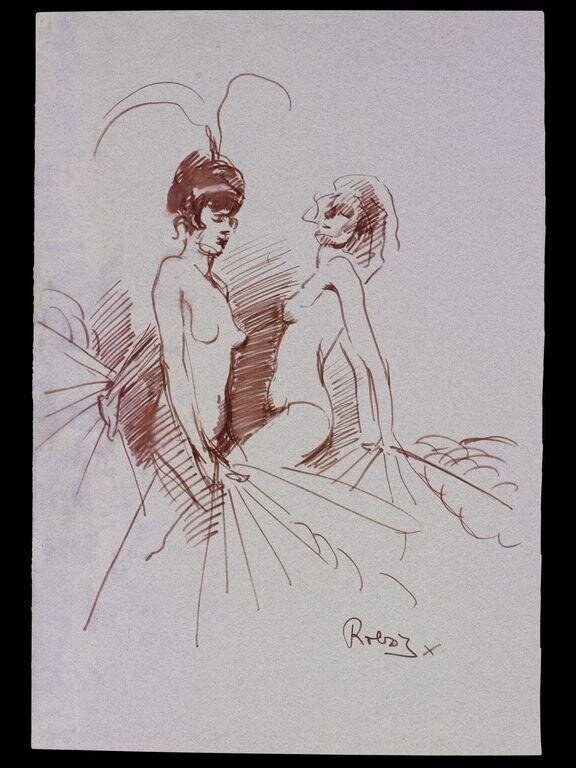
Fan dancers at the Windmill Theatre
Roboz, Zsuzsi
- Collection:
- Drawing
- Source:
- Victoria and Albert Museum
- Rights:
- Rights vary by item — check the source record before reusing this image. Source record ↗
- Recorded as:
- V&A — check rights per item
Fan dancing is a largely undocumented form in serious dance history, often dismissed or overlooked as variety theatre rather than 'dance' proper. This sketch, by a respected visual artist of the mid-twentieth century, legitimises the form as worthy of artistic attention and preserves a snapshot of how it was actually performed. For historians of theatre, sexuality, and the body in performance, it is a rare eyewitness record.
What you are looking at
Two female figures with exaggerated, stylised features are depicted in a loose ink sketch rendered in warm reddish-brown tones. Both dancers are nude or nearly so, their bodies elongated and sinuous. The figure on the left wears an elaborate headdress with long, curved plumes or antennae rising from the crown; the figure on the right has a more modest but still pronounced coiffure. Both are surrounded by radiating lines that suggest expansive skirts or fan-shaped costume elements—the primary visual feature of the composition. The setting is minimal: the background is blank paper, with only the dancers and their costume elements rendered. The drawing style is loose and gestural, with confident ink strokes defining the bodies and more elaborate cross-hatching suggesting the volume and texture of the large fan-like structures that dominate the lower half of the composition. The overall effect is one of movement and lightness, captured through the upward thrust of the headdresses and the radiating lines of the fans.
The dancing
Both figures stand in a frontal or three-quarter pose with minimal weight shift suggested. Their bodies are slim and abstract, rendered with simple outlines; the artist has emphasised the head and the costume elements rather than anatomical detail or weight distribution. The arms and hands are sketched lightly, without strong definition of grip or frame. The posture is upright and presentational rather than engaged in narrative contact. The headdresses and fans read as costume and prop rather than as elements emerging from disciplined movement technique.
The dance depicted
The title identifies these as fan dancers from the Windmill Theatre, a London venue famous for its revue performances and, from the 1930s onward, for nude and semi-nude dance spectacles that pushed the boundaries of theatrical convention. Fan dancing as a theatrical form flourished in the early-to-mid twentieth century, popularised by figures like Sally Rand at the 1933 Chicago World's Fair. The form combined elements of burlesque, variety theatre, and decorative movement, with large fans used as both costume and prop to suggest movement and form while observing legal and social constraints on nudity. This sketch, dated 1964, documents the later life of that tradition at a venue where such performances remained a commercial and artistic staple.
How it was made
This is a pen or ink drawing on paper, executed with confident, loose linework. The artist has used cross-hatching and parallel lines to suggest shadow and volume, particularly in the fan structures and the shading of the torsos. The technique is economical and gestural—more a rapid study or notation than a finished rendering—which suggests it may be a sketch made from life or from memory immediately after a performance. The warmth of the brown ink and the fluidity of the line work convey spontaneity and directness of observation.
About this work
This is a 1964 ink sketch by Hungarian-born artist Zsuzsi Roboz documenting a performance tradition at the Windmill Theatre in London. Fan dancing was a twentieth-century theatrical form that occupied a contested space between dance, burlesque, and visual spectacle—a form that exploited the aesthetic and legal ambiguities of costume, movement, and the display of the body. Roboz's sketch captures two performers at a moment when this tradition was well established but historically shifting. The drawing is spare and confident, more concerned with recording the essential visual elements—the headdresses, the fans, the stylised femininity of the poses—than with anatomical precision. It is a document of theatrical practice and of the artist's eye for the performative and the fashionable.
How to look at it
Focus first on the headdresses and fan structures, which are the dominant visual elements and which tell you at once that this is a stylised, decorative form of movement rather than classical or contemporary dance technique. The artist has chosen to freeze the figures in a moment of stillness or presentation rather than in mid-movement—a choice that emphasises the costume and visual spectacle over kinetic energy. Notice how Roboz has used the radiating lines of the fans to suggest expansion and lightness, almost as if the costume elements are floating or about to take flight. The looseness of the line work, especially in the bodies, conveys sketch-like immediacy and suggests the artist is recording what she sees rather than composing an ideal.
The artist
Zsuzsi Roboz (1909–2000) was a Hungarian-born painter, draughtsman, and illustrator who worked primarily in Paris and London. She was known for her fashion illustration, figure drawing, and theatre work, and for her ability to capture movement and personality with remarkable economy of line. Her sketches of performers and dancers form an important record of mid-twentieth-century theatre practice in France and Britain. She exhibited widely and worked as a commercial and fine artist throughout a long career.
The period
The Windmill Theatre, which opened in 1931, became famous for its policy of continuous live performance and, from the late 1930s onward, for its nude and semi-nude dance revues, which operated in a legal grey area in Britain. Fan dancing and similar forms of aesthetic striptease were at their commercial and cultural peak in the 1940s and 1950s, but remained a fixture of London variety theatre into the 1960s. By 1964, when Roboz made this sketch, the form was beginning to fade as tastes changed and as legal restrictions on theatrical nudity were gradually relaxed—a paradox that made such performances less transgressive and thus less commercially vital. The sketch documents a tradition in its twilight.
Where it lives
Held in the Victoria and Albert Museum as a drawing. The record provides minimal information, but the signature 'Roboz' visible in the lower right confirms attribution to the artist.
Dance in this work
Questions about this work
What is fan dancing?
Fan dancing is a form of theatrical performance that emerged in the early twentieth century, in which a performer (usually female, usually semi-nude or nude) uses large decorative fans as a prop and pseudo-costume to suggest movement and form while navigating legal and social restrictions on the display of the body. It was popularised by performers such as Sally Rand and became a staple of variety theatres, nightclubs, and revue venues, especially in the 1930s–1950s. The Windmill Theatre in London was one of the most famous venues for this form of performance.
Why is this drawing important?
Fan dancing is rarely documented in visual art or dance history, and is often dismissed as variety theatre rather than 'real' dance. This sketch by a respected twentieth-century artist provides an eyewitness record of how the form was actually performed and suggests that it was worthy of serious artistic attention. It is also a snapshot of a specific moment in theatrical history—1964—when the tradition was fading as cultural attitudes toward nudity and theatrical performance were changing.
Who was Zsuzsi Roboz?
Roboz (1909–2000) was a Hungarian-born painter and draughtsman who worked primarily in Paris and London. She was celebrated for her fashion illustration, figure drawing, and theatre work, and for her ability to capture movement and character with economical, confident linework. Her sketches of performers form an important informal archive of mid-twentieth-century theatrical practice.
What was the Windmill Theatre?
The Windmill Theatre, which opened in London in 1931, became famous for its policy of continuous live performance (it never closed during World War II, earning the motto 'We Never Closed'). From the late 1930s onward, it was known for its nude and semi-nude revues, which pushed the boundaries of what was legally and socially acceptable in British theatre. It remained a major venue for variety theatre and dance until its closure in 1964.
More dance artwork





