49 works in this view — arrow keys or swipe to move between them.
Dance in Art
Design
Dulac, Edmund
- Collection:
- Design
- Source:
- Victoria and Albert Museum
- Rights:
- Rights vary by item — check the source record before reusing this image. Source record ↗
- Recorded as:
- V&A — check rights per item
This work documents a crucial and often-overlooked moment in dance history: the assimilation of non-Western visual culture into European modernist theater, and the emergence of the performer as a site of exotic spectacle rather than classical technique. For historians of costume, cabaret, and early modernism in theater, it offers tangible evidence of how bodies were designed and imagined for the stage in the post-war European avant-garde.
What you are looking at
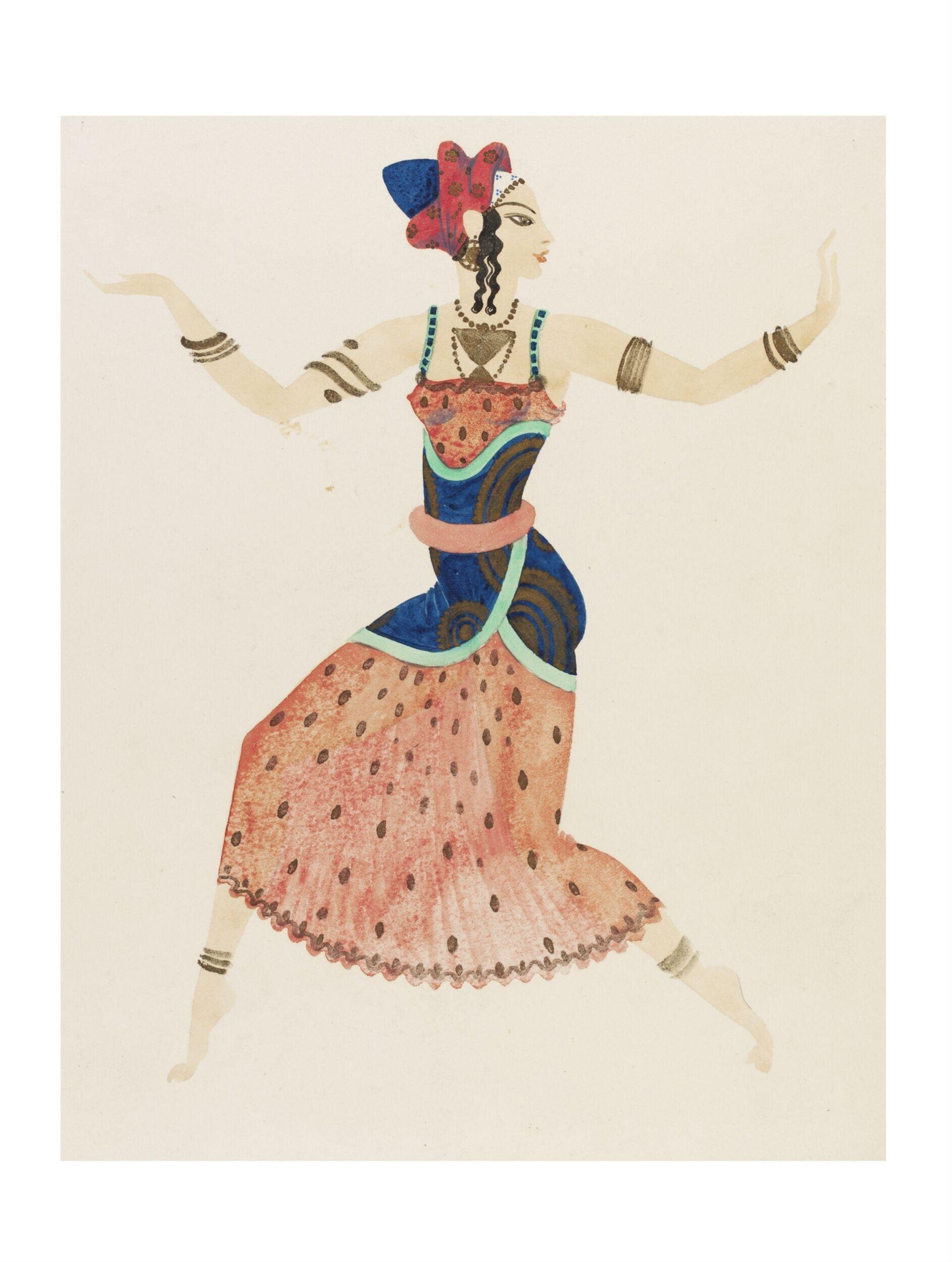
A single female figure stands in a dynamic, open pose against a pale neutral ground. She faces left in profile, with both arms raised to shoulder height and slightly forward, palms open in a gesture of presentation or invitation. Her body is elongated and elegant, weight shifted slightly onto one leg while the other extends in a relaxed stance. She wears a striking costume: a coral-pink skirt with dark brown spots or seed-pod details, cut with a scalloped hem that reaches mid-calf; a fitted bodice in coral above a broad blue hip-band decorated with geometric patterns in gold and teal; a gold and teal draped panel covers part of the torso. Her upper arms are bare save for multiple gold bracelets stacked at the wrists and forearms. Her legs are bare from mid-thigh to ankles, with gold ankle cuffs. The head is turned sharply to profile, adorned with an elaborate headdress: a large red-pink construction with blue accents and what appears to be feather or plume elements, set above black curled hair. A black beauty mark or decorative dot marks the cheek. Gold chains or beaded necklaces drape across the chest. The entire figure radiates controlled elegance and theatrical presence, rendered in gouache or watercolor with precise, decorative linework and a flatness that emphasizes silhouette and ornament over dimensional modeling.
The dancing
The single figure is poised in what appears to be a moment of presentation or formal address rather than active locomotion. Both arms are raised symmetrically to approximately shoulder height, with elbows soft and slightly bent, palms facing forward or upward in an open, welcoming gesture. The body is upright and elongated, suggesting trained posture; the legs show minimal flexion, with the weight appearing to rest on the balls of the feet. The head is held high in sharp profile, with a gaze directed outward and slightly upward. The overall frame is open and expansive rather than contained, with no suggestion of a partner or closed hold. The silhouette reads as statuesque and posed rather than caught mid-motion.
The dance depicted
This appears to be a design for a theatrical performer or cabaret dancer, likely from a European modernist revue or show of the early 1920s. The costume is neither derived from any single historical dance tradition nor designed for classical ballet technique. The figure's pose—the open arms, the profile presentation, the elaborate ornamental headdress—suggests a performer in a stylized, orientalist-influenced entertainment number, possibly as part of a Ballets Russes-adjacent production or a nightclub or stage show emphasizing exotic spectacle. The bare legs, stacked bracelets, geometric patterns, and theatrical makeup indicate a modernist aesthetic applied to popular entertainment rather than an attempt to document an actual dance form. The gesture is one of display and audience address, characteristic of cabaret or music-hall performance.
How it was made
The work is executed in gouache or watercolor on paper, evident from the flat, saturated color fields and the characteristic translucency and bloom of these media. The line work—particularly in the geometric patterns, the facial features, and the ornamental details—is executed with a fine brush or pen in dark brown or black, creating precise decorative arabesques over the painted color. The technique produces a graphic, almost illustrative quality more akin to a costume design or theatrical set sketch than to fine art painting. This approach was standard for theatrical design work in the 1920s, where gouache on paper allowed rapid iteration, vibrant color, and clean reproduction for production teams.
About this work
This is a costume design or theatrical figure study by Edmund Dulac, dated 1922, depicting a stylized female performer in an exotic, orientalist-inflected entertainment costume. The work captures the aesthetic of modernist European theater in the early 1920s—a moment when the Ballets Russes and related theatrical movements were synthesizing non-Western visual idioms, geometric modernism, and the spectacle of cabaret and music-hall entertainment into a new theatrical language. The figure's pose is one of presentation and display rather than of classical dance technique; the ornament and exoticism of the costume, the theatrical makeup, and the open, welcoming gesture all suggest a performer designed to enchant and seduce the eye rather than to demonstrate virtuosity. Dulac's precise, decorative line work and brilliant color create a design that reads simultaneously as a fashion illustration, a theater design, and a modernist artwork.
How to look at it
Attend first to the pose: the figure is not caught mid-step or mid-leap, but rather frozen in a moment of presentation—an address to the viewer. The openness of the arms and the outward gaze suggest a performer aware of and performing for an audience. Notice how the ornament—the headdress, the bracelets, the patterned fabrics—overwhelms and subordinates the body; the figure is a display case for design rather than a moving, breathing dancer. The use of flat color and decorative line creates a surface that emphasizes the costumier's and designer's vision rather than any attempt at naturalism or dimensional modeling. The profile pose was a convention of fashion illustration and costume design of the period, allowing the viewer to see the full line and silhouette of the garment.
The artist
Edmund Dulac (1882–1953) was a French-born illustrator and designer who became a leading figure in Edwardian and modernist British theater and book design. He was closely associated with theatrical productions, particularly through his work in costume and set design for plays and revues. In the 1920s, following the success of the Ballets Russes and the broader embrace of modernist aesthetics in European entertainment, Dulac produced numerous designs for theatrical performers, dance companies, and production houses. His work synthesized Art Deco geometry, orientalist imagery, and a sophisticated understanding of color and line into designs that were both commercially successful and artistically innovative.
The period
This design was created in 1922, at the height of the post-war modernist theater movement in Europe. The Ballets Russes, under Sergei Diaghilev, had revolutionized the visual and choreographic language of dance between 1909 and the early 1920s by commissioning avant-garde artists and composers and by incorporating non-Western visual traditions into European theatrical spectacle. Simultaneously, the cabaret and music-hall entertainment industries were booming in Paris, Berlin, and London, creating demand for striking costume designs and theatrical innovations. The orientalism evident in this figure—the geometric patterning, the exotic headdress, the bare legs and stacked bracelets—reflects the broader European modernist fascination with non-Western aesthetics, a fascination that was often more about visual novelty and erotic appeal than about cultural understanding. The figure's androgynous, elongated silhouette and the emphasis on flat, graphic color also reflect Art Deco's influence on fashion and theater design in the early 1920s.
Where it lives
The work is part of a design collection, suggesting it may be a theatrical production document or a design study intended for reproduction and discussion among production teams. The title 'Design' is generic, suggesting it may be one of a series of costume or figure studies.
Dance in this work
Questions about this work
Is this a ballet costume design?
Unlikely. While created during the height of the Ballets Russes' influence, this design shows no features of classical ballet technique—no pointe shoes, no tutu, no balletic posture or frame. Instead, it depicts a theatrical performer in an exotic entertainment costume, more aligned with cabaret, music-hall, or modernist revue aesthetics.
What is the headdress supposed to represent?
The headdress appears to be an orientalist fantasy rather than a reproduction of any specific cultural object. It combines geometric, Art Deco elements (the blue section, the angular structure) with floral or feather-like ornaments, creating an abstract and theatrical effect. This kind of imaginative 'exoticism' was typical of 1920s European theater design.
Why are the legs bare?
In 1922, bare legs on stage were still relatively daring and were associated with modern, sophisticated entertainment—cabaret, revue, and music-hall performance. The bare legs, combined with the stacked bracelets and the ornate headdress, signal a performer of contemporary, urban entertainment rather than classical or traditional dance.
Who was Edmund Dulac?
Dulac was a prominent illustrator and theater designer of the Edwardian and modernist periods, known for his sophisticated use of color, ornament, and line. He worked extensively in book illustration and theatrical design, and his work exemplified the synthesis of fine art and applied design that characterized early 20th-century modernism.
More dance artwork





