49 works in this view — arrow keys or swipe to move between them.
Dance in Art
Han dance
Wang, Jianan
- Collection:
- Dish
- Source:
- Victoria and Albert Museum
- Rights:
- Rights vary by item — check the source record before reusing this image. Source record ↗
- Recorded as:
- V&A — check rights per item
This work demonstrates how dance, even when titled after a historical tradition, became a vehicle for formal modernist experimentation in late-20th-century ceramics. It shows a ceramicist engaging with the body as a primary subject of inquiry—not as ornament or narrative illustration, but as pure movement and encounter. For anyone tracking how Asian dance was translated into visual culture during this period, this is a rare example of a major art medium (ceramics) engaging seriously with the question of how to represent motion and physical tradition.
What you are looking at
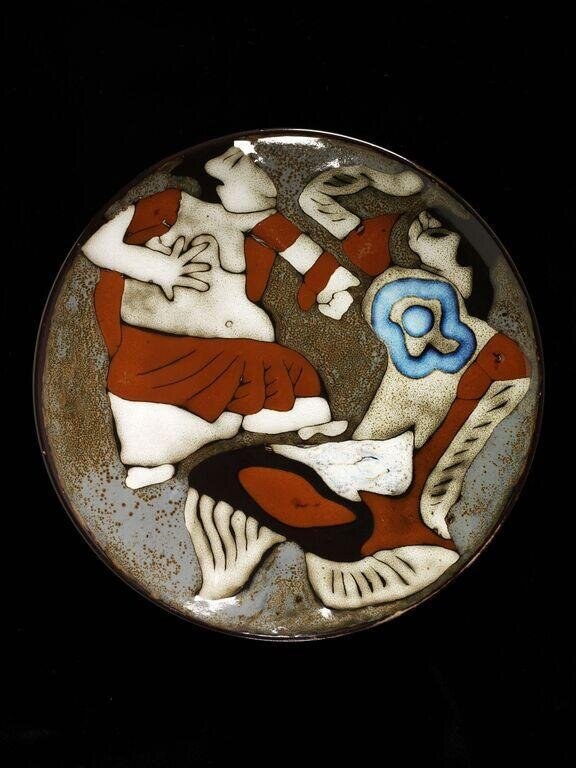
A ceramic dish with a deeply incised and inlaid design presents two nude figures in dynamic interaction against a speckled gray-brown ground. The figure on the left, rendered in cream with russet-red drapery, leans back with one arm extended and the other raised, the body arched in an open, receptive posture. The figure on the right, similarly pale and muscular, bends forward into this space with arms reaching. Between and around them are fragments of red cloth, a striking blue flower or ornament, and gestural marks suggesting movement and spatial complexity. The composition is circular, enclosed by a polished rim, with the figures occupying most of the field. The style is boldly modernist—the figures are abstracted and geometricized, their anatomy suggested rather than naturalistic, and the overall effect is of captured motion rather than posed stillness.
The dancing
Two figures dominate through their physical opposition and engagement. The leftmost figure is supine or recumbent, pelvis tilted, with weight distributed across the back; the right figure is in a forward lunge or press, torso inclined, arms extended toward the other body. Neither assumes a balletic line or closed frame. Their interaction is intimate and kinetic—the composition suggests a moment of contact or near-contact, with the red drapery fragmenting around them, possibly indicating movement through space or costume in transition. The musculature is rendered summarily but with clear attention to the skeleton beneath.
The dance depicted
The work is titled 'Han dance' and appears to document or interpret a Han (汉) Chinese dance tradition, though the modernist abstraction and the intimate, partnered physical engagement do not correspond to documented Han court or folk dances as typically represented. The title may reference the Han dynasty (206 BCE–220 CE) or Han ethnic dance practices. The image suggests either a studio study of a contemporary dance interpretation of Han movement, or an abstract meditation on dance as physical encounter. Without specific costume markers, context, or inscription, the precise dance form cannot be identified with confidence. The naked bodies and fluid, asymmetrical composition suggest a 20th-century avant-garde or modern dance sensibility rather than a historical reconstruction.
How it was made
This is a ceramic dish with incised and inlaid surface decoration. The design is cut into the clay body and filled or highlighted with contrasting materials—cream slip for the figures, russet and red inlays for drapery, and a striking cobalt or blue inlay for the ornamental element. The technique requires precise carving and careful inlay work, indicating a skilled ceramicist. The result is a shallow three-dimensional tableau rather than a painted surface, giving the figures and cloth a sculptural presence. The irregular, speckled glaze on the ground mimics natural stone and grounds the composition in a material, haptic register.
About this work
This is a 1985 ceramic work by Wang Jianan presenting an abstracted, modernist vision of human figures in dance or movement. The title invokes Han Chinese dance tradition, but the execution is thoroughly contemporary—the naked bodies, the fragmentary drapery, the incised and inlaid technique all reflect late-20th-century studio ceramics practice and an avant-garde approach to figuration. The work sits at the intersection of dance documentation, abstract sculpture, and craft, treating the body in motion as a subject for formal experiment rather than representation. For historians of modern Chinese art and dance scholarship, it offers evidence of how traditional dance forms were being reinterpreted through modernist and contemporary visual media in the 1980s.
How to look at it
Study the two bodies and their relationship first: note the curve of the recumbent figure's back, the forward thrust of the other body, and the spatial gap between them. Then trace the red drapery as it fragments around and between the bodies—this is not static clothing but fabric caught in motion. The blue ornament (perhaps a flower or jewel) should be read as part of the narrative, not as mere decoration. Finally, attend to the incised and inlaid surface itself: the fact that the image is carved into the clay rather than painted onto it gives the figures a sculptural solidity and a material presence that a painted representation could not achieve. The speckled gray ground, too, is not empty space but an active, textured field that grounds the encounter.
The artist
Wang Jianan is a contemporary Chinese ceramicist working at the intersection of traditional ceramic techniques and modernist sculptural practice. Working in the 1980s, during a period of significant cultural reassessment in China, Wang engaged with historical and cultural themes through the language of contemporary art. The emphasis on the body, the sophisticated incision and inlay work, and the abstract treatment of figuration reflect training in both traditional Chinese ceramics and exposure to international modern art.
The period
This work was made in 1985, a pivotal moment for both Chinese contemporary art and global dance discourse. In China, the 1980s saw a rapid opening to international contemporary art practices and a wave of critical reassessment of traditional culture. In dance, the 1980s were marked by intense cross-cultural exchange and the emergence of contemporary dance practices that drew on non-Western traditions while rejecting literal reconstruction. Han dance, whether historical or contemporary, would have been a site of both nationalist interest and modernist reinterpretation. In ceramics, the 1980s saw a global revival of studio pottery as a high-art medium, with artists increasingly treating the surface as a field for figuration and abstraction.
Where it lives
The work is documented as a ceramic dish held in a collection listed as 'va' (the source field in the catalogue record). No further provenance, acquisition date, or accession number is recorded.
Dance in this work
Questions about this work
What is Han dance?
Han dance refers to dance practices of the Han Chinese people and, more broadly, to the dance cultures of the Han dynasty (206 BCE–220 CE) and subsequent periods of Han cultural dominance in China. These include court dances, folk traditions, and ritualistic movement. However, this work's modernist abstraction and intimate partnered composition suggest a contemporary reinterpretation rather than a historical reconstruction or documentation of a specific Han dance form.
Why are the figures nude?
In modernist and contemporary art practice, the nude body allows the artist to focus on movement, weight, and spatial relationships without the distraction of costume. The nudity here emphasizes the physicality of the encounter and aligns the work with 20th-century dance documentation and body art, in which the unclothed body became a primary subject of investigation.
How was this made?
This is a ceramic dish with incised and inlaid surface decoration. The artist carved the design into the clay body and filled the lines with contrasting slip or inlay materials—cream for the figures, red and russet for drapery, and blue for the ornamental element. The technique is labor-intensive and requires considerable skill; the result is a three-dimensional tableau rather than a flat painted surface.
Who is Wang Jianan?
Wang Jianan is a contemporary Chinese ceramicist. The catalogue record provides no biographical details, but the sophistication of the technique and the conceptual ambition evident in this work suggest a trained artist working within both traditional ceramic practice and modernist visual culture. The work's date (1985) places it during a significant moment of cultural and artistic reassessment in China.
More dance artwork